
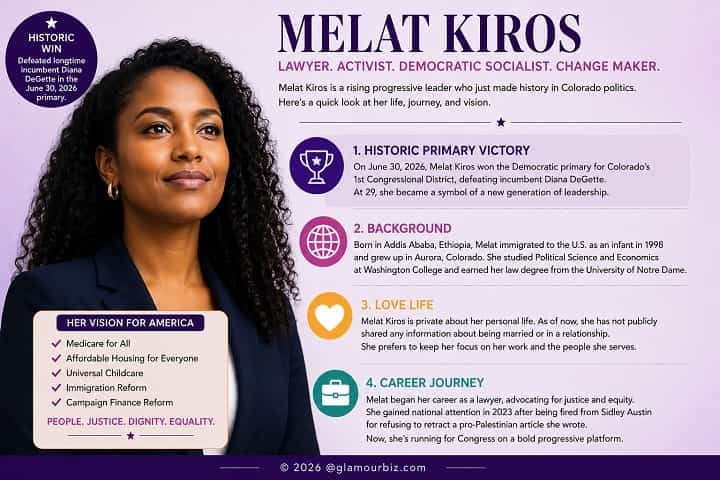
Melat Kiros just became one of the most talked-about names in American politics. At 29, the Ethiopian-born lawyer and longtime activist did something few thought possible: she beat Diana DeGette, a congresswoman who'd held her Colorado seat for nearly three decades.
It wasn't a close call either, it was a genuine upset, and one that a lot of people are now pointing to as proof that the Democratic Party is heading in a new direction generationally. Kiros had real firepower behind her campaign, including a Bernie Sanders endorsement and backing from Justice Democrats.
But what stood out most was her message. She kept things focused on the stuff people actually feel in their daily lives: healthcare that doesn't bankrupt families, housing they can actually afford, childcare that doesn't cost a fortune, and getting corporate money out of politics. Nothing flashy, just issues that hit close to home for a lot of voters. Now her win is being talked about as part of something bigger, a progressive wave that could reshape how Democratic politics looks going forward.
How Melat Kiros Shook Colorado Politics With a Historic Primary Victory
Colorado's political establishment did not see it coming, or at least not this fast. Melat Kiros, a 29-year-old attorney, doctoral student, and part-time barista, walked into the Democratic primary for Colorado's 1st Congressional District and walked out with the nomination, unseating Diana DeGette, a lawmaker who had represented the Denver-based district since 1997. For context, DeGette had already been in Congress for years before Kiros was even born.
The numbers tell part of the story. Colorado's 1st District carries a Cook Partisan Voting Index of D+29, making it one of the safest Democratic seats in the Mountain West. In practical terms, that means winning the primary is essentially winning the seat. Barring a major surprise in November, Kiros is on track to head to Washington.
What makes the win notable is not just the scoreboard but the resistance she overcame to get there. Three Super PACs poured roughly $1.3 million into advertisements attacking her candidacy in the final stretch of the race. Two of those groups registered so close to the election that they were not required to disclose their funding sources until after voters had already cast ballots. Kiros framed the spending as proof of her central campaign argument that entrenched interests were nervous about losing a reliable vote in Congress and were willing to spend heavily to keep it.
Her victory also fits into a larger pattern taking shape across the country. Democratic Socialists of America and the Justice Democrats have notched a string of primary wins this cycle, including two in New York City the week before Kiros's race and another in Pennsylvania back in May. Political analysts have started referring to it as a generational shift within the Democratic Party, with younger, further-left candidates challenging long-serving incumbents and, in several cases, winning.
If Kiros wins the general election as expected, the attorney-turned-candidate will join a small group of House members who identify as Democratic Socialists, a club that currently includes Alexandria Ocasio-Cortez and Rashida Tlaib. She would also become just the second member of Generation Z ever elected to the House, following Florida's Maxwell Frost, and the first Gen Z woman to hold a seat in Congress. On primary night, Kiros struck a gracious tone toward her opponent, thanking DeGette for her decades of service and specifically for her advocacy on reproductive rights, even as she prepared to replace her.
The Making of Melat Kiros: From Ethiopian Roots to a Rising Political Force
To understand how Kiros got to this moment, it helps to start in Addis Ababa, Ethiopia, where she was born in 1997. Her birth came just weeks before her father was selected through the United States' Diversity Visa Lottery, a program that grants a limited number of green cards each year through a random drawing. That stroke of fortune changed the family's trajectory entirely, and they soon relocated to Denver, drawn in part by the city's established Ethiopian immigrant community.
Kiros has spoken openly about what those early years in Colorado looked like. Her parents worked multiple jobs simultaneously, in part to put her father through pharmacy school, while leaning on an informal network of family and friends for help with babysitting, groceries, and job leads. It was a household built on reciprocity, and Kiros has said that watching her parents eventually become the ones offering that same help to newer arrivals shaped her understanding of community and public service.
She attended Eaglecrest High School in the Denver area before heading east for college, earning a dual bachelor's degree in Political Science and Economics from Washington College in Chestertown, Maryland, in 2018. From there, the future candidate enrolled at Notre Dame Law School, graduating with a J.D. in 2022. Somewhere between law school and the campaign trail, Kiros also began a Ph.D. program in public affairs, a pursuit she has continued to juggle alongside a demanding run for federal office.
The immigrant narrative is not incidental to her campaign messaging; it is central to it. Kiros has repeatedly framed her candidacy as an extension of her own lived experience with housing costs, medical bills, and the day-to-day pressures facing working families. In campaign materials and interviews, the candidate has described herself plainly as a recovering lawyer, a renter, a first-generation immigrant, and a doctoral student still carrying student debt, a description meant to draw a sharp contrast with a career politician who has held office for nearly three decades.
The Israel-Palestine Stance That Sparked Controversy and a Firing
Before politics, Kiros had a conventional, high-paying legal career. After law school, she took a position as a securities regulatory associate at Sidley Austin, working out of the firm's New York office. By most external measures, it was the kind of job that law students spend three years competing for.
That career took an unexpected turn in late 2023. More than 220 law firms across the country had signed a letter addressed to law school deans, warning them to address what the letter described as rising antisemitism on college campuses. While the letter also referenced Islamophobia, critics, including the National Association of Muslim Lawyers, argued it was one-sided and focused almost entirely on discrimination against Jewish students, with the effect of discouraging Muslim, Arab, and Palestinian law students and lawyers from speaking freely.
Kiros responded by publishing an open letter of her own on Medium, defending law students who were organizing in support of Palestine. When Sidley Austin asked her to take the post down, she declined. She was fired shortly after.
That decision has become one of the defining moments of her public life, referenced constantly in campaign coverage and candidate profiles. Rather than distance herself from it, Kiros has built much of her foreign policy platform around it. She has called for ending U.S. military aid to Israel, describing the issue as, in her words, the moral question of the current era. She has also voiced support for an arms embargo and has publicly described Israel as an ethnocracy rather than a Jewish state, a characterization that has drawn sharp criticism from segments of Colorado's Jewish community. Local reporting identified this issue as the single largest policy divide between Kiros and DeGette during the primary, and it remains one of the more polarizing elements of her platform heading into the general election.
From Courtrooms to Campaign Trails: The Career Path That Built Melat Kiros
Losing a corporate law job might have derailed a lot of career plans. For Kiros, it appears to have redirected one. After the firing, the attorney took work as a barista to help cover living expenses and student loan payments while continuing her doctoral studies, a detail her campaign has leaned into rather than downplayed.
That blend of legal credentials and hourly, customer-facing work has become a defining feature of how Kiros presents herself to voters. She is, by her own description, a lawyer who has also pulled espresso shots to make rent, and that duality shows up throughout her campaign messaging. It allows the candidate to speak both the technical language of policy and the more grounded language of missed bus transfers, surprise medical bills, and rent increases that outpace paychecks.
Kiros formally launched her congressional campaign in mid-2025, building a platform around several core pledges: abolishing U.S. Immigration and Customs Enforcement, pursuing Medicare for All, raising the federal minimum wage to match local living costs, closing tax loopholes for the ultra-wealthy, and cutting Pentagon spending by ten percent. She also made getting corporate money out of politics a centerpiece of her run, pledging from the outset to refuse donations from corporate PACs and lobbyists, a stance she used to draw a direct contrast with DeGette's history of accepting contributions from defense, energy, and pharmaceutical interests.
Along the way, she picked up endorsements from national progressive organizations, including Justice Democrats, the Democratic Socialists of America, the Working Families Party, and Senator Bernie Sanders. That coalition, combined with her personal story and her willingness to take on an entrenched incumbent, helped carry the campaign from a long-shot bid to a headline-grabbing upset.
Whether Kiros can translate that same energy into an effective legislative record remains an open question, one that will only be answered once she takes office. But her path so far, from a courtroom in New York to a coffee counter in Denver to a primary night victory speech, has already made her one of the most closely watched new figures in national Democratic politics.