
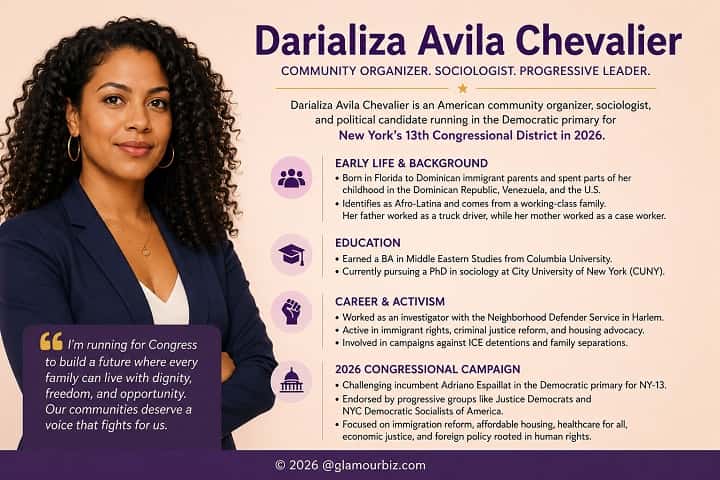
"Nobody saw it coming. On June 23, 2026, Darializa Avila Chevalier, a 32-year-old community organizer, defeated five-term incumbent Adriano Espaillat in New York's 13th Congressional District Democratic primary, and the political establishment is still catching its breath.
She ran on the things residents of Harlem, Washington Heights, and the Bronx actually worry about: rent, immigration enforcement, and a government that stopped listening. Backed by Mayor Zohran Mamdani and a tight-knit network of grassroots organizers, she turned frustration into votes.
If she wins the general election in November, and in this safely Democratic district that is almost a given, Avila Chevalier will become the first Dominican woman to represent the district in Congress. For a community that has waited a long time for that kind of representation, it means everything."
Darializa Avila Chevalier Defeats Adriano Espaillat in Stunning NY-13 Primary Upset
Nobody in the backrooms of the Democratic Party saw this coming. The voters of upper Manhattan did. There is a particular kind of silence that falls over a political campaign headquarters when the numbers start moving in the wrong direction. On the night of June 23, 2026, that silence settled over Adriano Espaillat's camp early. And it never really lifted.
Across town, Darializa Avila Chevalier was watching the same numbers with her supporters, and the mood could not have been more different. By the time the night was over, she had done something that virtually no one inside the Democratic establishment believed was possible: she had beaten a five-term congressman, a caucus chair, and one of the most institutionally protected incumbents in New York politics.
The final tally told a tight but decisive story. With more than 86% of the expected vote in, Avila Chevalier held 49.4% to Espaillat's 45.9%. In a district covering Harlem, Washington Heights, Inwood, and parts of the Bronx, those numbers represented something far bigger than a percentage point spread. They represented a community that had grown tired of waiting.
"Every single one of us has a story about being let down by our government," she told the crowd that night, her voice steady and clear. "Our representative, soon to be former representative, wouldn't pick up the phone. But that ends today."
The loss stung for Espaillat in ways that go beyond the personal. He is the first former undocumented immigrant ever elected to Congress, the first Dominican American to hold the seat, and a figure who had built his entire political identity around fighting for immigrant communities. He came into this race with the endorsement of House Minority Leader Hakeem Jeffries, Governor Kathy Hochul, Attorney General Letitia James, and the state AFL-CIO. He had institutional armor that most incumbents only dream about.
It wasn't enough. And the reason it wasn't enough gets at something real about the moment we're living in politically. Working-class voters in upper Manhattan are not interested in a list of endorsements. They are interested in the cost of their rent, the presence of ICE vans in their neighborhood, and whether their congressman will actually answer the phone. On each of those measures, a growing number of voters had made up their minds about Espaillat long before Avila Chevalier ever entered the race.
Her campaign didn't invent that frustration. It organized it. With $1.5 million from Justice Democrats and $1.3 million from American Priorities, a pro-Palestine super PAC built to counter AIPAC's influence in primaries, Avila Chevalier had the resources to turn grassroots energy into actual votes. Add in the late May endorsement from Mayor Zohran Mamdani, whose own political movement had just reshaped city hall, and the pieces were in place.
The closing weeks of the campaign got ugly. Old social media posts from 2018 to 2022 were dug up and broadcast widely. A senior adviser to Espaillat, on unpaid leave from his congressional office, made openly racist and Islamophobic remarks about Avila Chevalier in Spanish-language media, claiming she and Mamdani were trying to replace Dominican New Yorkers with Muslims and Haitians. Espaillat himself condemned the comments. But the damage was done, and not in the direction his campaign had hoped. Voters saw the attacks for what they were, and many of them came out angrier than before.
When Espaillat finally took the stage to concede, he kept it brief. "Tonight wasn't our night," he told his supporters. "But I love you anyway." It was a graceful exit from a man who had given decades of service to his community. The district owes him that acknowledgment, even as it moves on. What the district is moving toward is still being written. But the first chapter started on June 23, and it belongs entirely to Darializa Avila Chevalier.
Who Is Darializa Avila Chevalier? The Progressive Challenger Reshaping New York Politics
Darializa Avila Chevalier grew up watching her immigrant parents fight for everything. Now she is taking that fight to Congress. Long before Darializa Avila Chevalier was a congressional candidate, she was a kid in a Dominican household trying to make sense of a country that did not always make sense for people like her family. Her parents came to the United States carrying the particular mixture of hope and anxiety that immigrants know well. They built a life. They navigated paperwork, bureaucracies, and systems that were not designed with them in mind. And their daughter watched all of it.
That upbringing did not produce bitterness in Avila Chevalier. It produced clarity. She knew early on that the systems shaping people's lives were not neutral. They were built by choices, which meant they could be changed by choices. That belief would eventually drive everything else. She went to Columbia University, which is the kind of institution that can either smooth the edges off a person's politics or sharpen them considerably.
For Avila Chevalier, it was the latter. She graduated with her views intact and her activism deepened. In 2023 and 2024, she helped lead the Columbia encampment organized in solidarity with Palestinians in Gaza, a protest that drew national attention and put her in direct confrontation with the university administration. She did not back down.
But Darializa Avila Chevalier had been doing this kind of work long before the encampment made headlines. Years earlier, she helped lead the campaign to remove the Central Park statue of J. Marion Sims, a physician celebrated in medical history but notorious for performing experimental surgeries on enslaved Black women without anesthesia. The statue came down in 2018. Avila Chevalier was part of the coalition that made it happen.
She also fought for Abdikadir Mohamed, a man who spent 18 months in ICE detention under Trump's travel ban. She worked with Families for Freedom, organizing against the family separation policy that was tearing apart communities across the country, including the communities of upper Manhattan that she now seeks to represent.
Today she works as an investigator at Neighborhood Defender Services of Harlem, a public defender organization that supports people caught up in the legal system who cannot afford private representation. It is not glamorous work. It does not come with a lot of recognition. But it keeps her close to the ground, connected to the specific and often brutal ways that government power touches individual lives.
Darializa Avila Chevalier is a member of the Democratic Socialists of America and a UAW member. She supported Mamdani's mayoral campaign before he ever endorsed her congressional run. She is, in the truest sense of the phrase, a product of the movement she now helps to lead.
Her campaign was not without its complications. Social media posts from between 2018 and 2022 included calls to abolish police, prisons, and borders, as well as strong criticisms of Democratic leaders and questions about Israel's existence. When they surfaced during the campaign, Avila Chevalier addressed them directly rather than pretending they did not exist. "I was young, yes," she said. "But my values have always been my values. My understanding of how to approach these systems has grown."
That answer satisfied enough voters to get her over the line. It also speaks to something genuine about her: she is not a politician who has been carefully managed and polished into palatability. She is a person with a history, a record of real fights, and a willingness to be honest about the distance between who she was at 25 and who she is now. In a political environment saturated with carefully crafted personas, that kind of authenticity is rarer than it should be.
From Grassroots Activist to Historic Nominee: Darializa Avila Chevalier Makes NY-13 History
Darializa Avila Chevalier never ran for school board or city council. She went straight for a congressional seat held by one of the most connected men in New York politics. And she won. Most political careers follow a recognizable arc. Local office first. Maybe a state legislative seat. Build relationships, collect endorsements, and wait your turn.
Darializa Avila Chevalier did not do any of that. When Justice Democrats recruited her to challenge Adriano Espaillat, she had never held elected office of any kind. What she had instead was something harder to manufacture: years of real, on-the-ground organizing in the exact communities she wanted to represent.
That unusual path matters because it shaped how she campaigned. She did not have a political machine to lean on. She had people. Volunteers who had worked alongside her at protests and vigils; neighbors who knew her from her work at the public defender's office; activists who had watched her show up for causes that did not always make the news. When it came time to knock on doors across Harlem, Washington Heights, and the Bronx, the people doing the knocking were not hired campaign staff. They were part of a community.
She also showed up in ways that traditional campaigns sometimes avoid. She debated Espaillat multiple times on NY1, on WNYC with Brian Lehrer, on PIX11, on BronxNet, and on Telemundo 47 in Spanish. She made her arguments in both languages, directly and without hedging, week after week. She did not treat the voters of this district as people who needed to be managed or carefully messaged. She treated them as people who deserved a real conversation.
The turning point that most observers point to came on May 25, 2026, when Zohran Mamdani announced his endorsement of Avila Chevalier at a joint interview on MS NOW. This was a significant moment, not just because of Mamdani's political stature but because of what it represented. Mamdani had previously been understood to be sympathetic to Espaillat. When he switched, it sent a message about which direction the energy of New York's left was actually moving.
The establishment did not go quietly. The Congressional Hispanic Caucus, which Espaillat chairs, poured resources into the race. AIPAC and affiliated donors spent heavily against Avila Chevalier. Governor Hochul, Hakeem Jeffries, the Congressional Black Caucus, and the AFL-CIO all threw their weight behind the incumbent. The attacks on Avila Chevalier's character and past statements were relentless.
She absorbed all of it and kept moving. In the final stretch of the campaign, when the racist remarks from Espaillat's adviser became public, she responded not by retreating but by leaning in. "The smear campaign against me is not politics," she said. "That is racism dressed up and unleashed by my opponent because he has nothing else left."
When she stood at her watch party on election night and the numbers started coming in, there was a moment, observers noted, when the room understood before she did what was happening. The cheers grew before she had even spoken. When she finally addressed the crowd, she did it with the composure of someone who had been preparing for this responsibility for a long time, even if the title was new.
If she wins the general election in November, which she almost certainly will in this reliably Democratic district, she will become the first Dominican woman ever to represent NY-13 in Congress. That is a significant milestone in a district that has been shaped by Dominican immigration for decades. It is the kind of representation that residents of Washington Heights and Inwood have been waiting a long time to see.
The journey from community organizer to congressional nominee is not a straight line. It is made up of a hundred smaller decisions to show up, to keep fighting, and to believe that power is not something you wait to be given. It is something you build. Darializa Avila Chevalier has been building it for years. She is now about to take it to Washington.
What Darializa Avila Chevalier's Win Means for the Democratic Socialist Movement in 2026
The political earthquake that started in New York City in 2025 just sent another tremor. This one reached all the way to Congress. When Alexandria Ocasio-Cortez beat Joe Crowley in the 2018 Democratic primary, a lot of people in the political world treated it as a fluke. A young, unknown candidate with no money and no institutional support had walked into a crowded congressional district and knocked off a ten-term incumbent and heir apparent to the House Democratic leadership. Remarkable, certainly. But repeatable? Most people said no.
They were wrong. And now, eight years later, with Darializa Avila Chevalier's victory in NY-13, the democratic socialist movement in New York has produced another upset that the establishment cannot explain away as an accident or an anomaly. At some point, a pattern is just a pattern.
What has changed since 2018 is not just the frequency of these wins but the infrastructure behind them. Justice Democrats has become a real operation, capable of identifying candidates, raising money, and running sophisticated campaigns against incumbents with far greater resources. American Priorities demonstrated in this race that there is a growing counterforce to AIPAC's money in Democratic primaries and that it can be competitive. Zohran Mamdani's mayoralty has given New York's democratic socialist movement something it has long lacked: an institutional center of gravity with real governing power and a citywide coalition.
Avila Chevalier did not win this race on ideology alone. She won it because she articulated a set of concerns that a majority of voters in NY-13 recognize from their own lives. The rent is too high. ICE is too present. The congressman was too absent. Her policy positions, Medicare for All, ICE abolition, a halt to arms sales to Israel, and federal social housing investment are not abstract to the people in this district. They are responses to concrete, daily realities.
That is the piece of the democratic socialist moment that often gets lost in coverage focused on ideology and messaging. These campaigns do not win because voters suddenly converted to a political philosophy. They win because the philosophy is connected to material conditions that people actually live in. When the theory meets the reality, it becomes a lot more persuasive.
The implications for the Democratic Party are uncomfortable and unavoidable. Espaillat was not a weak candidate. He had seniority, relationships, money, and the backing of essentially every significant Democratic institution in New York State. A 32-year-old first-time candidate with no prior office beat him anyway. If the party's leadership is serious about understanding what happened, it needs to grapple with the possibility that its institutional endorsements are worth less than they used to be and that the voters they take for granted have been doing the math on their own.
As for Avila Chevalier herself, the real work is just beginning. Congress is an institution designed to slow things down, to absorb energy and produce incremental results at best. A junior member in what will likely be a minority caucus does not have many obvious levers to pull. She will face frustrations that the campaign trail did not prepare her for.
But that is not really the point, at least not yet. The democratic socialist movement in America has never been a project about what one member of Congress can pass in their first term. It is a longer game: shifting the floor of what is politically sayable, building a generation of elected officials who came up through organizing rather than through party structures, and demonstrating, district by district and cycle by cycle, that the boundaries of the politically possible are not fixed.
On the night of June 23, 2026, standing before a crowd of people who had spent months working toward this moment, Darializa Avila Chevalier said she had faith in the future. It is the kind of thing candidates always say on election night. But coming from her, in that room, after that campaign, it did not sound like a talking point. It sounded like something she had actually earned the right to believe.