
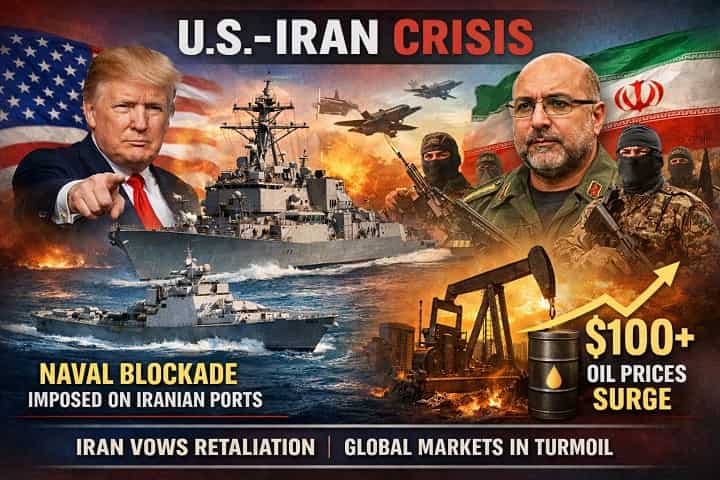
The United States has launched a naval blockade targeting Iranian ports, escalating tensions in the Middle East. The move has raised serious concerns over global energy security, as fears of disruption in the Strait of Hormuz pushed oil prices above $100 per barrel. Markets worldwide are reacting with volatility as analysts warn of possible economic ripple effects.
U.S. Launches Targeted Naval Blockade on Iranian Ports
The United States has taken a significant and highly strategic step in its escalating confrontation with Iran by announcing a naval blockade targeting Iranian ports. Donald Trump confirmed the operation, set to begin at 10:00 a.m. Eastern Time on Monday, via his Truth Social platform.
Describing the U.S. Navy as “the finest in the world,” Trump warned that any attempt by Iran to interfere with the blockade would be met with overwhelming force. According to U.S. Central Command, the operation will apply to vessels of all nationalities attempting to enter or leave Iranian ports across key waterways, including the Persian Gulf, the Strait of Hormuz, and the Gulf of Oman.
However, U.S. officials have stressed that the blockade is not a blanket shutdown. Commercial ships merely passing through the Strait of Hormuz—one of the world’s most critical energy corridors—will still be allowed safe passage. This is a crucial distinction, as the strait typically handles around 20% of global oil and liquefied natural gas shipments.
The primary objective, according to Washington, is to stop what it describes as Iran’s “illegal toll-taking” and interference with maritime traffic while ensuring global trade routes remain open. U.S. forces are also working to clear naval mines in the region to maintain safe navigation for allied and neutral vessels.
While the move is being framed as a calculated and controlled escalation, analysts warn it carries serious risks. For everyday consumers worldwide, the impact is already being felt through rising fuel prices and potential increases in shipping costs.
Breakdown of Pakistan Peace Talks Triggers Hardline U.S. Stance
The decision to impose a blockade comes shortly after high-stakes diplomatic talks between the United States and Iran collapsed in Islamabad. The negotiations, which lasted more than 20 hours, were led by U.S. Vice President JD Vance. Despite initial signs of progress, the talks ended without any agreement. Speaking to reporters afterward, Vance stated that Iran had “chosen not to accept our terms,” signaling a firm shift in Washington’s approach.
At the core of the disagreement was Iran’s nuclear program. The U.S. demanded strict guarantees that Iran would never develop nuclear weapons, viewing the issue as a major regional and global security threat. Iran, however, rejected what it described as excessive and inconsistent demands.
President Trump responded bluntly, stating that Iran “still wants a nuclear weapon” and making it clear that the U.S. would not allow that to happen. In a series of strong remarks, he indicated that military options remain on the table and that U.S. forces are “locked and loaded.”
The collapse of the Islamabad talks marked a turning point. What had been a fragile diplomatic effort has now shifted toward a strategy focused on pressure and deterrence. The naval blockade is widely seen as a direct consequence of this failed diplomacy—an attempt to force Iran back into negotiations under more favorable conditions.
Iran Rejects Pressure and Warns of Strong Retaliation
Iran has responded to the U.S. blockade with defiance, stressing that it will not back down under pressure. Senior officials, including parliamentary speaker Mohammad Bagher Ghalibaf, have publicly rejected Washington’s actions. Ghalibaf stated that Iran “will not surrender under threats” and called for national unity in the face of rising tensions. In a pointed message aimed at American audiences, he also pointed out the possible economic consequences, suggesting that U.S. citizens could soon face significantly higher fuel costs.
Meanwhile, the powerful Islamic Revolutionary Guard Corps (IRGC) issued a stern warning. It declared that any foreign military presence near the Strait of Hormuz could be considered a violation of existing understandings and would be met with a “severe response.” Iranian leaders have also pushed back against the U.S. narrative regarding the failed talks. They claim negotiations came close to success but ultimately collapsed due to what they describe as shifting American demands.
Despite mounting economic pressure and internal challenges, Iran’s leadership continues to project resilience. State messaging emphasizes strength, independence, and a refusal to yield to external coercion. However, the situation remains highly volatile. With both sides adopting firm positions, even a small miscalculation could escalate tensions into a broader conflict.
Oil Prices Surge Past $100 as Global Markets React
The geopolitical escalation has sent shockwaves through global energy markets. Oil prices have surged sharply, with Brent crude rising above $102 per barrel and U.S. West Texas Intermediate exceeding $104 in some trading sessions.
These increases reflect growing fears of disruption in the Strait of Hormuz—a narrow but vital passage that carries roughly one-fifth of the world’s oil supply. Market analysts warn that even limited interruptions could remove up to two million barrels of oil per day from global supply chains. Such a scenario would have widespread consequences, affecting everything from fuel prices to food costs.
The impact is already being felt worldwide. Transport industries are facing rising fuel expenses, while households in Europe, Asia, and beyond are bracing for higher living costs. Inflation concerns are also resurfacing, potentially complicating central bank policies and delaying economic recovery efforts.
Stock markets have shown increased volatility, with energy stocks rising while broader indices struggle under the weight of uncertainty. Meanwhile, countries without strong energy reserves are particularly vulnerable to prolonged disruptions. Although the United States has strategic reserves to cushion domestic impacts, many of its allies remain exposed. Some nations, including the United Kingdom, have chosen not to participate directly in the blockade but are supporting efforts to keep shipping lanes open.
As the blockade begins, the key question is whether this surge in oil prices will be temporary—or the start of a longer period of economic strain. Much will depend on whether diplomatic efforts can be revived or if tensions continue to escalate.
Top 5 FAQs on the U.S. Naval Blockade on Iranian Ports
1. What is the U.S. naval blockade on Iranian ports?
The blockade is a military operation announced by the United States targeting vessels entering or leaving ports in the Iran. It is aimed at restricting maritime activity around key waterways such as the Strait of Hormuz, the Persian Gulf, and the Gulf of Oman, while still allowing neutral ships safe passage through major transit routes.
2. Why did the United States impose the blockade?
According to statements tied to former President Donald Trump and U.S. officials, the decision follows the collapse of high-level nuclear negotiations in Islamabad. The U.S. claims the move is intended to stop Iran’s alleged interference with maritime traffic and pressure Tehran back into compliance over its nuclear program.
3. How did failed negotiations contribute to this decision?
The blockade reportedly came after unsuccessful talks led by U.S. Vice President JD Vance. The discussions broke down over disagreements regarding Iran’s nuclear ambitions. The U.S. viewed the failure as a turning point, shifting from diplomacy to a more forceful deterrence strategy.
4. What is the expected impact on global oil markets?
The Strait of Hormuz is one of the world’s most critical oil routes, handling about 20% of global oil and gas shipments. Any disruption has already pushed oil prices above $100 per barrel. Analysts warn that prolonged tensions could lead to reduced supply, higher fuel costs, and increased global inflation.
5. Could this situation escalate into a wider conflict?
Yes, analysts consider the situation highly volatile. Iran has warned of retaliation against foreign military presence near its waters, while the U.S. has indicated it is prepared to respond with force if necessary. With both sides maintaining strong positions, the risk of further escalation remains significant unless diplomatic efforts resume.