
Dallas, Texas — Lakepointe Church senior pastor Josh Howerton made waves this week after comparing the United States to the biblical prodigal son during an appearance on The Shawn Ryan Show, released August 3.
Howerton argued the nation has spent years chasing political power and material wealth instead of faith but said he now sees signs of a turnaround: rising church attendance, more baptisms, and growing interest in Christianity among younger Americans.
While careful to note that political leaders alone can't fix what he called a deeper spiritual drift, Howerton framed the shift as a "resurgence of the purposes of God." The comments have sparked mixed reactions online, with supporters calling it a hopeful message and critics dismissing it as one pastor's biased read on the culture. The episode has since circulated well beyond typical church-podcast audiences.
Why Josh Howerton Says America Is a 'Prodigal Nation' and What It Means?
It's one thing to preach to a packed sanctuary in Dallas every Sunday. It's another to sit across from Shawn Ryan, whose podcast draws millions of listeners well outside traditional church circles, and make the case that the entire country is in the middle of a spiritual homecoming. That's exactly what Howerton did during his appearance on The Shawn Ryan Show, an episode that dropped in early August and quickly found its way into conversations far beyond the usual church-media bubble.
The comparison he reached for wasn't subtle. Howerton described the United States as a "prodigal nation," pulling directly from the parable in the Gospel of Luke about a son who squanders his inheritance, hits rock bottom, and eventually finds his way home. In Howerton's telling, America has spent decades on its own version of that reckless detour, chasing political power, material wealth, and whatever cultural trend happened to be dominant at the moment, all while drifting further from the spiritual footing the country was supposedly built on.
But the point of a prodigal story isn't just the wandering. It's the return. And that's really the crux of what Howerton was arguing on Ryan's show: he believes the U.S. is somewhere in the middle of that turn back home. He pointed to what he sees as tangible evidence: churches filling back up, a noticeable uptick in baptisms, and a growing curiosity about Christianity, especially among younger people who might have written off organized religion just a few years ago. He framed all of it as part of what he called a "resurgence of the purposes of God," a phrase he used to describe a shift he believes is happening quietly beneath the surface of American culture.
Ryan, for his part, seemed to meet Howerton halfway on the diagnosis, if not necessarily the theology. At one point he noted how difficult it's become for people to find anything solid to anchor themselves to, joking that society can't even agree on basic definitions anymore, let alone bigger questions of purpose or meaning. His observation that people have "put their faith in men"—and kept getting let down by that bet—gave Howerton an opening to make his larger argument: that no politician, celebrity, or cultural movement can fill the void he believes only faith can address.
That distinction mattered a lot to Howerton. Even while framing the moment as hopeful, he was careful to draw a hard line between spiritual renewal and political salvation. He acknowledged that there are things he hopes political leaders will get right, but he was explicit that lasting change, in his view, was never going to come from Washington. It was always going to have to come from something deeper.
Predictably, the comments didn't land the same way with everyone. Supporters have embraced the "prodigal nation" framing as an optimistic, faith-affirming read on a country that often feels fractured and directionless. Critics, meanwhile, see it differently, as one pastor's interpretation of complicated cultural data, dressed up in biblical language that conveniently confirms what he already believed going in. Either way, the clip has traveled far past the usual audience for sermon podcasts, which is arguably the whole point of a preacher choosing to sit down with someone like Shawn Ryan in the first place. It's one more example of how Howerton has built his platform: not by staying inside the four walls of a church but by taking his message to rooms where it might get pushback.
The Making of a Preacher: Josh Howerton's Roots and Upbringing
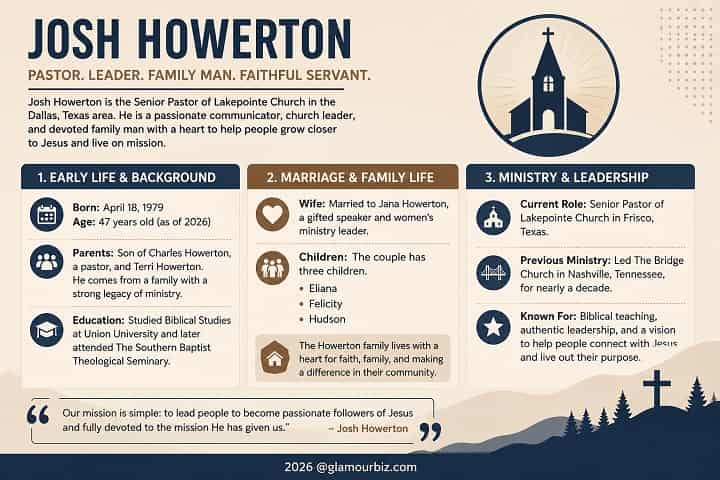
Ministry runs in Josh Howerton's blood, quite literally. He is a third-generation pastor, a lineage that stretches back to his grandfather, who spent his career preaching in small Baptist congregations scattered across Missouri, Kentucky, and Michigan. That same calling was passed down to Josh's father, Rick Howerton, who pastored throughout Josh's childhood and teenage years and who, in a full-circle moment, eventually joined the staff at Lakepointe Church alongside his son.
Growing up as a pastor's kid is often portrayed as a mixed bag, sometimes even a burden. Josh has pushed back on that narrative in interviews, describing his own upbringing as the opposite of a hardship. He has spoken warmly about feeling loved and discipled within the church community he grew up in, crediting that environment for shaping the trajectory of his life long before he ever stepped into a pulpit himself.
The real turning point, though, came at sixteen. That's the age Josh points to when describing a personal and deeply transformative encounter with his faith, the moment that took an inherited family tradition and turned it into something he owned for himself. It wasn't simply that he was born into a ministry family; it was that he chose, as a teenager, to walk the same path his father and grandfather had walked before him.
Interestingly, that choice wasn't met with immediate enthusiasm at home. According to Josh, his parents actually tried to steer him away from pastoral work at first, having witnessed firsthand how demanding and, at times, painful the calling could be. His grandfather's ministry experience, in particular, had been a difficult one. But the pull toward ministry proved stronger than their concerns, and Josh pressed forward.
He went on to study biblical studies at Union University, laying the academic groundwork for the theological depth that would later define his preaching style. From there, he continued his education at Southern Seminary, sharpening the tools he would eventually use to build one of the more prominent pulpits in American evangelicalism. Long before Lakepointe, though, there was Nashville, a decade-long chapter that would quietly prepare him for everything that came next.
Love and Partnership: Meet Jana Howerton, His Wife
Behind every public figure with a demanding, high-visibility career is usually a partner holding down the parts of life that never make it into interviews or Instagram captions. For Josh Howerton, that partner is his wife, Jana. Theirs isn't a relationship where one person preaches while the other simply supports from the sidelines. By most accounts, ministry is something the two of them approach as a shared calling, working side by side rather than in separate lanes.
Together, Josh and Jana are raising three children: daughters Eliana and Felicity and a son named Hudson. Josh has been candid about where his priorities sit, repeatedly describing his role as a husband and father as the most important calling in his life, more important, in his own words, than the pastoral platform that has brought him national attention. It's a distinction worth noting in an era when public ministers are increasingly treated as brands; Howerton seems intent on keeping the order of his priorities straight, at least in how he talks about them publicly.
Life inside the Howerton household isn't hidden away from public view, either. Jana maintains her own presence on social media, and the couple's family life occasionally surfaces in the content Josh shares across his platforms, from Instagram to his podcasts. Yet for a man who has built a significant online following, north of two million on Instagram alone, the details of his marriage remain relatively private compared to the cultural commentary he's known for. What is clear is that Jana isn't a background figure in his story. She's described as a full partner in the mission, someone who shares not just a household with Josh but the broader vision behind Lakepointe's work.
There's also something notably grounded about how Josh frames fatherhood. Rather than treating his children as an extension of his public ministry, he speaks about raising Eliana, Felicity, and Hudson with an emphasis on faith formation at home, teaching them to love and serve the church, not simply attend it. It's a subtle but telling detail: for a man whose job is speaking to crowds, some of the most important conversations of his week likely happen around his own dinner table.
From Nashville to Dallas: The Rise of a Pastor's Career
Every prominent ministry has an origin story, and Josh Howerton's began well before Lakepointe Church became his home base. For a full decade, he served as pastor of The Bridge Church in Nashville, Tennessee, a role that gave him years of hands-on pastoral experience long before he stepped onto a larger stage. That decade in Nashville isn't just a résumé line; it's the foundation that shaped how he leads, teaches, and connects with a congregation, skills that would later scale to a much bigger audience.
The move to Lakepointe Church marked a significant shift in both scope and visibility. As senior pastor, Josh now oversees a multisite, multilingual congregation with six campuses spread across the Dallas–Fort Worth metroplex, a far cry from a single-location Nashville church. Lakepointe's growth hasn't gone unnoticed within the broader evangelical world, either; the church has previously ranked among the fastest-growing and largest-attending congregations tracked by Outreach magazine, a signal of just how much momentum has built around Howerton's leadership.
But Howerton's influence doesn't stop at Lakepointe's front doors. He also leads the Strategic Launch Network, a church-planting initiative connected to Lakepointe that has helped launch and continues to coach more than sixty churches, many of them in cities considered predominantly secular. It's a strategic bet on expansion beyond the traditional Bible Belt, planting churches in places where evangelical Christianity doesn't always have an easy foothold.
What truly sets Howerton apart from many of his pastoral peers, though, is his embrace of digital media as a ministry tool. He hosts two distinct podcasts that reach audiences well beyond his physical campuses. The first, simply titled after Lakepointe Church, functions as a digital mirror of his weekly sermons, biblical exposition delivered in the same format churchgoers would hear on a Sunday morning, just accessible to anyone with a phone and an internet connection. For many listeners scattered outside Dallas, this podcast has effectively become their church.
His second show, Live Free with Josh Howerton, takes a noticeably different approach. Rather than sticking to traditional sermon content, it wades directly into cultural commentary: political debates, social controversies, and current events, all filtered through a biblical lens. It's a format built for conversation rather than proclamation, and it's arguably the platform most responsible for expanding his reach beyond conventional churchgoing audiences into the wider, often contentious, world of online religious and political discourse.
That expansion hasn't come without friction. Howerton has increasingly become known as a polarizing figure, someone unafraid to weigh in on hot-button cultural issues, which has earned him both a loyal following and no shortage of critics. Whether discussing international policy, social trends, or church culture itself, he's positioned himself as a pastor willing to engage messy, real-world conversations rather than avoid them.
Taken together, Howerton's career reflects a broader shift happening across American evangelicalism: pastors are no longer confined to their pulpits. They're becoming media personalities, podcast hosts, and cultural commentators, often blurring the line between preacher and public figure. Josh Howerton, with a decade in Nashville behind him and a growing multimedia empire built around Lakepointe, has become one of the clearer examples of exactly where that shift is headed.