
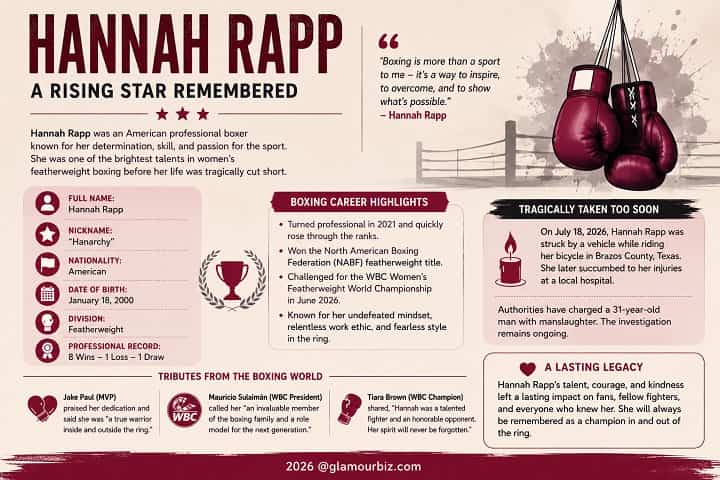
The article from E! News reports that Hannah Rapp, 26, died after being struck by a vehicle while riding her bicycle in Brazos County, Texas, on July 18, 2026. Authorities allege the driver passed two cyclists, then reversed and struck Rapp.
The driver, Charles Medina, 31, was arrested and charged with manslaughter. The incident remains under investigation. The boxing community, including Most Valuable Promotions, Jake Paul, and the World Boxing Council (WBC), paid tribute to Rapp following her death.
Who Was Hannah Rapp? Inside the Boxing Career of the Purdue Track Star Turned Rising Champion
Before she ever stepped into a boxing ring, Hannah Rapp was chasing a different kind of speed. Raised in Yorktown, a small town in Indiana, she grew up with an athlete's instincts long before she found the sport that would define her short but remarkable career. As a young woman, Rapp ran track at Purdue University, where she built the discipline, endurance, and competitive edge that would later translate seamlessly into the boxing ring.
It's not unusual for combat sports to draw talent from other athletic backgrounds, but Rapp's transition stood out because of how quickly she made her mark. After finishing her time as a collegiate athlete, she made the decision to relocate to College Station, Texas, a move that would reshape the rest of her life. There, she found a boxing home at the Bryan Boxing Club, training under the alias "Hanarchy," a nickname that captured both her fighting spirit and her sense of humor.
Rapp turned professional in 2024, a relatively late start compared to fighters who begin their pro careers in their teens or early twenties. But what she lacked in a head start, she made up for in results. Fighting out of College Station, she compiled an 8-0-1 record, taking on opponents across Texas, Mexico, and beyond. Her style, an orthodox stance paired with relentless pressure, quickly caught the attention of promoters and fans within the featherweight division.
What made Rapp's story resonate beyond the boxing community was the fact that she never stopped working her day job. While training for fights and building her professional record, she maintained full-time employment as a fire and life safety inspector at Texas A&M University. It's a detail that appeared in nearly every account of her life and death, not as a footnote, but as a defining characteristic. She was, by every description, someone who refused to choose between stability and ambition. She simply pursued both.
That balance came to a head in June, when Rapp earned the biggest opportunity of her career: a shot at Tiara Brown for the WBC women's featherweight world title. The bout took place at MVPW-04, an event held at the Caribe Royale Resort in Orlando, Florida. Rapp entered as the underdog against a champion with a significantly deeper résumé, but she didn't back down. Over the course of the fight, she pushed Brown through what both fighters would later describe as a genuinely competitive, spirited battle. In the end, the judges' scorecards favored Brown, and Rapp lost by unanimous decision. But the fight left an impression. It wasn't a blowout. It was a statement that Rapp belonged at that level and that bigger opportunities were likely still ahead of her. Just weeks later, that promising trajectory would be cut short in the most unexpected way, not in the ring, but on a rural Texas highway.
How Hannah Rapp Died: A Timeline of the Brazos County Crash
The morning of Saturday, July 18, began like any other for Hannah Rapp. She was out cycling, a common form of cross-training for athletes looking to build cardiovascular endurance without the impact of running. She wasn't alone. Her boyfriend, an instructional assistant professor of civil and environmental engineering at Texas A&M, was riding alongside her along FM 159, a farm-to-market road south of College Station.
According to the Brazos County Sheriff's Office, deputies were dispatched to the 23000 block of FM 159 at approximately 10:00 a.m. after reports of a major crash involving a vehicle and a bicyclist. What officers found when they arrived was devastating: an adult woman lying unresponsive in the roadway.
The sequence of events leading up to that moment, based on a probable cause statement later obtained by news outlets, paints a troubling picture. A vehicle, later identified as a 2008 Honda driven by 31-year-old Charles Medina, passed both cyclists while traveling along the road. Rather than continuing on, Medina brought his car to a stop. He then shifted into reverse and began backing up, ultimately striking one of the two cyclists, Rapp, with the rear of his vehicle.
Medina later told investigators he believed the cyclists were attempting to flag him down, which he said prompted him to brake hard enough that his tires locked up before coming to a stop. He also claimed that as he reversed, he did not see Rapp until the last moment before impact and estimated his speed at roughly 15 miles per hour. Physical evidence at the scene told its own story: Medina's Honda was found with a crushed rear hatch and a shattered back window, consistent with the force of the collision. Investigators also documented skid marks on the roadway that appeared to show the vehicle braking hard before rapidly accelerating in reverse.
First responders arrived quickly and administered emergency medical care before rushing Rapp to a nearby hospital. Despite those efforts, she could not be saved. She was pronounced dead shortly after arrival, at just 26 years old.
The Sheriff's Office has said its investigation remains ongoing, though officials have characterized the crash as an isolated incident rather than part of any broader pattern targeting cyclists in the area. Still, the manner of the crash, a vehicle stopping, reversing, and colliding with a cyclist, has fueled public scrutiny and raised uncomfortable questions about intent that authorities are continuing to examine.
Charles Medina's History: What We Know About the Man Charged in Rapp's Death
In the hours following the crash, Charles Medina was arrested and formally charged with manslaughter. He was booked into the Brazos County Detention Center, where he remained held as the investigation proceeded. Public records reviewed by news outlets show that Medina lived roughly two miles from the location where the crash occurred, placing him well within familiar territory on FM 159 that morning.
What has drawn particular attention, however, is Medina's history with law enforcement, which stretches back well over a decade. According to jail records reviewed by reporters, his first documented arrest in Brazos County dates back to 2012, when he was taken into custody for reckless driving and for evading arrest while operating a vehicle. He ultimately pleaded guilty in both cases.
The pattern didn't end there. Records show Medina was arrested again in 2014, once more for reckless driving, an offense that mirrors elements of the fatal 2026 crash. Then, in 2020, he was arrested for hit and run, an incident that, like this most recent case, involved fleeing or otherwise failing to properly stop or respond following a collision.
Taken together, this history has become a central part of the public conversation surrounding Rapp's death. For many in the College Station community, and increasingly beyond it, the case isn't just about one tragic morning. It's about whether a documented, decade-long pattern of dangerous driving behavior should have kept someone off the road well before it turned deadly. That question has become the driving force behind a new grassroots movement inspired directly by Rapp's death.
The Boxing World Mourns Hannah Rapp While a Community Pushes for "Hannah's Law"
Word of Rapp's death spread quickly through the boxing community, and tributes followed almost immediately. WBC President Mauricio Sulaimán issued a statement describing the loss as heartbreaking, calling Rapp an exceptional boxer and an invaluable member of the WBC family. He extended sympathy to her loved ones, her team, and everyone who had the privilege of knowing her throughout what he described as a brilliant career.
Perhaps the most personal tribute came from Tiara Brown, the very fighter Rapp had challenged for the world title just weeks earlier. In a message shared on social media, Brown reflected on their fight with visible emotion, describing Rapp as one of the toughest opponents she'd ever faced professionally. Brown recalled a moment after their bout when Rapp asked her for an autograph, a small gesture that Brown said struck her deeply given the intensity of the competition they'd just shared. She closed her tribute by calling it an honor to have shared the ring with Rapp.
Beyond the boxing world, Rapp's death has sparked a broader community response centered on road safety and accountability. Supporters in the College Station area have begun organizing around what they're calling "Hannah's Law," a proposed measure aimed at giving Texas courts stronger legal authority to keep repeat traffic offenders off the road before their behavior escalates into tragedy. Advocates point directly to Medina's documented history, arguing that a legal system equipped to intervene earlier might have prevented the events of July 18.
Whether that push translates into actual legislation remains to be seen. But for the community that came to know Rapp, both as a fighter and as the fire safety inspector who greeted them on campus, her death has become a rallying point. It's a reminder of a life built on discipline and dual ambition, cut short in an instant, and now fueling a conversation about how to prevent similar losses in the future.
As the investigation into her death continues, Hannah Rapp is being remembered not for how her story ended, but for everything she built in the years before it: a promising boxing career, a steady career in public safety, and a reputation, inside and outside the ring, for showing up fully for everything she pursued.