
Avital Balwit made headlines in August 2026 after reports said her husband, Leopold Aschenbrenner's, AI-focused hedge fund lost around $45 billion just days before their wedding in Carmel, California. The news quickly drew public attention to the couple.
Although Balwit's name appeared in the coverage, there is no evidence that she was involved in the fund's operations. She is best known for her own work in artificial intelligence as chief of staff to Anthropic CEO Dario Amodei.
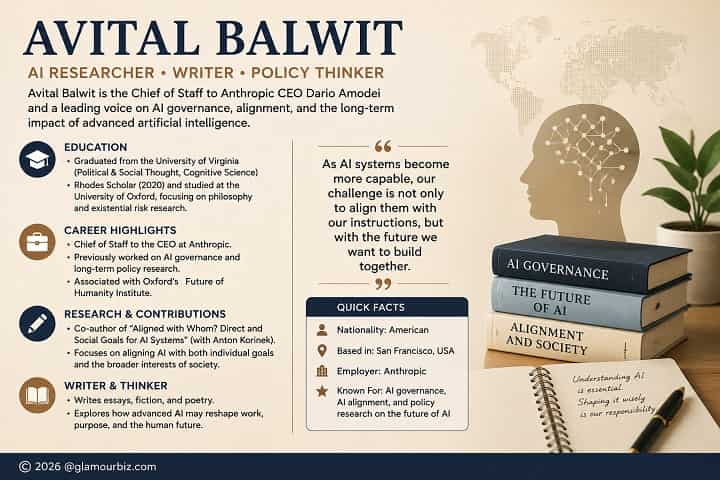
From Portland Poet to Philosopher in the Room: Avital Balwit's Formative Years
Long before her name became attached to boardroom strategy at one of the world's most talked-about artificial intelligence companies, Avital Balwit was a kid in Portland, Oregon, with a notebook full of half-finished stories. Friends and early profiles describe her as a natural writer from a young age, someone who gravitated toward short fiction and poetry rather than science fairs or coding camps. Some of her earliest creative work found a home in publications centered on Jewish literary voices, a detail that hints at the introspective, almost literary sensibility that still runs through her professional writing today.
That instinct for language and ideas followed her to college. Rather than choosing computer science or engineering, the fields that dominate Silicon Valley resumes, Balwit majored in political and social thought, with an added focus on cognitive science, at the University of Virginia. It was an unconventional foundation for someone who would later end up steering strategy at a frontier AI lab, but it turned out to be the perfect training ground for the kind of thinker she would become: someone fluent in the language of philosophy, ethics, and governance, even while working alongside engineers building some of the most powerful software systems ever created.
Her academic trajectory took a sharp turn upward when she was named a Rhodes Scholar, one of the most prestigious postgraduate honors an American student can receive. The scholarship sent her to the University of Oxford, where she became affiliated with the Future of Humanity Institute, a research center known for tackling big, uncomfortable questions about long-term risks tied to advanced technology. It was there, immersed in debates about existential risk and the far future of humanity, that Balwit sharpened the intellectual toolkit she would later bring into the AI industry itself.
She has kept her exact birth date private, but in a widely read 2024 essay she mentioned being 25 years old, which places her birth year somewhere around 1998 or 1999. That detail matters less for its own sake than for what it reveals about her career pace. By the time most people her age are still finding their footing in a first or second job, Balwit had already moved from academic research on existential risk to a senior operational role inside one of the companies actually building the technology she once studied from a safe theoretical distance. It is that blend of humanities-trained caution and insider proximity to the frontier that makes her such an unusual figure in the AI world, not a pure technologist nor an outside critic, but something in between.
On the Cusp of the Singularity: A Carmel Wedding for AI's Power Couple
Late July 2026 brought a very different kind of headline for Balwit, one with far less to do with algorithms and far more to do with wedding florists. According to reporting from the Wall Street Journal, Balwit married Leopold Aschenbrenner, a former OpenAI researcher turned hedge fund manager, in Carmel, California, in what was described as a sprawling, multi-day celebration. The festivities reportedly opened with something only this particular crowd could pull off: a colloquium featuring panels and breakout sessions before moving into a ceremony held at a Tuscan-style villa. The couple was then said to be sent off toward a honeymoon at a forest spa retreat.
The relationship itself has roots that trace back several years, long before either of them became fixtures of AI industry gossip columns. The two are reported to have first met while working at the FTX Future Fund, the now-defunct philanthropic arm connected to Sam Bankman Fried's cryptocurrency empire. Both are said to have left the organization around the same time, following the dramatic collapse of FTX in late 2022, a shared professional experience that appears to have forged an early bond between them. Their engagement was first reported publicly by Fortune magazine in October, cementing their status in tech circles as something of a power couple, one half building AI at Anthropic, the other betting on it from Wall Street.
True to the small, insular nature of the AI world she works in, Balwit has poked fun at just how tightly wound this social circle really is. She reportedly joked on the social platform X that she had asked her wedding planners to aim for a theme she called "European Garden," while acknowledging with dry humor that the event was, in her words, happening on the edge of the singularity, a nod to the very technology she and her fiancé had built careers around.
It is worth being careful here, though, before treating every detail as settled fact. Several outlets covering the wedding have noted that neither Balwit, Aschenbrenner, nor Anthropic has issued a formal, on-the-record confirmation of the marriage. The coverage so far rests on reporting from outlets like the Journal and Fortune rather than a personal announcement from the couple themselves, so readers should treat the broad strokes as well-sourced but not yet officially confirmed by the two people at the center of the story.
The Existential Risk Researcher Who Became Dario Amodei's Right Hand
Balwit's move from academic research on long-term AI risk to an executive seat at Anthropic is not as strange a leap as it might first appear. Her time at Oxford's Future of Humanity Institute placed her directly inside a community of researchers who were thinking seriously, years before it became mainstream conversation, about what happens when artificial intelligence systems grow powerful enough to reshape entire economies and even threaten human oversight. That world of longtermist thinking and effective altruism has quietly fed a surprising number of people into leadership roles at frontier AI labs, and Balwit's career is one clear example of that pipeline in action.
Today she holds the title of Chief of Staff to Dario Amodei, the CEO of Anthropic, a company built by former OpenAI researchers with safety as a core part of its founding mission. It is a role that places her close to the center of major strategic decisions, even though she does not carry an engineering title and has never positioned herself as a technical researcher. Her value inside the company appears to come instead from her ability to translate between worlds, connecting philosophical questions about risk and governance with the day-to-day operational demands of running a fast-moving AI company.
Outside of her corporate responsibilities, Balwit has built a genuine public voice as a writer. Her essays have appeared in outlets including Palladium Magazine and The Free Press, and she has taken part in recorded public conversations, including one alongside economist Tyler Cowen, exploring how advanced AI might reshape work, identity, and even spiritual meaning. Importantly, her published essays typically carry a disclaimer noting that they reflect her personal views rather than any official Anthropic position, a distinction that gives her more freedom to explore uncomfortable or speculative ideas than a corporate statement ever could.
Wedding Bells and Margin Calls: How a $45 Billion Meltdown Crashed the Honeymoon
If the wedding itself made headlines, the timing made it a genuine spectacle. Just as Balwit and Aschenbrenner were preparing to celebrate, Aschenbrenner's own hedge fund, Situational Awareness, was reportedly in serious trouble. He had built the fund to an eye-watering 45 billion dollars in capital through a concentrated bet on companies tied to memory chips and data center infrastructure, like CoreWeave and SK Hynix, a strategy that earned him the nickname "the Nostradamus of AI" among industry watchers who had seen his earlier predictions about AI's trajectory come true.
That success, though, came with enormous risk attached. According to the Wall Street Journal, Aschenbrenner had leveraged those bets three to four times over, meaning he was borrowing several dollars for every dollar of his fund's actual capital. It is an aggressive strategy that can produce extraordinary returns when markets cooperate, and equally extraordinary losses when they do not. In the same week as the wedding, reports indicate that his fund nearly collapsed under the weight of that leverage, forcing him to sell off the bulk of Situational Awareness to Citadel, reportedly at a discounted price.
What followed only added to the strange, almost cinematic quality of the story. Aschenbrenner is said to have spent part of his honeymoon fielding one-on-one calls with investors, trying to manage the fallout of the deal even as he and Balwit were meant to be celebrating their marriage. For a couple whose relationship has always existed at the intersection of two of the most closely watched corners of the tech industry, artificial intelligence research and AI-focused investing, it was perhaps a fittingly chaotic collision of personal milestones and professional turbulence.
The episode has since become something of a talking point in Bay Area tech and finance circles, less because of the size of the losses themselves and more because of what it revealed. Even the sharpest minds building and betting on artificial intelligence are not immune to the same market pressures and financial risks that have humbled traders for generations. For Balwit, a woman who has spent much of her career writing thoughtfully about uncertainty, risk, and the limits of human control in the age of AI, the timing offered an almost poetic real-world echo of the very themes she has spent years exploring on the page.