
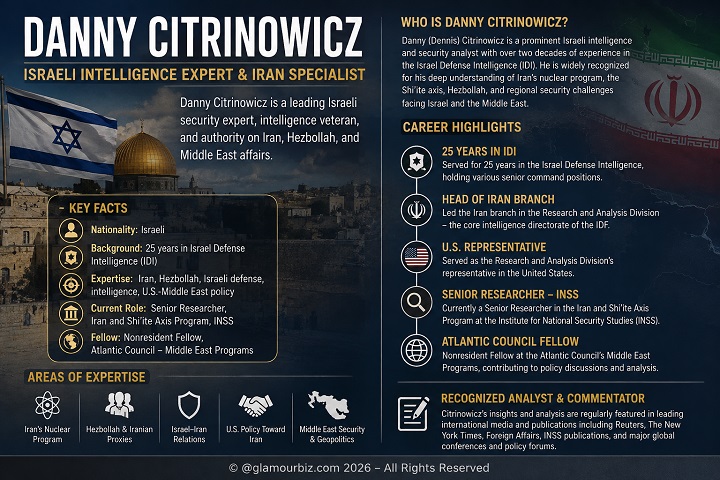
There are analysts who talk about Iran from behind a desk, and then there are people like Danny Citrinowicz, who spent a quarter-century inside the machinery that actually watches Iran. That distinction shows up in almost everything he says and writes today.
When he talks about Tehran's nuclear calculus or the mood inside the Islamic Revolutionary Guard Corps, he isn't guessing from open-source reports. He's drawing on decades spent reading the country from the inside, first as a serving officer and now as one of the most quoted independent voices on the subject in English and Hebrew media alike.
Before the Briefings: The Making of an Intelligence Mind
Public detail on Citrinowicz's childhood and upbringing is thin, which is fairly common for people who spend their careers in intelligence work rather than public life. What is on the record is that he studied at the Hebrew University of Jerusalem, one of Israel's oldest and most prestigious academic institutions, before making the move into military service that would define the next twenty-five years of his life.
That move eventually took him into Unit 8200, Israel's signals intelligence corps and arguably the most storied unit in the country's defense establishment. Unit 8200 has produced a long list of Israeli tech founders and intelligence officials over the decades, and it's where Citrinowicz began building the analytical and technical skill set, SIGINT collection, source analysis, pattern recognition across huge volumes of data that would eventually make him one of the country's go-to Iran specialists.
It's worth pausing on what this means in practice. Unlike a policy analyst who studies a country from afar, Citrinowicz came up through a system built around one core question: What is the adversary actually planning to do next, and how confident can we be in that assessment? That question would follow him for the rest of his career, first as an officer producing classified reports for Israeli decision-makers and later as a public commentator trying to explain those same dynamics to a much wider audience.
25 Years Watching Tehran: Inside the Iran Branch
Citrinowicz's military career eventually centered almost entirely on one country. He rose to become head of the Iran branch within the Research and Analysis Division of Israeli Military Intelligence, a position that put him at the center of Israel's effort to understand Iran's nuclear ambitions and its regional proxy network. He also served as the division's representative in the United States, spending time in Washington as a deputy intelligence and defense attaché, a posting that placed him directly in the loop between Israeli and American assessments of Iran.
In a 2021 interview with the Times of Israel, Citrinowicz described his job in blunt terms. He was responsible for evaluating Iran's strategic intentions, everything from its nuclear program to its activities in Syria, and turning that analysis into recommendations for policymakers. He was, in his own words, essentially tasked with reading the "red side," trying to determine whether Tehran genuinely intended to build a weapon and what its next moves in the region would look like.
What makes his account particularly striking is his candor about how those assessments were received. Citrinowicz has been publicly critical of Israeli political leadership for what he describes as a failure to adopt a more nuanced approach to Iran policy over the years, a failure he argues contributed to accelerating rather than slowing Tehran's nuclear progress. That's not a small claim coming from someone who spent years producing the very intelligence those decisions were based on. It also set the tone for the second half of his career: a former insider willing to say, publicly, that warnings were sometimes ignored.
Twenty-five years is a long tenure by any standard, and it left Citrinowicz with a rare vantage point. He watched Iran policy from inside multiple Israeli governments, across multiple Iranian presidencies, and through several distinct phases of the nuclear standoff. Few people writing about Iran today can claim that kind of continuity.
Trading the Uniform for the Pen: A Spy's Second Act as Strategic Voice
When Citrinowicz left active military service, he didn't step away from Iran analysis; he simply changed the venue. He moved into Israel's think tank world, taking on roles as a senior fellow at the Institute of Policy and Strategy, part of the Abba Eban Institute for International Diplomacy at Reichman University, and later as a senior researcher at the Institute for National Security Studies, one of Israel's leading defense and foreign policy research bodies, where he now focuses specifically on Iran and what INSS terms the "Shi'ite Axis," the network of Iran-aligned groups across the region.
This transition mattered for a simple reason: it let him say things publicly that he couldn't say while still in uniform. His writing for outlets like the Times of Israel's blog section and Israel Hayom started to carry a different tone than typical think tank output, more direct, more willing to challenge conventional wisdom, and grounded in the specific texture of intelligence work rather than academic theorizing. He wrote pieces on the practical difficulties of modern intelligence gathering, on the implications of cyber operations, and increasingly, as tensions escalated, on what a military confrontation with Iran might actually look like on the ground.
This period also turned him into a genuine media figure. He became a regular voice in interviews and analysis pieces whenever Iran-related news broke, precisely because editors and producers knew he could speak with authority that came from experience rather than secondhand research.
The Iran Whisperer: Citrinowicz's Reach from Tel Aviv to Washington
Today, Citrinowicz's influence stretches well beyond Israel. He holds a position as a nonresident senior fellow with the Atlantic Council's Scowcroft Middle East Security Initiative, giving him a platform in Washington policy circles alongside his Tel Aviv-based work at INSS. He's also been featured by the Washington Institute for Near East Policy and the European Leadership Network, two of the more influential foreign policy shops on either side of the Atlantic.
His social media presence tells its own story. With over 70,000 followers on X, he's become one of the platform's most-followed independent voices on Iran, posting real-time analysis in both Hebrew and English whenever the situation escalates. That reach expanded further as the Iran-Israel conflict intensified through 2025 and into 2026. Citrinowicz has offered pointed commentary on the killing of Iran's Supreme Leader, arguing that removing the one figure historically most cautious about crossing the nuclear threshold might paradoxically leave Iran more likely to pursue a bomb, not less, given its intact technical expertise and a stockpile of highly enriched uranium believed to be sitting in tunnels beneath Isfahan.
He's also become a regular guest on English-language podcasts aimed at foreign policy audiences, including an appearance on The Long Game alongside former Biden administration officials Jake Sullivan and Jon Finer, where he offered a frank assessment of what Israel had and hadn't accomplished militarily against Iran, and what the postwar picture might realistically look like.
What ties all of this together is consistency. Whether he was writing classified assessments for the Israeli government two decades ago or explaining escalation risk to a Washington podcast audience last spring, Citrinowicz has stayed focused on the same core question he started with in his Unit 8200 days: What does Iran actually want, and how sure can anyone really be about the answer? That question has aged with him, but it hasn't gone anywhere, and neither, it seems, has he.