
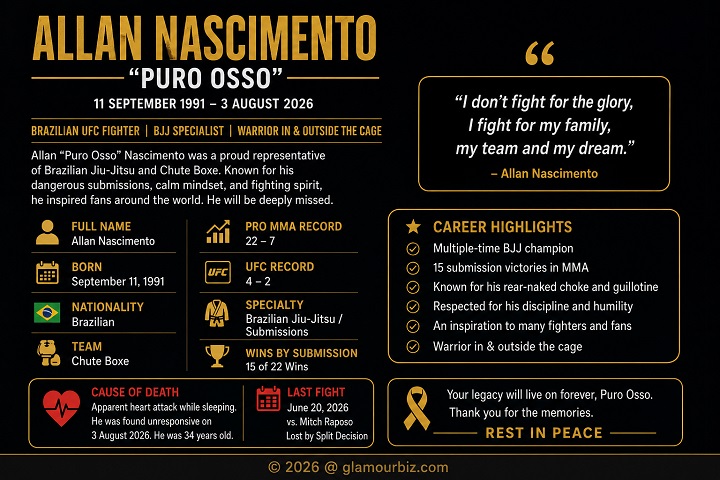
UFC flyweight Allan Nascimento, known as "Puro Osso," has died at 34, the promotion confirmed Monday. He was found unresponsive after suffering an apparent heart attack in his sleep and pronounced dead at the scene.
The Brazilian black belt finished his career 22-7, going 4-2 in the UFC, with his last fight a split-decision loss to Mitch Raposo in June. Fighters including Dustin Poirier and Henry Cejudo shared condolences.
Who Was Allan Nascimento? The Brazilian Grappler Known as "Puro Osso"
Before his name ever showed up on a UFC poster, Allan Nascimento was just another kid from São Paulo grinding it out on Brazil's regional fight scene, the kind of circuit where you fight for pride and gas money long before anyone knows your name. Born September 11, 1991, he grew into a lean 5'8" flyweight who walked around at 125 pounds. He had a bit of a reach advantage over most guys in his division, though he was never the type to overpower anyone. His game was built on patience and timing, not brute strength.
His nickname said it all. "Puro Osso," which loosely means "pure bone," wasn't just something a commentator slapped on him for flair. It fit who he was as a fighter. He didn't chase highlight-reel finishes or talk trash to build hype. He simply put in the work, year after year, taking losses when they came and coming back sharper the next time out.
Not much has been publicly said about his childhood or his family, which isn't unusual for fighters who spend most of their careers away from the mainstream spotlight, grinding through small shows most casual fans never hear about. What we do know is that São Paulo shaped him, both as a person and as a competitor. He trained at Chute Boxe Diego Lima, one of the most respected gyms in Brazil, rolling and sparring alongside training partners like former UFC lightweight champion Charles Oliveira. That kind of environment, full of world-class jiu-jitsu and with no shortage of hard days on the mats, is where fighters either get better or get weeded out. Nascimento clearly got better.
People who trained alongside him often talk about how tight-knit that Chute Boxe crew was, more like family than teammates. It was in that gym, far from any arena lights, that Nascimento turned himself from a solid regional prospect into someone who genuinely belonged in the UFC. His story is a good reminder that every fighter you see on a big pay-per-view card spent years doing unglamorous work nobody was watching.
"Puro Osso" No More: UFC Flyweight Allan Nascimento Dead at 34
The MMA world woke up to heartbreaking news on Monday, August 3. The UFC confirmed that flyweight Allan Nascimento had died at just 34 years old. According to the promotion's statement, he was found unresponsive after suffering an apparent heart attack in his sleep. Medical staff responded quickly, but there was nothing they could do. He was pronounced dead at the scene.
The UFC's statement didn't try to soften the blow, and honestly, there wasn't much that could: "Our thoughts and deepest condolences are with Allan's family, friends, teammates, and loved ones during this incredibly difficult time." What made the news hit even harder is how recently he'd been active. Just two months earlier, in June, he'd dropped a tight split decision to Mitch Raposo at UFC Vegas 119, a fight nobody could have known would end up being his last.
Tributes started rolling in almost immediately. Dustin Poirier, Henry Cejudo, Mackenzie Dern, and others shared their condolences publicly, and it said a lot about the kind of respect Nascimento had earned inside the sport. He was never the loudest guy in the room or the one grabbing headlines, but clearly plenty of people noticed the work he put in and the way he carried himself.
His death is also a hard reminder that combat sports take a toll that goes beyond what happens inside the cage. Heart related emergencies among elite athletes are rare, but they do happen, and Nascimento's passing has brought renewed attention to how fighters are monitored for cardiac and overall health throughout their careers, not just in the lead-up to a fight.
Inside the Octagon: Allan Nascimento's UFC Career and Fighting Record
Getting to the UFC wasn't easy for Nascimento, and it definitely wasn't quick. His first shot came in 2018 through Dana White's Contender Series, the show designed to fast track promising fighters straight into a UFC contract. He lost a split decision to Raulian Paiva that night, the kind of setback that ends a lot of careers before they really start. Instead of fading away, Nascimento spent the next three years back on the regional grind, sharpening every part of his game until the UFC finally called again in 2021.
Even then, his debut didn't go how he wanted. He dropped a split decision to Tagir Ulanbekov at UFC 267 that October. Two tough losses on the sport's biggest stage would rattle most fighters, but Nascimento just kept working. He answered with a run of performances that reminded everyone exactly why he'd earned his spot.
In May 2022, he picked up a clean unanimous decision win over Jake Hadley. Then in January 2023, he submitted Carlos Hernandez in the very first round, a finish good enough to earn him a Performance of the Night bonus. He followed that up with another unanimous decision, this time over Jafel Filho in May 2025, and closed things out with a second-round submission win over Cody Durden that November. Those wins told you everything about what made him dangerous. Once a fight hit the ground, he was a nightmare for anyone across the cage from him.
By the time it was all said and done, Nascimento's professional record stood at 22 wins and 7 losses, with a 4-2 mark inside the UFC itself. Fifteen of his 22 career wins came by submission, which tells you just how dominant his ground game really was. As a Brazilian Jiu-Jitsu black belt, he had the kind of technical sharpness that let him consistently outwork opponents once things left the feet, even guys who were bigger or more athletic than him.
His last fight came in June 2026, a split decision loss to Mitch Raposo at UFC Vegas 119. It wasn't the result he wanted, but it capped off a career built on grit, technical skill, and a refusal to ever stop improving.
The Rise of "Puro Osso": How a BJJ Black Belt Built a 22-7 Professional Record
Every fighter's story starts somewhere far from the bright lights, and Nascimento's began back in 2011 when he turned pro on Brazil's regional circuit, a world where fighters often earn next to nothing and fight in front of crowds you could count by hand. He came out swinging, winning nine of his first ten fights and quickly earning a reputation as a submission threat that other fighters wanted no part of.
Over the next decade, he fought all over Brazil's competitive landscape, taking on all comers in promotions like Legacy Fighting Championship and a handful of smaller regional shows. His finishes piled up steadily: rear-naked chokes, heel hooks, triangle chokes, kneebars, you name it. Every one of those wins added another layer to his reputation as one of the best grapplers nobody outside hardcore MMA circles had heard of yet. He even picked up experience overseas, competing in RIZIN, one of Japan's top MMA promotions, against a different style of competition altogether.
What really stands out about his climb is that he never let setbacks knock him off course. Losses to solid competitors along the way weren't career-ending moments for him, they were lessons he took back to the gym. By the time he finally locked down his UFC contract in 2021, he'd already spent a decade fighting professionally, and that experience showed up in how calm and composed he looked once he finally got there.
Training at Chute Boxe Diego Lima alongside guys like Charles Oliveira only sped up his development. That gym has built a reputation for producing sharp, jiu-jitsu heavy fighters, and it's no surprise Nascimento's best UFC moments came by way of submission. His ability to consistently finish fights on the ground, even against UFC level competition, is what made him one of the more dangerous grapplers in the flyweight division.
When you add it all up, the numbers speak for themselves: a 22-7 career record, 15 submission wins, two Performance of the Night bonuses, and a 4-2 run inside the UFC. He was never the fighter chasing headlines or flashy finishes for the highlight reels. Allan Nascimento built his legacy the hard way, through patience, discipline, and a mastery of his craft that few in the sport could match.