
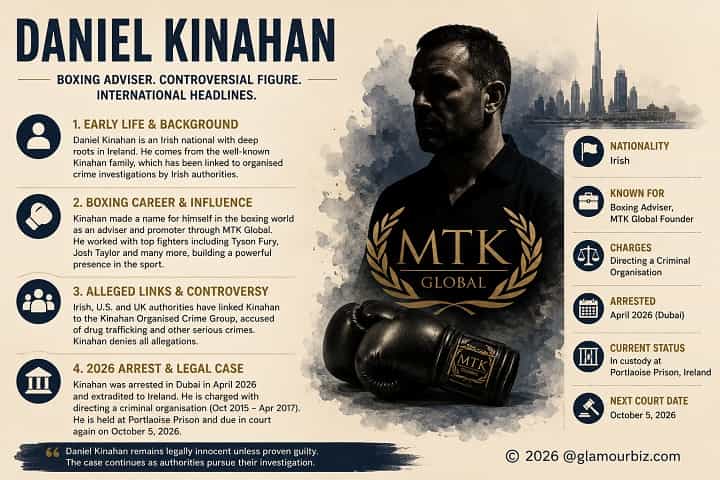
Daniel Kinahan has returned to Ireland after being extradited from Dubai in a high-security operation, marking a major development in the long-running investigation surrounding the alleged Kinahan organized crime group. The 49-year-old former boxing promoter was brought before Dublin’s Special Criminal Court under armed escort and charged with directing the activities of a criminal organization.
Following the hearing, Kinahan was ordered to remain in custody at Portlaoise Prison while the case proceeds. Authorities have alleged that he was involved in overseeing an international drug-trafficking operation, allegations Kinahan has denied. His next appearance before the three-judge Special Criminal Court is scheduled for October 5, 2026.
Kinahan previously built a prominent profile in boxing through MTK Boxing while living in Dubai, where he worked with several high-profile fighters. His return to Ireland now shifts the focus from his years abroad and boxing connections to the criminal proceedings he faces at home.
From Boxing Promoter to Europe's Most Wanted: The Double Life of Daniel Kinahan
For years, Daniel Kinahan wore two very different faces. To the sporting world, he was a slick, well-connected boxing figure who rubbed shoulders with world champions and helped build one of the sport's most talked-about management outfits. To Irish courts and international law enforcement, he was something else entirely: the alleged head of one of Europe's largest and most violent organized crime networks.
Born in Dublin in 1977, Kinahan grew up in the Oliver Bond flats, a working-class area of the city that would later become inseparable from his name in the public imagination. He built his early reputation not in the shadows but in the spotlight, positioning himself as an adviser and dealmaker in professional boxing. He was linked to some of the biggest names in the sport, including a heavyweight world champion, and he co-founded a boxing management company that briefly became one of the most powerful forces in the business.
That public profile made the allegations against him all the more jarring. Irish courts have named him as a senior figure in organized crime on a global scale, someone accused of directing an operation worth well over a billion dollars. Investigators say the group he is accused of leading grew out of ordinary drug dealing in 1990s Dublin into a sprawling, multinational enterprise trafficking cocaine, firearms, and laundered cash across Ireland, Britain, mainland Europe, and beyond.
The contradiction between the two lives, boxing insider and alleged crime boss, was never fully resolved in public. Kinahan was never criminally convicted during his years operating openly, which allowed him to continue moving through elite sporting circles even as investigative journalists and law enforcement agencies quietly built a case against him. Eventually, the pressure of that scrutiny, combined with sanctions from the United States government, pushed his name out of the boxing headlines and into the international manhunt columns instead. The double life, it turned out, could not last forever.
Blood in Marbella: How a 2015 Murder Sparked a Decade Long Gangland Feud
The chain of events that would eventually define Kinahan's public downfall can be traced back to a single, brutal act on Spain's southern coast. In 2015, a man named Gary Hutch was shot dead in Marbella, a killing attributed to the crime network associated with the Kinahan family. That single act of violence lit the fuse on what would become one of the most notorious criminal feuds in modern Irish history.
What followed were years of retaliation, ambushes, and assassinations carried out by both sides of the conflict, now widely known as the Kinahan-Hutch feud. By the early 2020s, the death toll from the feud had climbed into the double digits, with shootings taking place not only in Ireland but in Spain and elsewhere in Europe. Entire communities in Dublin found themselves living under the shadow of gangland violence, with innocent bystanders sometimes caught in the crossfire of a conflict that had little to do with them.
Irish authorities have repeatedly tied Kinahan directly to this bloodshed. During a court case connected to the Criminal Assets Bureau, a senior Garda officer stated under oath that Kinahan had personally sanctioned a number of killings carried out as part of the feud. That same case saw properties linked to Kinahan seized by the courts after judges ruled they were proceeds of criminal activity, a significant blow to the financial infrastructure believed to support the wider organization.
The feud also exposed how deeply the criminal network had embedded itself into everyday life. Money laundering fronts, legitimate-looking businesses and family-run enterprises were all allegedly used to disguise the movement of drug profits. Even as the violence played out on the streets, the organization's leadership, prosecutors allege, continued operating with a level of discipline and reach more commonly associated with international cartels than with a Dublin-based gang. It was this scale, more than the violence alone, that eventually drew the attention of governments far beyond Ireland's borders.
A Decade on the Run: Dubai, Sanctions and the Fifteen Million Dollar Manhunt
As pressure mounted at home, Kinahan relocated to Dubai, settling into a life that Irish media and law enforcement would later describe as a kind of gilded exile. He lived openly in the emirate for roughly a decade, a period during which he continued to be linked, at least informally, to boxing circles even as formal ties to his management company were said to have ended.
The turning point came in 2022, when the United States Treasury's Office of Foreign Assets Control formally sanctioned Kinahan, his father Christy, and his brother Christopher Junior, alongside several associates and businesses connected to the organization. American officials described Kinahan as someone who sourced large quantities of cocaine from South America and played a central role in coordinating drug supply routes into Ireland and the United Kingdom. The same officials noted he had used false identity documents to help evade detection over the years.
Alongside the sanctions came a significant financial incentive for information leading to his capture, a reward that would eventually grow to fifteen million dollars. In 2024, Ireland's Garda Commissioner Drew Harris made a direct and unusual public appeal, urging people close to Kinahan to come forward, collect the reward, and enter witness protection rather than continue protecting him. The message reflected just how difficult conventional policing had found it to reach a man living comfortably in a jurisdiction with no extradition treaty at the time.
That changed in April 2026, when Kinahan was arrested in Dubai on the strength of an Irish warrant tied to serious organized crime allegations. The arrest did not immediately guarantee his return home. Legal proceedings in the UAE dragged on for months as his case moved through the Dubai court system, a process that tested the patience of Irish investigators who had waited years for this moment. His eventual extradition would ultimately hinge on the outcome of a final appeal before the country's highest court.
From Dubai to Portlaoise: Kinahan's Extradition and the Case Ahead
The long wait ended in August 2026. The Dubai Court of Cassation issued its final ruling, clearing the way for Kinahan's extradition under a treaty between the United Arab Emirates and Ireland. An Irish government jet flew from Dublin to Dubai to collect him, departing the emirate the following morning with Kinahan on board for the first time in roughly a decade.
The scale of the security operation surrounding his return reflected just how significant the moment was considered. Irish authorities deployed armed police, military personnel, and prison service staff to manage the handover. After landing at a military airfield on the outskirts of Dublin, Kinahan was placed in a specially reinforced, bulletproof transport vehicle and driven directly to the Special Criminal Court for an unusual late-night sitting.
Inside the courtroom, dressed in a plain tracksuit, Kinahan was formally charged with directing the activities of a criminal organization between late 2015 and early 2017, the period covering the peak of the feud violence. When told that any application for bail would need to be made separately to the High Court, he responded calmly, acknowledging that he did not expect to be released and thanking the court for the clarification. He was remanded in custody.
From there, Kinahan was taken to Portlaoise Prison, a maximum security facility with a long and storied history of holding some of Ireland's most high-risk prisoners. He has reportedly been housed alone on a specially cleared wing, complete with its own small gym, library, and a netted exercise yard designed to prevent contraband from being thrown over the walls. The isolation reflects both security concerns and the unusually high-profile nature of his case.
His trial is expected to take place at the Special Criminal Court, a non-jury court reserved for cases involving organized crime and paramilitary activity, sometime in 2027. If convicted, Kinahan could face a sentence of up to thirty years. He is due to appear before the court again in October, either in person or via video link, as the case against him begins to take shape. For a saga that has spanned a Marbella murder, a Dubai exile, and a multi-year international manhunt, the legal battle now unfolding in Dublin may finally determine how the story ends.