
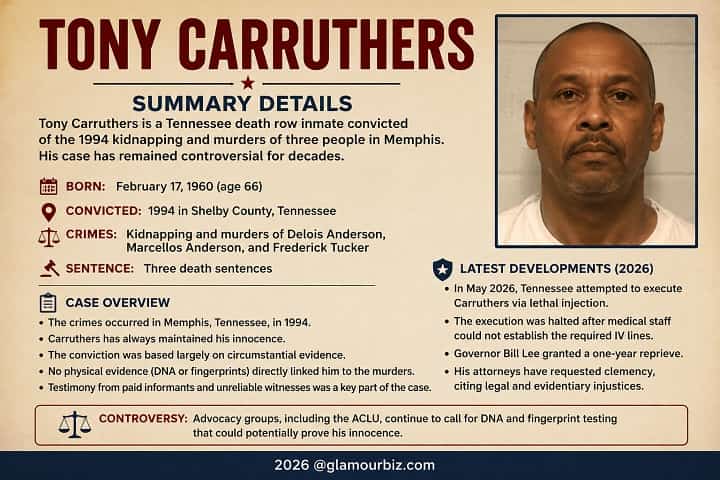
Tony Carruthers, who has been on death row since his 1994 murder conviction, had his scheduled execution halted after defense attorneys raised fresh legal challenges questioning the fairness of his original trial.
Lawyers pointed to inconsistencies in witness testimony, concerns over early investigative decisions, and limitations in how forensic evidence was presented at the time. While none of these arguments have overturned the conviction through years of appeals, a court found enough unresolved questions to pause proceedings.
Carruthers remains in legal limbo as further court review is expected. The case continues to fuel the wider debate over capital punishment, particularly whether decades-old convictions can ever meet the certainty required for an irreversible sentence.
Tony Carruthers' Execution Halted Amid Long-Standing Doubts Over His 1994 Murder Conviction
Few cases in recent memory have refused to stay quiet the way Tony Carruthers' has. Convicted of murder in 1994, he has spent decades on death row and just when proceedings seemed to be reaching their end, his scheduled execution was stopped. For anyone who has tracked this case over the years, the halt felt less like a shock and more like the latest chapter in a story that has never quite found its conclusion.
The conviction itself has always carried an asterisk. From early on, legal advocates and outside observers raised concerns about the trial's integrity, how certain evidence was handled, whether witness accounts were thoroughly tested, and whether the defense mounted at the time was truly adequate. Those concerns never succeeded in undoing the verdict, but they were persistent enough to keep the case alive in appellate courts long after similar ones faded from view.
Tony Carruthers' Execution Put on Hold Amid Renewed Legal Challenges to His Conviction
The most recent halt didn't arrive out of nowhere. Defense attorneys pushed back again, pointing to what they describe as unresolved gaps in the original case, inconsistencies in testimony, questions about early investigative choices, and limits in how forensic evidence was interpreted.
None of this has been enough, across multiple rounds of appeals, to erase the conviction. But in capital cases, even a sliver of procedural uncertainty tends to carry enormous weight. That's exactly what happened here. The legal team argued that irreversible punishment demands more than a verdict that has merely survived review; it demands confidence that nothing significant was missed.
Courts have repeatedly grappled with where to draw that line, and for now, they drew it in Carruthers' favor, at least temporarily. The halt is neither an exoneration nor a signal that the case will unravel. It's a pause, one that places Carruthers back in the familiar limbo he has occupied for much of his adult life.
Questions Over Fair Trial Emerge as Tony Carruthers' Execution Is Delayed
Whenever an execution is delayed at the final hour, it tends to pull a much bigger conversation in its wake. In this instance, attention has shifted back to a question that has shadowed the case from the beginning: did Carruthers receive a genuinely fair trial?
His supporters have long argued that the original proceedings fell short not necessarily because the wrong person was convicted, but because the process didn't fully explore what happened or give the defense a real opportunity to present mitigating factors. That distinction matters. Questioning the fairness of a trial is different from claiming innocence, and it's the kind of argument courts are obligated to take seriously.
On the other side, those who believe the process has run its course point to the decades of appeals as proof that the system has done its job. The conviction has been reviewed, challenged, and upheld more times than most. At some point, they argue, continued review stops being about justice and starts being about delay.
What makes this case so difficult to resolve cleanly is that both arguments have merit. Thirty-plus years have passed since the original verdict. The idea that a 1994 trial is still generating active legal debate in 2026 says something uncomfortable about how justice works or sometimes doesn't when the stakes are this high.
Death Penalty Case of Tony Carruthers Reopens Debate After Execution Halt
The Carruthers case has never been just about one man. Every time it surfaces, it pulls the broader death penalty debate with it. For those who oppose capital punishment, cases like this cut to the heart of the argument against it: a system built on human judgment, fallible evidence, and imperfect procedure cannot be trusted to get every irreversible decision right.
The fact that questions about this conviction still exist after all this time, after all these reviews, is, to them, precisely the point. Those who support the death penalty tend to see it differently. They argue that the system has, in fact, worked and that every concern has been aired, every appeal heard. Indefinite delay, they contend, undermines the authority of the courts and prolongs suffering for the families of victims, who have already waited decades for a resolution.
Neither side is likely to be satisfied by what comes next. Carruthers remains in legal uncertainty, his fate dependent on future rulings and whatever arguments still have room to be made. What's undeniable is that the halt has reignited something that shows no sign of settling: a national conversation about whether the justice system can ever truly know enough to justify a punishment from which there is no coming back.