
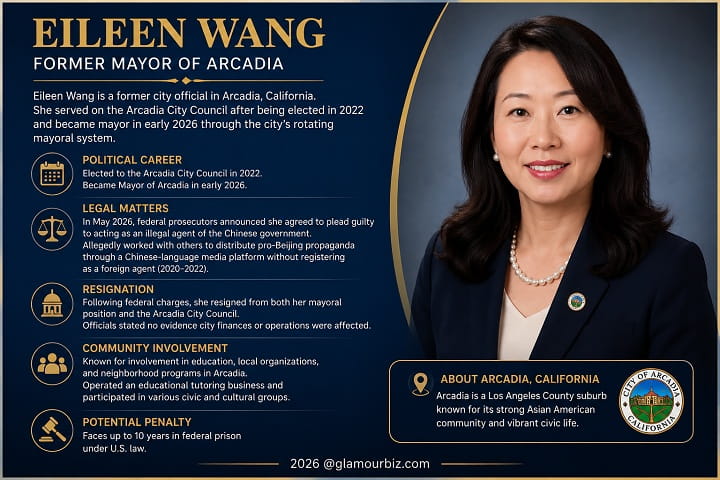
The case involving Eileen Wang highlights concerns over political accountability and possible foreign influence in local U.S. governance. The controversy has raised questions about transparency in public office and the safeguards needed to protect democratic institutions. It also reflects how legal and national security issues can quickly impact municipal leadership and public trust.
Eileen Wang Resigns as Arcadia Mayor After Agreeing to Plead Guilty in Chinese Agent Case
The resignation of Eileen Wang as mayor of Arcadia marked a turning point in a developing legal and political controversy that has captured widespread attention. Reports indicate that her decision to step down followed her agreement to plead guilty in connection with a case involving alleged foreign agent activity.
The announcement sent shockwaves through local governance structures in Arcadia, as Wang had been a prominent figure in city administration. Her tenure was previously associated with municipal development efforts, civic planning, and community engagement initiatives. However, the recent legal developments shifted public focus from her administrative record to questions about legal accountability and political transparency.
While official court proceedings are still unfolding, the resignation itself is being viewed as a major moment in the city’s political history. It also raises broader questions about how local governments respond when elected officials face federal-level investigations involving sensitive geopolitical allegations.
For residents, the sudden departure created uncertainty. Leadership transition processes were initiated immediately, with city officials working to stabilize governance and reassure the public that essential services would continue without disruption.
Legal Fallout Deepens as Federal Authorities Detail Case Against Eileen Wang
As the case progressed, federal authorities began releasing more details that deepened public interest and scrutiny. According to reports, the investigation involves allegations tied to foreign influence operations, prompting discussions around national security protocols and political oversight.
The legal fallout extends beyond the individual case itself. It has raised questions about how local officials are vetted, monitored, and held accountable when engaging in international interactions or policy-related communications.
Legal experts suggest that cases involving alleged foreign agent activity often involve complex layers of evidence, including communications records, financial transactions, and potential coordination with external entities. However, as of now, much of the publicly available information remains part of ongoing legal proceedings, and final determinations have not been fully established in court.
The seriousness of the allegations has intensified media coverage and public debate. Analysts emphasize that cases of this nature often have long-term implications, not just for the individuals involved, but also for political institutions that must reinforce trust and transparency. At the center of the discussion is how governance systems balance openness in global engagement with safeguards against unauthorized influence.
Arcadia City Council Faces Uncertainty After Sudden Leadership Exit
The abrupt resignation of a sitting mayor inevitably creates a leadership vacuum, and Arcadia’s city council has been tasked with managing the immediate aftermath.
Following the exit of Eileen Wang, council members initiated emergency meetings to ensure continuity in governance. Interim leadership arrangements were discussed, focusing on maintaining administrative stability and avoiding disruptions in public services such as infrastructure planning, budgeting, and community programs.
Local governance experts note that sudden political transitions can affect not only administrative workflows but also public confidence. Residents often look to city councils for reassurance during such periods, especially when leadership changes are linked to legal controversies.
In Arcadia’s case, the situation is further complicated by heightened media attention. The council has had to balance transparency with procedural caution, ensuring that statements to the public are accurate while avoiding interference in ongoing legal matters.
Community reactions have been mixed. Some residents express concern over reputational damage to the city, while others emphasize the importance of due process and avoiding premature judgment. Ultimately, the city’s focus has shifted toward restoring stability and preparing for potential future elections or appointments depending on how the legal situation evolves.
China-Linked Espionage Allegations Raise National Security Concerns in Local Politics
Perhaps the most widely discussed aspect of the case involves allegations related to foreign influence and national security. Reports linking the case to possible connections with foreign intelligence activities have sparked broader debate across political and academic circles.
While such allegations remain under legal review, they have already influenced public discourse about the vulnerabilities of local political systems in a globally connected environment. Experts in national security policy argue that even allegations of foreign involvement in local governance can have significant implications, as they may impact public trust and institutional credibility.
The discussion has also extended to how municipalities and local governments interact with international stakeholders, including cultural exchange programs, trade delegations, and diaspora engagement initiatives. These interactions, while often beneficial, can become complex when concerns about foreign influence arise.
Policy analysts suggest that this case may lead to renewed scrutiny of oversight mechanisms, including background checks for public officials, disclosure requirements, and training related to foreign engagement protocols.
Regardless of the legal outcome, the broader conversation highlights a growing concern in modern governance: ensuring that transparency and security coexist in an increasingly interconnected political landscape.
Top 5 FAQs about Eileen Wang
1. Who is Eileen Wang?
Eileen Wang is a former mayor of Arcadia, California, who became the subject of federal investigation linked to allegations involving foreign influence.
2. Why did she resign as mayor?
Reports indicate she resigned after agreeing to plead guilty in connection with a case involving alleged foreign agent activity, though legal proceedings are ongoing.
3. What is the case about?
The case reportedly involves allegations of unauthorized foreign influence or coordination, which is currently under federal review.
4. What happens to Arcadia after her resignation?
The Arcadia City Council has stepped in to manage governance and ensure continuity through interim leadership arrangements.
5. Is the case fully resolved?
No. The case is still part of ongoing legal proceedings, and final judicial outcomes have not been publicly concluded.