
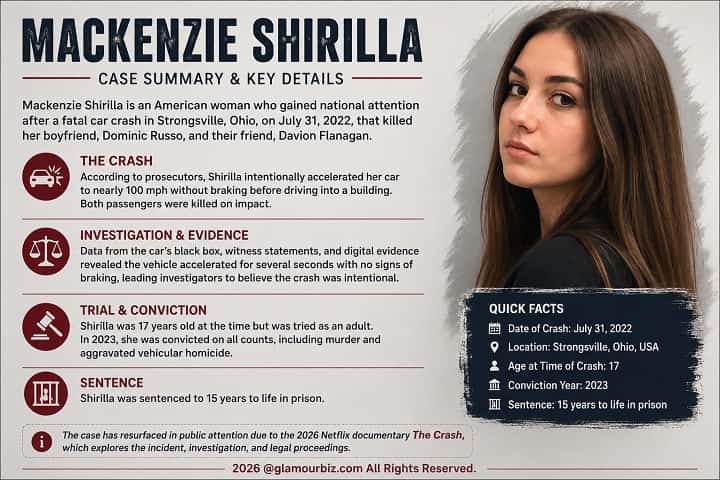
Following Netflix's release of The Crash documentary in May 2026 about the 2022 Mackenzie Shirilla crash case, there was renewed interest in her case, which involved a fatal crash in Ohio that killed Dominic Russo and Davion Flanagan.
As viewers reacted to the documentary, there was a spirited conversation on many social media platforms about whether her crash was an accident or murder. Many people believe the documentary left out important evidence from the investigation and trial that could provide different perspectives on this case (both former inmates and others online claimed the way Shirilla was portrayed in the documentary made her appear less guilty than what they thought about her during the trial.
The murder conviction from court for Mackenzie Shirilla continues to be mentioned on numerous social media platforms, and viewers continue to share their opinions about the narratives provided in the documentary and the conviction from court.
The Crash Reopens a Case That Divided Strongsville
Some narratives will not remain unrevealed. Despite millions of gavel bangs in courtrooms and thousands of denials in terms of appeals, specific case files somehow emerge into public awareness through determined search efforts by investigative journalists or families. Mackenzie Shirilla is an example of such a narrative.
When Netflix released The Crash on May 15, 2026, it did much more than add another True Crime documentary in a very full world of True Crime; it enacted an ignition source (a "spark" since they did so on a "match") for an entire community, which had never fully extinguished, namely Strongsville, Ohio—just south of downtown Cleveland, Ohio. Once again, the small suburban community found itself at the center of a national discussion about intention, mourning, and loss, as well as that of the deeper philosophical consideration of what constitutes a "relationship."
The documentary looks back at what happened on July 31, 2022. It was a summer morning that started like any other but ended in disaster. Shirilla was driving a 2018 Toyota Camry. She was 17 years old at the time. Her boyfriend, Dominic Russo, and their friend, Davion Flanagan, were in the car with her.
They were on their way from a party for a high school graduation. Something changed inside the car. The car started going fast. Almost 100 miles per hour. It did not slow down. Try to avoid anything. It crashed into the side of a brick building. Russo and Flanagan died on the spot. Shirilla lived through the crash.
The documentary shocked viewers, not because of the types of things or facts discussed, but because it provided no easy or tidy way to determine what actually happened or to absolve or blame Shirilla (the driver) for her actions. The director did not have any intention of clearing or convicting Shirilla; what he did was much more uncomfortable and complex than either. He took all of the different pieces of information regarding the case and put them in a way that forces people to contend with the fact that they cannot say with absolute certainty what happened during the last few seconds leading up to the crash.
Both Dominic's and Davion's families have open wounds created by their deaths that will never heal. For Shirilla's parents, Steve and Natalie, they now have yet another chance to argue that their daughter has been severely misrepresented in this incident. And for the entire City of Strongsville, this documentary just reinforces that there are fractures in a community that remain unhealed long after they were created (e.g., "happening to them") and await, in silence, the next time they will occur (e.g. "happening to others").
The documentary started a discussion. This discussion is not about whether someone is guilty or not guilty. It is about how we deal with things that happen. We need to think about how we decide who is responsible and what happened in a town in Ohio. This town is now a place where people are very sad and there is a lot of interest in the true crime story and the internet is talking about it all the time. The documentary is about the tragedy and the true crime fascination and how the internet is affecting the town.
Where Is Mackenzie Shirilla Now?
Mackenzie Shirilla, 21 years old, is currently serving time at the Ohio Reformatory for Women in Marysville, Ohio — approximately an hour's drive from Strongsville, Ohio, where the tragedy began. She is serving two concurrent life sentences with a chance of being paroled in the future, but that date won't be until October 29, 2037; she will be 33 years old at that time.
It has been a complicated process to reach this point. In the case against Mackenzie, the 2023 bench trial in Cuyahoga County lasted several months, and a judge (versus a jury) rendered a verdict finding Mackenzie guilty of murder, felonious assault, and aggravated vehicular homicide. During sentencing, the presiding judge clearly stated that the crash was intentionally caused and not an accident. Therefore, the sentence was viewed by the judge to reflect the intent to commit these acts (in the jury's opinion).
Since then Shirilla's lawyers have tried every way to get her out of this situation. Her appeal was turned down. They also filed a petition to review the case after she was convicted. That got thrown out. In March 2026, the Eighth District Court of Appeals said that the petition was filed late and that was a big setback.
The thing is, three appeals were made and all three were denied. The conviction against Shirilla still stands. It has not changed all. Her legal team have used up all their options. The courts have made it clear that they will not be changing their decision. Shirilla's case is now closed. The conviction is final.
Prison has been where Shirilla has spent most, if not all, of her days creating art through painting and writing in a journal—both art forms that would traditionally be classified as individual activities that possess very little noise when compared to Suzanne's case as of today on the outside with respect to all the noise her case continues to produce on the outside. Her parents have consistent daily contact with her (telephone, online, or otherwise) and continue to be confident in their belief that she is innocent.
The majority of her mother publicly states that she believes Suzanne did not receive a fair trial and points to what she considers poor lawyers representing her daughter. This has been made worse for Steve Shirilla, Suzanne's father, who also agrees with Sue's assessment of her rights but had taken another relatively large step and agreed to be filmed for the Netflix documentary about her case—which has consequences of its own!
What is/was most interesting about the present of this case is the sheer volume of information that now exists to answer questions related to both the actual court record and the public discussion regarding the courtroom statements and convictions. The "courts" continue to continuously reaffirm the original court's ruling, yet the requested answers will continue being important as a result of their presence all around the world.
The major amplification effect of streaming services, social media platform algorithms, and the never-ending appeal that people have for stories that end without clear resolution is primarily a result of this continuing interest to find out the truth.
Why Did the Strongsville Crash Become a Murder Case?
To comprehend why this auto accident has turned into a murder case, we've got to let the actual evidence guide us, rather than emotion, sympathy, or media headlines. We have to analyze the substantial findings found within the wreckage of the auto accident as gathered by investigators on the scene.
The jury in this case was presented a compelling case of extensive and overwhelming evidence supporting the idea that the defendant committed murder by exhibiting extreme indifference/disregard for human life. The prosecution's evidence also established that the defendant exhibited a propensity for aggressive driving (such as speeding) from the time of the crash until he struck the building; thus, the prosecution had more than sufficient evidence establishing a history of reckless behavior on the part of the defendant.
The state did not stop at physics. They made a picture of what was going on between Shirilla and Russo. It was a relationship that was in trouble. The things people said in court and the things they found out showed that Shirilla and Russo were having a lot of problems in the weeks and days before the crash. They looked at what was on media and what people who saw things said and they wrote down things that happened. All of this showed that things were getting worse and worse between Shirilla and Russo.
Two weeks before the car crashed and someone died, Shirilla had said she would crash the car while Russo was in it. Someone saw Shirilla hit Russo when he tried to get out of her car. These things did not happen by themselves. They showed that Shirilla had a reason to do what she did according to the people who were trying to prove she was guilty. The state said that all these things together made sense and showed why Shirilla would do something bad. Shirilla and Russo had a lot of problems. That is what the state was trying to show.
The defense team pushed back at every turn. Shirilla has said many times that she does not remember what happened before the crash. Her lawyers thought maybe she had a medical problem, like POTS, which is a condition that affects your heart rate and blood pressure and can make you dizzy or even pass out. This was an idea but the court did not think it was enough to make them question what really happened.
The defense team just could not get around all the evidence. The accident was not something that happened because someone lost control of the car. It was like the person did not even try to get control back. The judge looked at how fast the car was going, where it was headed and the fact that the person did not try to avoid the accident. The judge also thought about the fact that Shirilla had threatened people before. All these things together made the judge think that Shirilla did this on purpose. Shirilla and her family do not agree with this at all. This is what the legal system has decided three times now.
Fallout Extends Beyond the Documentary
The release of The Crash has had serious effects beyond just social media or streaming queues. In fact, the multiple consequences of the film have reached into real-life situations, real-world jobs, and real families, with far-reaching effects occurring in ways that many people did not expect.
The first person impacted by the repercussions of The Crash was Steve Shirilla. Steve is a teacher who agreed to be interviewed as part of the documentary. In his testimony, he clearly stated that he is a father who loves his daughter absolutely and that he thinks she is innocent, as well as that he feels let down by how the legal system has handled his daughter’s case.
One of the reasons why the movie has hurt Steve, as well as other members of the shooting victims' families, is that several of the families associated with the young men that lost their lives on May 22, 2012, have been filing complaints against Steve for being unprofessional as a teacher, which led to him going on administrative leave when The Crash was released. Steven's situation is a reminder of how fresh and painful the deaths of Ryan Flanagan and Dominic Russo remain for residents of the community where both young men were killed.
The families of Dominic Russo and Davion Flanagan have been affected by the release of The Crash in a different manner than Steve. Dominic Russo's mother gave one of the most emotional victim impact statements during the trial, and she has previously said that her heart has been broken beyond repair. Therefore, no matter the intention of the filmmaker, by releasing the film, all of the grief associated with the loss of her son and friend has now been re-experienced, and all of those people will now have to live out their grieving again in front of an international audience.
The total cultural impact has also been great as well. In May 2026, an ex-inmate, who served time with Shirilla at Ohio’s women’s prison, went viral on TikTok, stating that the representation of the “contrite” Shirilla in The Crash is not an accurate presentation of who Shirilla was at the time they were incarcerated together. Allegations were made regarding social dominance, romantic relationships while incarcerated, and an apparent lack of concern about the severity of her criminal activities. This caused a large amount of debate on social media regarding the authenticity of The Crash, the performances of both women and true crime storytelling and its moral implications.
From all of this, the facts about Shirilla, from a legal perspective, have not changed. She is still convicted. She is still under the same sentence. The courts have consistently rendered the same decision for Shirilla. The “court of public opinion,” however, is not bound by the same rules as the judicial system and as a result, the individual named in The Crash, “Mackenzie Shirilla,” will have her name living on well before her case can be reviewed by any parole board.
The final outcome of this story indicates that the true-crime genre typically does not resolve any matter. Instead, the true-crime genre highlights various topics of interest, generates argument and discussion, creates various types of media in the form of 'clicks,' provides streaming services and generates 'think pieces' about those topics of interest and discussion. However, no amount of time will change the fact that two young men did not return home to their families after that July morning, and no matter how much sympathy the public showed, Mackenzie Shirilla will not change the fact that she was arrested, convicted, and will remain behind bars.
The complete sequence of events from the Strongsville accident has already taken place; two people have died, one man was found guilty of causing the deaths of two people, and the families of those victims are still mourning. Four years after these events, the process is still ongoing for everyone involved, including Shirilla and her family.