
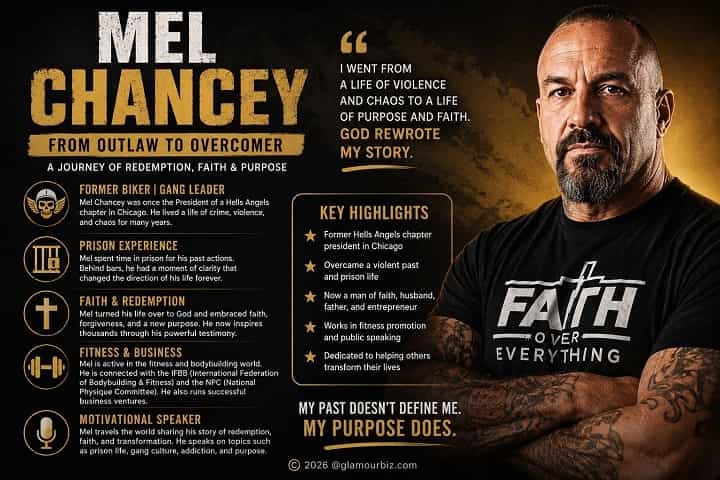
Mel Chancey, once linked to the world of outlaw motorcycle culture, is now drawing attention for a dramatic personal transformation that has taken him far away from his past life.
Mel Chancey was previously associated with discussions surrounding the outlaw biker scene, including groups often connected to the Hells Angels Motorcycle Club, a name long tied to stories of violence, loyalty codes, and organized biker conflicts. However, in a major shift over the years, Chancey has reportedly left behind that lifestyle and rebuilt his identity around discipline, fitness, and faith-based living. His early background—reportedly rooted in a structured Catholic upbringing as an altar boy—adds a striking contrast to his later involvement in the biker world.
Today, he is being discussed more as a figure of transformation than controversy, with his story increasingly framed as one of reflection, personal accountability, and life rebuilding rather than outlaw identity. His journey continues to circulate as a rare example of someone stepping away from a high-risk subculture and redefining their path entirely.
Mel Chancey: The Hells Angels Leader Who Found Redemption After a Life of Violence
Mel Chancey’s life reads less like a straight biography and more like a series of turning points that don’t seem like they belong to the same person. At one point, he was connected to the outlaw biker world—a space built on loyalty, fear, reputation, and strict internal codes. At another, he stepped away from that identity entirely and began rebuilding his life around discipline, fitness, and faith.
To understand his story, you have to understand the environment he was once part of. Outlaw motorcycle culture isn’t just about riding bikes or forming clubs. It’s a closed world with its own hierarchy, expectations, and consequences. Among the most recognized names in that world is the Hells Angels Motorcycle Club, a group often surrounded by allegations of violence, organized crime investigations, and long-standing rivalries with other clubs.
Inside that kind of system, identity becomes something you inherit through association and prove through action. You don’t just “join” a lifestyle—you become part of a structure where reputation is everything. That structure can be attractive to people who feel disconnected or searching for belonging, but it also demands loyalty in ways that are not easily undone.
Mel Chancey’s name has been discussed in connection with that world, and while details about his exact role vary depending on the source, what remains consistent is the narrative of immersion followed by withdrawal. What makes his story stand out is not the violence or the association itself, but the fact that he eventually stepped away from it.
Redemption stories are often oversimplified in public conversations, but in reality, they rarely happen in a clean break. They happen slowly. They happen in stages. And they often come with internal conflict that outsiders never fully see.
For Chancey, that shift eventually led him toward a life centered on physical discipline and personal reflection. Instead of continuing in a world defined by confrontation, he began focusing on structure in a different form—training, routine, and rebuilding identity outside of the biker label. His public persona today is less about who he was and more about what he believes he became through change. Still, the past never disappears completely. It remains part of the story, even when the direction changes.
How a Catholic Altar Boy Became Ensnared in the Outlaw Motorcycle World
One of the most striking parts of Mel Chancey’s story is the contrast between his early life and where he eventually ended up. Before anything related to biker culture, violence, or outlaw associations, he was reportedly raised in a structured Catholic environment. As a young altar boy, his early life was shaped by routine, discipline, and a strong sense of moral instruction. It’s the kind of upbringing that emphasizes order and spiritual guidance.
That makes the shift later in life even more complex to understand. People don’t usually move from structured religious environments into outlaw subcultures overnight. It tends to happen gradually. Small changes in environment, friendships, exposure to different social groups, and personal choices all stack together over time.
The outlaw motorcycle world offers something very specific: belonging. For someone searching for identity, that can be powerful. In that space, you are not just an individual—you are part of a group that operates with its own rules, values, and expectations.
Groups like the Hells Angels Motorcycle Club are often portrayed as tightly bonded communities where loyalty is absolute and hierarchy is clearly defined. That kind of structure can replace uncertainty with certainty, even if the cost is high.
For someone like Chancey, the shift meant moving from a world guided by religious structure into one guided by subcultural rules. Both are systems in their own way—but they operate very differently.
What makes this transition important in understanding his life is not just the change itself, but what it represents: a search for identity. When people feel disconnected from one environment, they often gravitate toward another that offers clarity, even if it comes with risk. Over time, that new environment becomes normal. It becomes home. And leaving it becomes much harder than entering it ever was.
The Dark Reality of Biker Warfare: Bombings, Betrayals, and Federal Crackdowns
Outlaw motorcycle culture has long been surrounded by stories of conflict, and in some cases, those stories are rooted in real and documented history. Biker wars are not random acts of violence. They are usually the result of long-standing tensions between rival clubs, internal disputes over leadership, or betrayals that escalate over time. What begins as personal or organizational conflict can sometimes grow into wider cycles of retaliation.
Within this landscape, groups like the Hells Angels Motorcycle Club have often been mentioned in broader discussions about outlaw motorcycle conflicts, particularly during periods of heightened rivalry and law enforcement scrutiny.
Law enforcement agencies in multiple countries have spent decades monitoring, investigating, and prosecuting organized biker groups. These efforts have included surveillance operations, undercover investigations, and large-scale legal cases aimed at understanding how these organizations operate.
But despite these efforts, the culture itself has proven difficult to eliminate. Instead of disappearing, it has often adapted. Increased pressure from authorities has led to more secrecy, more caution, and in some cases, more fragmentation.
For individuals inside that world, this creates a constant sense of instability. Trust is limited. Relationships are conditional. And the line between loyalty and danger is often very thin. It’s within this kind of environment that many people eventually begin to reassess their choices. Not everyone leaves, but those who do often describe it as a slow realization rather than a single decision.
From Gang Leader to Faith Advocate: Life After the Collapse of the Hells Angels Empire
The later part of Mel Chancey’s story is defined less by what he left behind and more by what he chose to build afterward. After stepping away from the outlaw biker lifestyle, he gradually shifted toward a more structured and reflective way of living. For many people who leave intense subcultures, this stage is not about reinvention for attention—it’s about stability.
Fitness became an anchor. Discipline became a routine. And faith became a framework for understanding the past. This kind of transformation is rarely dramatic in real life. There are no clean breaks or instant reinventions. Instead, it is a gradual process of separating identity from environment. Chancey’s public narrative today often emphasizes lessons rather than glorification. Instead of presenting his past as something to admire, he frames it as something that shaped him but does not define him anymore.
That distinction is important. Many transformation stories fail when they try to erase the past completely. In reality, most people carry their history with them—they just learn how to interpret it differently. In Chancey’s case, his shift reflects a broader human theme: the possibility of change even after years in deeply structured, high-intensity environments. His life today is not positioned as a perfect ending but as an ongoing process of rebuilding.
Top 5 FAQs about Mel Chancey
1. Who is Mel Chancey?
He is a former figure associated with outlaw biker culture who later shifted toward fitness, discipline, and a faith-based lifestyle.
2. Was he part of the Hells Angels?
He has been linked in discussions involving outlaw motorcycle culture and the Hells Angels Motorcycle Club, though detailed official records of rank or membership vary.
3. What was his early life like?
He reportedly grew up in a structured Catholic environment and served as an altar boy before later drifting into biker culture.
4. Why did he leave the biker lifestyle?
His transition appears to have been gradual, driven by personal reflection, lifestyle changes, and a desire to rebuild his identity.
5. What is he doing now?
He focuses on fitness, personal development, and sharing life lessons based on transformation and discipline.