
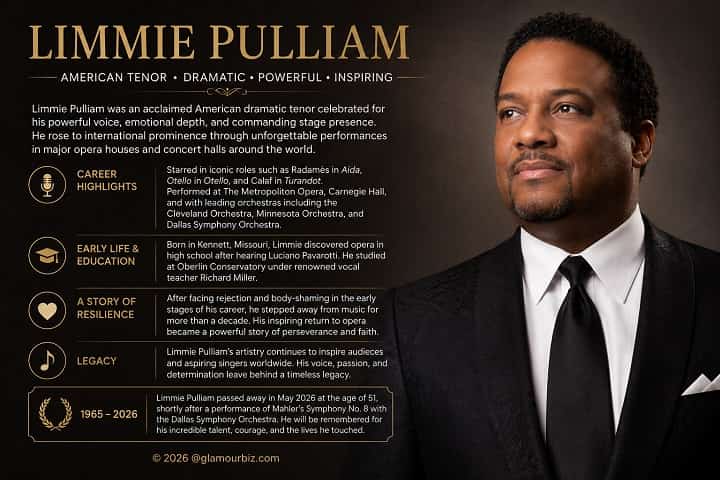
American opera tenor Limmie Pulliam has died at the age of 51 shortly after delivering a powerful performance of Mahler’s Symphony No. 8 with the Dallas Symphony Orchestra. His final appearance earned a standing ovation and marked the peak of a remarkable late-blooming career.
His Last Note: Limmie Pulliam Sang Mahler's Eighth to a Standing Ovation — and Died the Next Day
There's a particular kind of silence that follows a great performance — the kind where an audience holds its breath for just a moment before erupting. Limmie Pulliam knew that silence well. He earned it last weekend at the Dallas Symphony Orchestra, singing the demanding tenor solos in Mahler's colossal Eighth Symphony. The crowd rose. The moment was complete. By Monday night, he was gone. He was 51.
Nobody saw it coming. That's the part that's hardest to sit with. Here was a man who had just given everything on stage — and then, just like that, the music stopped. Pulliam's story was never a straight line. Growing up in Missouri, he found his way to the Oberlin Conservatory of Music in Ohio, where he trained seriously and dreamed of an operatic career. But the opera world can be brutal in ways that have nothing to do with talent.
Directors told him, sometimes in writing, that they'd consider him once he lost 50 pounds. Not after hearing him sing. Just — lose the weight, then come back. So he left. He worked as a debt collector. A security guard. He put the voice away and got on with life.
But voices like his don't stay quiet forever. When he was invited to sing the National Anthem at some political events, something clicked. He could hear it himself — a new depth, a weight to the sound that hadn't been there before. He went back to his studies, and this time, the world paid attention.
In 2022, he debuted with the Cleveland Orchestra and the Metropolitan Opera in the same year. A few months later, Carnegie Hall. The places that once wouldn't return his calls were now rolling out the red carpet.
His cousin remembered him as "Junior" — funny, warm, the kind of person who showed up for people. Musicians who worked with him talked less about the voice and more about the man. That infectious laugh. The way he made everyone around him feel at ease backstage. The Dallas Symphony put it simply: they were honored to share those three performances with him. Three performances. A standing ovation. And then silence — the permanent kind, the one no applause can fill.
Who Was Limmie Pulliam? Inside the Life and Background of the Celebrated Opera Tenor
Limmie Pulliam didn't come from the world of velvet curtains and chandelier-lit opera houses. He came from Kennett, Missouri — a small town where nobody handed you anything. And maybe that's exactly what made him who he was.
From the time he was young, music wasn't just something Limmie did. It was something he needed. Long before anyone gave him a stage, he had a voice that seemed to carry more feeling than a kid his age should reasonably have. People around him noticed. They always notice a voice like that.
He eventually made his way to the Oberlin Conservatory of Music — a serious, demanding place that takes raw talent and asks it to grow up fast. Limmie rose to that challenge. He worked hard, studied deeply, and somewhere in those years of training, the singer he was always meant to be started to take real shape. But then life got complicated. It usually does.
Opera, for all its beauty, can be an unforgiving world. It has expectations — not just about how you sound, but about how you look. Limmie was open about this. He talked honestly about the weight discrimination he faced, about doors that didn't open the way they should have, about the quiet, grinding frustration of being talented and still being passed over. That kind of thing wears on a person.
Eventually, he stepped away. He left the stage behind, not with a dramatic exit, but with the quiet exhaustion of someone who had been fighting for too long. For most people, that would have been the end of the story. It wasn't the end of his.
What happened during those years away from music is, in some ways, the most important chapter of his life. He worked on himself — his health, his sense of worth, his relationship with the very passion that had hurt him. It wasn't quick, and it wasn't easy. But somewhere in that silence, he found his way back to the music. And when he returned, he brought everything those hard years had taught him.
That's the thing audiences felt when they heard him sing. It wasn't just technique. It was lived experience — the particular weight of someone who had lost something precious, fought to reclaim it, and somehow come out the other side more themselves than ever before. People connected with that. Deeply.
Limmie had a gift for being real in an art form that can sometimes feel untouchable. He didn't perform from a distance. He pulled you in. He talked about his struggles without shame, and somehow that vulnerability only made his performances more powerful. You weren't just watching a tenor — you were watching someone's whole story, set to music.
Offstage, he was the kind of person other people gravitated toward. Warm, humble, quick to encourage the younger artists who were just starting out. Fame didn't change him. The people who knew him best made sure to say that.
He died at 51 — too soon, by any measure — in the middle of what had become a genuinely flourishing career. The cruelty of that timing hit his admirers hard. But there's also something right, in a bittersweet way, about how it happened: he was doing what he loved, in front of people who loved him for it.
Limmie Pulliam's life doesn't fit the usual shape of an opera legend. There was no straight line from talent to triumph. There was struggle, silence, a long road back, and then — finally, fully — the music. That's a story worth remembering. Not just for what he achieved, but for the courage it took to keep going when he had every reason not to.
Limmie Pulliam's Opera Career: From Late Breakthrough to International Recognition
Most opera legends have a tidy origin story. Prodigy discovers voice early, gets the right training, lands the right roles, and the rest writes itself. Limmie Pulliam's story didn't go like that. And honestly, that's what made it worth telling.
After Oberlin, he stepped into a world that is far less welcoming than it looks from the outside. His voice was never the question — a dramatic tenor with that kind of raw power and emotional reach doesn't go unnoticed. But opera is a business as much as it is an art form, and the business had opinions about more than just how you sang. It had opinions about how you looked. How you fit. How easily you could be packaged and sold.
Limmie didn't fit the mold they wanted. So they kept him on the edges, and eventually the edges got lonely enough that he walked away altogether. What he did during those years away, the quiet work of rebuilding himself from the inside out, doesn't make the highlight reel. But it made everything that came after possible. When he finally came back to singing, something had shifted. The voice was still there, but now it carried something extra — the particular weight of a person who had been through it and come out the other side. Audiences heard that immediately. You can't fake that kind of depth.
The comeback didn't happen overnight. It built slowly, one performance at a time, until the night at Carnegie Hall changed everything. That concert felt like a statement. Critics who had never seen him before walked out wondering where he'd been hiding. Fans who had followed him for years felt something close to relief. Here, finally, was the recognition he'd deserved all along.
After Carnegie Hall, the world opened up. Engagements with major orchestras followed — the Dallas Symphony, the Cleveland Orchestra, the Minnesota Orchestra, the Baltimore Symphony. Opera companies across the United States and Europe came calling. His repertoire tackled some of the most punishing roles in the tenor canon: Verdi, Puccini, Wagner — composers who ask everything of a voice and settle for nothing less.
Then came the Metropolitan Opera. Radamès in Aida. For any singer, a Met debut is the dream. For Limmie, it was something more personal than that — a kind of answer to every door that had been shut in his face. He walked out onto that stage carrying years of rejection with him, and he turned all of it into music.
Critics reached for words like "power" and "vulnerability" and "emotional honesty." What they were trying to describe, really, was the feeling of watching someone sing like their life depended on it — because in a very real sense, his had.
His final chapter, performing in Mahler's Symphony No. 8, feels almost poetic in retrospect. The "Symphony of a Thousand" is not a piece for the faint-hearted. It demands everything a voice has — stamina, intensity, commitment without reservation. By all accounts, Limmie gave it exactly that. He sang with the kind of full-throated joy that only comes from someone who knows what it felt like to almost never sing again.
He died not long after. Fifty-one years old, at the height of everything he had worked so hard to become. The loss landed hard on people who had followed his journey, because they understood what the journey had actually cost him. This wasn't a career handed to someone talented and lucky. This was something fought for, step by slow step, over years of doubt and silence and quiet stubbornness.
What Limmie Pulliam left behind isn't just a collection of recordings and reviews. It's proof — real, living proof — that the industry's narrow definitions of who deserves to stand on a great stage are wrong. That talent doesn't expire. That coming back after a long absence isn't a weakness in your story. Sometimes it's the whole point of it. For every young singer standing on the outside of a world that hasn't made room for them yet, his name means something. It means keep going.
He Moved Thousands to Tears Onstage — But Who Had Limmie Pulliam's Heart Offstage?
There's a particular kind of performer who can make a concert hall full of strangers feel like they're hearing something meant only for them. Limmie Pulliam was that kind of performer. And yet, for all the intimacy he poured into his singing, the man himself kept his private life quietly, deliberately his own.
He grew up a preacher's kid in Kennett, Missouri — "PK," as he'd later call himself on social media, almost like a badge he wore with affection. That detail matters more than it might seem. Growing up in a preacher's household means growing up around music that isn't performed so much as felt. Sunday mornings in his father's church weren't concerts. They were something closer to confession. That's where Limmie first learned what a voice could do to a room full of people, and that lesson never really left him.
Even after Carnegie Hall. Even after the Met. He still described himself online with the same handful of words — opera singer, recording artist, foodie, former bodyguard, PK — always leading with where he came from rather than what he'd achieved. That tells you something about a person.
As for who he came home to after the curtain fell — that, Limmie kept to himself. In an era when so much of a performer's life gets fed into the machine of public attention, he made a quiet choice to protect something. Whether there was someone who knew the version of him that existed outside the spotlight, someone who sat across from him at dinner after a grueling rehearsal or waited up when flights ran late — he never said. And he didn't owe anyone that.
What's clear is that the people who knew him personally described warmth that had nothing to do with performance. Colleagues talked about his generosity. Younger singers talked about his encouragement. There was a version of Limmie Pulliam that existed entirely offstage, in ordinary moments, and by all accounts that version was just as full of life as the one audiences adored.
His faith ran through all of it like a thread. It wasn't something he wore loudly or used for show — it was quieter than that, more personal. The kind of faith that shapes how a person moves through the world rather than what they post about it. So who had his heart? Maybe that's not quite the right question.
What we know is that he loved his music with everything he had. He loved his faith. He loved the audiences who came back, night after night, to hear something real. And he loved the people in his life enough to shield them from the noise that came with being him. Some people share everything. Limmie Pulliam shared what mattered most—every time he opened his mouth to sing. The rest, he held close. And there's something quietly beautiful about that.