
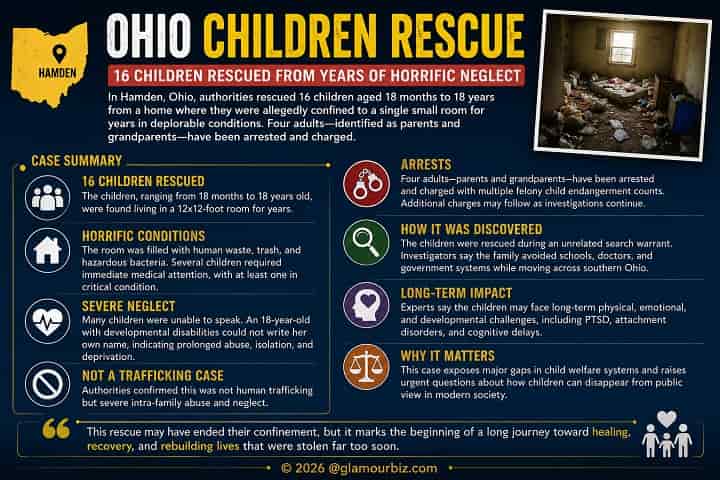
Authorities in Hamden, Ohio, rescued 16 siblings, aged 18 months to 18 years, from a home where they had reportedly been confined to a single small room for nearly four years. The house was found filled with human waste, and several children were unable to speak. Seven were hospitalized in Columbus, two were airlifted to trauma centers, and one remained in critical condition.
Four family members — Gary Siders Jr., Gary Siders Sr., Christina Siders, and Elizabeth Siders — face 16 felony counts each of child endangerment. All pleaded not guilty, with bond set at $300,000 each. Ohio's Attorney General called the case "beyond comprehension," while the county sheriff said the children were kept in worse conditions than livestock. The children are now in state custody as the case proceeds.
Sixteen Siblings Found Confined to One Room for Years in Rural Ohio Home
In the small village of Hamden, Ohio, a place most people outside Vinton County have never heard of, investigators walked into a rundown house on June 30 and found sixteen children living inside. The youngest was about eighteen months old. The oldest was eighteen years. According to authorities, most of them had spent nearly four years confined largely to a single room, roughly twelve feet by twelve feet.
That is a room the size of a small bedroom, holding more than a dozen children of different ages, for the better part of four years. Not a rough month. Not a temporary setback. Years. Hamden sits in Vinton County, one of the poorest counties in Ohio. It is the kind of area where houses can go unnoticed for a long time, tucked along quiet roads with a railroad embankment on one side and thick brush separating neighbors from each other. A family that wants to avoid attention has a real chance of doing so out there, especially if they keep moving.
And officials say this family did keep moving. Investigators believe the family relocated repeatedly over the years, which made it harder for anyone, teachers, doctors, or neighbors, to notice something was wrong. None of the sixteen children were enrolled in school. That detail matters more than it might seem at first. School is one of the main ways society checks in on whether kids are okay. Without it, a family can slip through the cracks for a long time.
When officers finally executed the search warrant, what they found was hard for even experienced investigators to process. The home was reportedly filled with human waste. Some of the children could not speak. One of them, an eighteen-year-old who investigators believe is still developmentally a minor, reportedly could not write her own name. That single fact gives some sense of how cut off these children were from ordinary childhood experiences like school, conversation, and basic education.
Officials have not said exactly how the children were kept in that one room, though they clarified that no cages were found inside the house. Whatever method was used, it apparently worked well enough to keep sixteen children largely confined to a space smaller than most home offices for years without anyone outside the family noticing.
The physical toll became clear almost as soon as the children were removed. Seven were taken to hospitals in Columbus. Two more needed helicopter transport to Level I trauma centers, the kind of facility reserved for the most serious injuries. At least one child was in critical condition.
What makes the timeline especially unsettling is what officials said afterward. Had the search warrant come even a day later, there is a real chance the outcome could have been fatal for one or more of the children. That is not an exaggeration added for effect. It is what officials concluded based on the physical state the children were in when they were found.
The children are now in the temporary custody of Ohio's Department of Job and Family Services, which will handle their care and help decide on longer-term placement as the case moves through the courts. Four adults connected to the family have already been arrested and charged, and the legal process is only getting started. For now, the picture that has emerged is hard to square with everyday life anywhere in the country. Sixteen children. One small room. Four years. And a community that had no idea.
Ohio AG Calls Child Endangerment Case "Beyond Comprehension" as Four Family Members Face Charges
When a state's top law enforcement official struggles to find the right words, it usually means something unusual is going on, even for someone whose job regularly exposes them to hard cases. Ohio Attorney General Andy Wilson addressed reporters this week to talk about the discovery of sixteen children living in conditions he called "beyond comprehension." He was not exaggerating.
According to his office, the investigation had actually been underway for some time before a separate, parallel inquiry led law enforcement to search a home in the village of Hamden, in rural Vinton County. What officers found did not match anything investigators in that part of the state were used to seeing.
Wilson pointed out that Vinton County is among the poorest counties in Ohio, but even accounting for the hardship common to the region, the scene inside that home stood apart. He said the family had been "clearly bouncing around" for years, moving from place to place in a pattern that made it easier to avoid the kind of routine oversight that might have caught the situation sooner.
That constant movement, combined with the fact that none of the sixteen children were enrolled in school, appears to be a big part of why this went undetected for so long. Wilson put it simply: the family was skilled at "keeping these kids out of sight and out of investigative eyes." It raises uncomfortable questions about how many gaps exist in the systems meant to catch situations like this before they stretch on for years.
Four adults have since been arrested and charged. Gary Siders Jr., Gary Siders Sr., Christina Siders, and Elizabeth Siders each face sixteen counts of second-degree felony child endangerment, one count for every child found in the home. The county's prosecuting attorney explained that the felony charges reflect how serious the harm involved was under Ohio law.
All four appeared in court over video this week, and a judge entered not guilty pleas on their behalf. Bond was set at $300,000 for each defendant. None of them had been assigned attorneys as of the hearing, so the legal process is still in its early days. Officials have said more charges could be filed as the investigation continues.
One thing the prosecutor was careful to clarify: despite how shocking the case is, this is being treated as what he called an "intra-family situation," not a human trafficking case. That distinction carries legal weight, even if it does little to soften what investigators described.
Wilson did not hold back when talking to reporters. He called the scene "pure evil," language that is not typical for an official briefing, which usually stays more measured. That he used a phrase like that says something about what his team walked into.
Ohio Governor Mike DeWine also spoke publicly about the case, calling it "tragic" and saying it was heartbreaking to learn about both the conditions the children lived in and the medical issues some of them are now dealing with. He thanked the agencies and medical staff working to help the children recover.
As the case moves forward, attention will likely turn not only to the four people charged but also to the broader systems, school enrollment checks, welfare visits, and community oversight that are supposed to catch situations like this long before they reach this point.
Sheriff: Livestock Treated Better Than Children Discovered in Hamden House
Some quotes stick with people long after a story fades from the headlines. For this case, it is a comparison made by the local sheriff, one so blunt it has been repeated in nearly every report about what happened in Hamden.
Vinton County Sheriff Ryan Cain, describing what his officers found, said that livestock on his own property were kept in better conditions than the sixteen children discovered inside that rural Ohio home. It is not a line meant to be clever or quotable. It is simply the most honest way a longtime rural sheriff could think to describe what he saw.
Cain has spent his career in a county where farming and rural life shape daily routines. For him to draw that comparison is not casual. It reflects real shock from someone who has likely seen a fair share of hard scenes over the years. He called the house "a disgusting scene" and said human waste was present throughout.
According to Cain, the children spent most of their time in a room roughly twelve feet by twelve feet, smaller than many suburban bedrooms, meant to hold sixteen children spanning nearly two decades in age. He said investigators did not find any cages inside, though he did not go into detail about exactly how the children were kept largely confined to that space over the years. Officials say this arrangement continued.
The physical and developmental toll on the children became clear quickly. Some of the kids found inside could not speak at all. One, an eighteen-year-old official believes is still developmentally a minor, could not write her own name. These are not just details of neglect in the ordinary sense. They point to years cut off from the basic building blocks of childhood, conversation, learning, and social contact.
The house sits along a road next to a steep railroad embankment, where freight trains still pass through the small village of Hamden. Neighbors are separated by trees and dense brush, though the home is described as easily visible from the road, a fact that raises its own question about how something this severe continued for years without anyone outside taking notice.
Emergency crews took seven of the children to hospitals in Columbus after the rescue, and two others were flown by helicopter to Level I trauma centers, the highest tier of emergency care usually reserved for the most severe cases. Ohio's Attorney General said at least one child was in critical condition, and officials believe further delay could have been fatal for one or more of the children.
Cain's blunt comparison, livestock treated better than children, has become something of an anchor point for how this story is being told. It is not technical language or a legal description. It is the plain wording of someone trying to explain something almost impossible to put into words for people who were not there.
As the case against the four adults moves through court, that one comparison is likely to remain one of the most repeated lines from the entire investigation, a shorthand for just how far removed conditions inside that house were from anything resembling basic care.
Rescued Ohio Children Hospitalized After Years of Alleged Neglect, One in Critical Condition
For the sixteen children pulled from a rural Ohio home this week, the rescue itself was only the start of a much longer road ahead. Authorities say seven of the children were taken to hospitals in Columbus after the search of the home in Hamden, a small village in Vinton County. Two more needed helicopter transport to Level I trauma centers, facilities equipped for the most severe medical emergencies. At least one child was reported in critical condition right after the rescue.
Ohio Attorney General Andy Wilson did not soften how close this situation came to a far worse outcome. He said that if authorities had waited even one more day before acting, there was a high chance the case would have involved the death of one or more children. That is a heavy statement, and it underscores how deteriorated conditions inside the home had become by the time the search warrant was carried out.
The children, ranging from about eighteen months to eighteen years old, are believed to be from the same family. Officials say most had spent close to four years largely confined to a single small room in the house, an arrangement that appears to have taken a real toll physically and developmentally. Some of the children found inside could not speak. One, an eighteen-year-old considered developmentally still a minor, reportedly could not even write her own name.
These details matter beyond how shocking they are. They point to years without much developmental stimulation, no school, limited social interaction, and very little exposure to the everyday experiences that shape a normal childhood. Officials confirmed none of the sixteen children were enrolled in school, likely a major reason the situation went unnoticed for so long by anyone outside the family.
The children are currently in the temporary custody of Ohio's Department of Job and Family Services, which will oversee their care while the criminal case against four family members moves forward. Gary Siders Jr., Gary Siders Sr., Christina Siders, and Elizabeth Siders have each been charged with sixteen counts of second-degree felony child endangerment, and all four pleaded not guilty during a video court appearance this week. Bond was set at $300,000 per defendant.
Beyond the legal side, the road ahead for the children is likely to be long. Recovering from years of isolation and limited stimulation typically takes sustained medical, psychological, and educational support, not just a single hospital stay. Child welfare experts generally point out that prolonged isolation like this can affect language development and emotional regulation, which is part of why officials have been careful to describe recovery as an ongoing process rather than something already resolved.
Ohio Governor Mike DeWine addressed the case publicly, calling it "tragic" and saying it was heartbreaking to learn both about the conditions the children endured and the medical needs some of them now face. He thanked the agencies and medical teams who responded once the situation came to light.
As of now, the immediate medical crisis appears to have stabilized for most of the children, though officials have not given a detailed update on the child who was listed as critical. What is clear is that the rescue, while urgent and necessary, marks only the beginning of what will likely be years of recovery, medical, emotional, and developmental, for sixteen young people whose early years were shaped by conditions officials have struggled to even describe.