
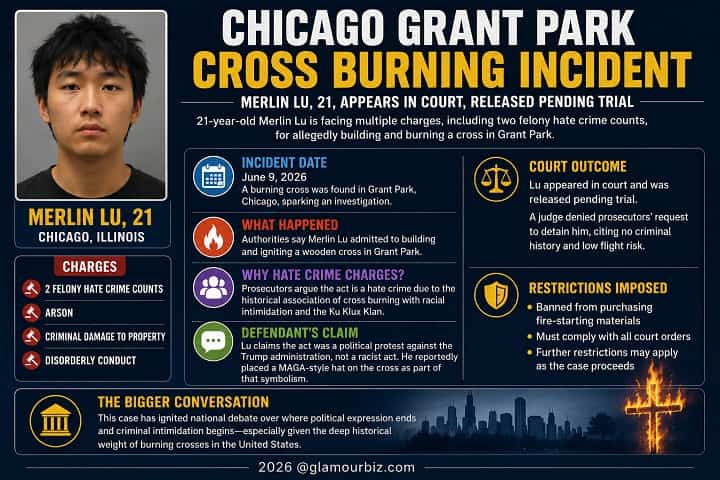
Merlin Lu, 21, faces hate crime and arson charges after allegedly burning a wooden cross in Grant Park. Prosecutors call it an act of intimidation, while Lu claims it was political protest. He was released pending trial under strict court conditions.
Protest or Hate Crime? Naperville Man Burns Cross in Grant Park, Claims It Was an Anti-Trump Message
On a warm Monday afternoon in early June, a wooden cross was set ablaze in the heart of Grant Park, one of Chicago's most iconic public spaces. A passerby caught the moment on video. Within hours, the footage was circulating across social media, sparking outrage, confusion, and a wave of questions that cut straight to the core of how America talks about protest, symbolism, and intent.
The man behind the fire was Merlin Lu, a 21-year-old from Naperville, Illinois. According to prosecutors, Lu brought tools and fire starter to the park, assembled a wooden cross, placed a Make America Great Again hat on top of it, and lit it on fire. When the flames spread to a nearby tree, Chicago firefighters arrived quickly and extinguished the blaze. Lu had already fled the scene.
What made this case immediately complicated was not just what Lu did, but why he claimed to have done it. Prosecutors say that after his arrest, Lu told investigators he set the cross on fire because he believed "the greatest threat to the American people is Trump, Epstein, their billionaire pedophile friends and their Christian nationalist base." In his own telling, this was not an act of hatred. It was a political statement directed at the current administration.
But the law does not always care about intent the way a person might expect. A burning cross, regardless of the message someone claims to attach to it, carries one of the heaviest symbolic weights in American history. It has been used for over a century as a tool of racial terror, deployed by white supremacist groups to intimidate Black communities, Jewish families, and anyone else they considered a threat. That history does not disappear simply because the person holding the match has a different agenda in mind.
Lu was charged with arson and committing a hate crime. The investigation drew in an unusually wide range of agencies, including the Chicago Police Major Crimes Division, the Illinois State Police, the U.S. Marshals, and the FBI. Father Michael Pfleger of St. Sabina Church, a longtime community activist in Chicago, had already offered a $10,000 reward for information leading to a suspect before Lu's identity became known.
The central question now hanging over this case is a difficult one. Can someone co-opt a symbol of racial violence and strip it of that meaning simply by rebranding the message? Or does the act itself carry consequences regardless of the motivation?
21-Year-Old Released After Burning Cross in Chicago Park: Said He Wanted to Warn America About Trump
When Merlin Lu appeared in a Cook County courtroom on a Thursday afternoon, many people expected to see someone held in custody given the weight of the charges against him. Instead, a judge reviewed the facts and reached a different conclusion. Lu was released from custody pending trial under pre-trial supervision level one. The judge cited his lack of criminal history and noted that he did not appear to be a flight risk.
For some, that decision was deeply troubling. For others, it reflected a reasonable application of the law to someone with no prior record. Either way, it set the stage for a legal process that will take months to unfold, with Lu due back in court on June 22.
Lu had been a student at the University of Illinois Chicago before withdrawing from enrollment in the fall of 2025. UIC released a measured statement acknowledging the situation while noting that federal privacy laws and the ongoing criminal investigation limited what the university could say publicly. Students who remained on campus reacted with a mix of curiosity and unease.
"I mean it is obviously a young man that is looking for attention to try to make a point in today's culture," said one UIC alum interviewed outside the campus. That sentiment captured something real about the moment. Lu was 21 years old. He had a strong political viewpoint, a sense of urgency about what he saw happening in the country, and apparently very little consideration for how his chosen method of expression would land.
The MAGA hat placed on top of the cross before it was set alight added another layer to an already complicated picture. Lu clearly wanted the visual to be read as a critique of the Trump administration and what he considered its Christian nationalist foundations. The problem was that the image produced something far more ambiguous. To many viewers, a burning cross is a burning cross, whatever hat sits on top of it.
Released from custody and awaiting trial, Lu now faces not just legal consequences but the broader social reckoning that comes with being at the center of a story this charged. Whether federal charges will follow remains an open question. Prosecutors have not yet indicated which direction they intend to take the case, and the involvement of the FBI suggests that possibility has not been taken off the table.
For the families and communities who have lived with the fear that a burning cross is meant to produce, the explanation that this was a political protest lands with a hollow sound. Good intentions, if that is what they were, do not erase the weight of what was done.
Symbol of Racial Terror Used as Political Statement: Grant Park Cross Burning Suspect Walks Free Pending Trial
There is a reason the burning cross became a hate crime symbol in the first place. The Ku Klux Klan began using it as a form of intimidation in the early twentieth century, and for decades it was used to terrorize communities across the American South and beyond. The image carries a specific and brutal history that is not easily separated from the act itself.
When Merlin Lu reportedly chose the burning cross as his vehicle for political commentary, he either did not fully reckon with that history or decided to ignore it. Neither explanation is particularly reassuring. The law, for its part, does not require that someone act with racial hatred in their heart to be charged with a hate crime. Illinois hate crime statutes are written broadly enough to cover acts that use symbols associated with hatred, regardless of the stated motivation of the person who commits them.
That legal framework is now being tested in a case that sits at an uncomfortable intersection of free speech, symbolic expression, and historical accountability. Lu's defenders might argue that burning a symbol of Christian nationalism alongside a political party's merchandise is a form of commentary, however extreme. His critics would respond that you cannot separate a burning cross from the terror it has historically represented, no matter how you dress it up.
What is clear is that the act produced real consequences in the community. Father Pfleger's $10,000 reward was not the response of someone indifferent to what happened. It was the response of a community leader who understood exactly what a burning cross communicates to people who have lived under its shadow. The fact that the incident took place in Grant Park, a shared civic space in the heart of Chicago, made it feel like a message directed at the entire city, regardless of what Lu claims he intended.
The investigation that followed was thorough and far-reaching. Multiple law enforcement agencies converged on the case quickly. Investigators released surveillance images of a suspect leaving the area near Columbus and Balbo, and it did not take long before Lu was identified and arrested at his Naperville home.
Lu has now walked free pending his trial, a fact that sits uneasily alongside the gravity of what he is accused of doing. The legal system moves slowly, and the presumption of innocence is a cornerstone of how that system is supposed to work. But for the people who saw that video of the burning cross in Grant Park, the slow pace of justice can feel like its own kind of wound.
From Arrest to Release: How a MAGA Hat, a Wooden Cross, and a Match Landed a UIC Student in Federal Crosshairs
The arc of this story, from a quiet June afternoon in Grant Park to a federal investigation involving multiple law enforcement agencies, is a reminder of how quickly a single act can spiral beyond anyone's control. Merlin Lu apparently planned the incident in advance. He brought the materials he needed. He constructed the cross. He placed the hat. He struck the match. And then he ran.
What he did not plan for, it seems, was the full weight of what would follow. Within days of the June 9 incident, the Chicago Police Major Crimes Division, Illinois State Police, U.S. Marshals, and the FBI were all involved in tracking him down. That level of federal and state attention is not typical for a standard arson investigation. It reflects how seriously law enforcement treats cases involving symbols with the specific history that a burning cross carries.
Lu was arrested at his home in Naperville and brought before a judge, who ultimately released him under supervision while his case moves forward. He is facing charges of arson and a hate crime, both of which carry serious potential consequences if he is convicted. The possibility of federal charges adds another layer of uncertainty to a situation that is already legally complex.
His path to this moment is worth considering. A 21-year-old who had attended college in Chicago, who held strong political views about the current administration, and who at some point decided that the way to express those views was to burn a cross in a public park. Whether that decision came from passion, frustration, a miscalculation about symbolism, or something else entirely, it has fundamentally altered the course of his life.
The case is also a lens through which to examine how young people are processing political anger in a moment of intense national division. The frustration that Lu expressed toward the Trump administration is shared by many Americans across various backgrounds. But the method he chose to express it placed him outside any defensible boundary, not because dissent is wrong but because some symbols carry a weight that no individual intent can override.
Lu is due back in court on June 22. The federal question remains unresolved. And in Grant Park, where the cross once burned and the tree was singed before the fire department arrived, life has returned to its ordinary rhythms. The deeper questions this incident raised, about protest, symbolism, history, and accountability, will take considerably longer to settle.