
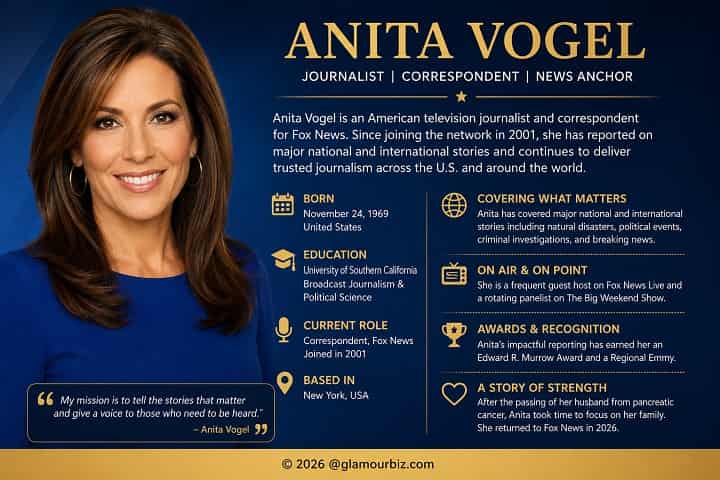
Anita Vogel, longtime Fox News correspondent, returned to The Big Weekend Show in early 2026 after months off air. Her absence followed a brutal 2025: she survived the Palisades Fire in January, then lost her husband, Mark Rozells, to pancreatic cancer in October.
She kept the news private until her return, when she shared a heartfelt message thanking fans and colleagues for their support. Vogel said stepping back into work was part of her healing process, and she hopes to eventually raise awareness about pancreatic cancer.
Anita Vogel's 2026 Comeback: The Story Behind Her Return to the Spotlight
When Anita Vogel walked back onto the set of *The Big Weekend Show* in early 2026, it looked, at first glance, like any other night at Fox News. Same studio lights, same panel format, same easy rapport with co-hosts. But regular viewers who had noticed her absence over the previous months were about to find out just how much had been happening off camera.
The Fox News correspondent had gone through a year most people would struggle to put into words. It started in January 2025, when the Palisades Fire ripped through parts of Los Angeles, forcing families to flee and reducing entire neighborhoods near where Vogel lived to ash. That alone would have been enough to shake anyone. Then, in October of that same year, tragedy struck again. Vogel's husband died after a battle with pancreatic cancer.
For months, none of this made it into the public eye. Vogel kept it quiet, on purpose. There was no press release, no statement rushed out in the immediate aftermath, just a long stretch of silence while the anchor dealt with the kind of grief that doesn't fit neatly into a news cycle. When she finally did return to the desk, Vogel addressed it herself, in her own words, on social media, ahead of that first broadcast back.
"2025 was a heartbreaking and tragic year for our family," she wrote, describing how the wildfire and her husband's death had landed almost on top of each other. Coming back to work, she explained, wasn't just about picking up where she left off professionally. It was part of getting through the grief, a way to find some kind of normal again after a year that had none.
The response was immediate. Colleagues at Fox News posted messages of support, and fans who had watched Vogel on air for years, without ever knowing what she was dealing with at home, flooded her mentions with condolences. Fellow anchor Griff Jenkins called her "one of the most amazing, talented, and kindest people you will ever meet," welcoming her back publicly.
What stands out about Vogel's return isn't just that she came back. It's how she chose to talk about it, briefly, honestly, and without turning her grief into a spectacle. She mentioned wanting to eventually use her platform to raise awareness about pancreatic cancer, a disease that's notoriously hard to catch early and even harder to treat once it's found. For now, though, the comeback itself is the story: a veteran broadcaster picking her career back up while still carrying the weight of everything that happened in between.
Before the Headlines: The Untold Story of Anita Vogel's Early Years
Long before any of the cameras or bylines, there was just a baby girl born in Tarzana, California, on November 24, 1969. Anita Vogel's early life didn't start with much stability. Her father, who was of Eastern European heritage, died when she was still an infant, leaving her mother to raise her alone.
That side of the family carries a story worth telling on its own. Vogel's mother is Armenian American, and the family's roots trace back to a small village called Evereg, in what is now Kayseri Province, Turkey. During the Armenian genocide, her mother's relatives lived through horrors that are hard to fully grasp from a distance: forced conversions, separated families, and a fight just to stay alive. Vogel has spoken about hearing these stories directly from her grandmother, who was only eleven years old when the genocide began and who carried those memories until she passed away in 1999.
Eventually, that side of the family made its way out of Turkey, through Cuba, and finally into the United States, settling first in New York before Vogel's mother later moved the family west to California when Anita was just two. It's not the kind of backstory that shows up in a typical anchor bio, but it clearly shaped how Vogel sees the world, and maybe even why she gravitated toward journalism in the first place. Stories about survival, about ordinary people living through extraordinary hardship, aren't abstract to her. They're family history.
Academically, Vogel found her footing at the University of Southern California, where she studied broadcast journalism alongside political science. It's a practical combination for anyone hoping to cover hard news, and it clearly worked. After graduating, she didn't wait around. She headed straight to Washington, D.C., in 1992, chasing a foothold in national media instead of easing into something smaller and safer. That decision set the tone for everything that came after: a career built on showing up in the room, even when it meant starting at the bottom.
Beyond the Camera: Anita Vogel's Marriage, Personal Loss, and Private Strength
Ask most people who follow Fox News about Anita Vogel's personal life, and they probably won't have much to say. That's by design. Unlike a lot of on-air personalities who share nearly everything, Vogel has always kept her family mostly out of the public conversation.
She married Mark Rozells in 2013. Rozells worked in the hospitality industry as a hotel executive, but beyond that, details about their relationship stayed largely private. No big public wedding reveal, no steady stream of couple content online. Rozells himself mostly avoided social media altogether, appearing only occasionally in photos Vogel posted. The couple went on to have a daughter, Evangeline, whose life has been shielded from public view just as carefully.
That instinct toward privacy became especially important in 2025, when Rozells was diagnosed with pancreatic cancer. Anyone who has watched a loved one go through that diagnosis knows how fast things can spiral, and how little space is left for anything else. Vogel stepped away from her on-air duties to be there for her husband and daughter, choosing family over the demands of a national broadcast schedule without hesitation.
When Rozells died in October 2025, the loss was compounded by everything else that year had already thrown at the family, including surviving a wildfire just months earlier. And yet, when Vogel eventually spoke about it publicly, there was no bitterness in her words, just love and gratitude. "My husband was the best husband and father," she wrote. "Pancreatic cancer is a silent killer."
That single sentence says a lot about who Vogel is outside of the studio. She's not someone who processes grief in public in real time. She waited, she grieved privately, and only when she felt ready did she let people in, briefly, and on her own terms. It's a kind of quiet strength that doesn't always translate well on camera, but it's clearly there underneath the professional composure viewers see every week.
From Breaking News to National Recognition: How Anita Vogel Built a Lasting Media Legacy
Careers in national television news rarely start at the top, and Anita Vogel's is no exception. Her first job in the industry, back in 1992, was as a desk assistant at ABC News in Washington, D.C., working behind the scenes on *This Week with David Brinkley*. It wasn't glamorous work, but it put her inside a national newsroom at a young age, watching how big stories actually got put together.
From there, she worked her way up through a string of local television markets: WJET-TV in Erie, Pennsylvania, WTLV-TV in Jacksonville, Florida, and KCRA-TV in Sacramento, California. These were the years where she actually learned to report, covering community stories and local politics long before anyone outside those markets knew her name. Her work at WJET-TV earned her a Pennsylvania Association of Broadcasters award for Best Documentary, an early hint that she had a knack for storytelling that went beyond just reading headlines.
Everything changed in October 2001, when Vogel joined Fox News. Based out of Los Angeles, she quickly found herself covering some of the biggest and most difficult stories of the decade. She was on the ground for the 2012 Aurora, Colorado, movie theater shooting, one of the deadliest mass shootings in recent American history, and she reported on a house rigged with explosives that caught fire in Escondido, California. These aren't easy assignments. They require a level of composure and sensitivity that not every reporter has.
Her résumé isn't limited to domestic tragedy, either. In 2006, Vogel traveled to Mexico City to cover the country's presidential election, and in 2005, she was in New Orleans reporting live as Hurricane Katrina tore the city apart. She stayed there for two weeks afterward, covering the aftermath as the city tried to figure out what came next. Those two weeks, by most accounts, left a lasting mark on how she approaches disaster coverage even now.
Along the way, she's landed some genuinely notable interviews, including a sit-down with former President Bill Clinton during the Nevada Caucuses that earned her a Golden Mike Award for Best Breaking News Coverage. She's also interviewed the Dalai Lama, which isn't exactly a common line item on most anchors' résumés. Add in an Edward R. Murrow Award and a regional Emmy for Best Newscast, and it's clear she's built a career that goes well beyond just showing up and reading a teleprompter.
More than two decades after joining Fox News, Vogel is still there, still filling in as anchor, still showing up on programs like *The Big Weekend Show*. Given everything she's been through personally in just the past couple of years, that alone says something about how much this work actually means to her.