
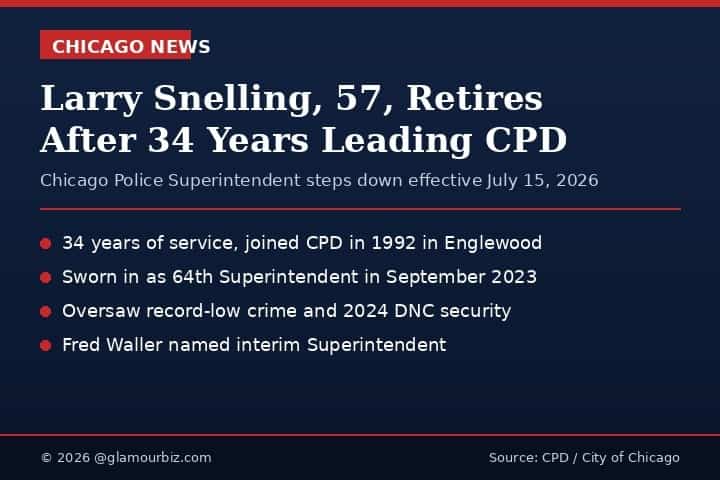
For more than three decades, Larry Snelling has been a familiar face in Chicago’s fight against crime. He started out as a beat cop walking the streets of his own neighborhood. Later, he became the man in charge of the entire police department. This week, that chapter came to a close.
The superintendent announced his retirement, effective July 15 at age 57, closing out a career that began in 1992 and ended at the very top of the city’s law enforcement ranks. His departure has brought a wave of tributes, questions, and a fair amount of speculation about what happens next for a department that has been through reform battles, court oversight, and constant political pressure.
“Son of Englewood” Rises to the Top: A 34-Year Journey from Patrol Officer to Superintendent
Long before he was standing behind a podium at City Hall, Snelling was a 22-year-old rookie walking a beat in Englewood, the South Side neighborhood where he grew up and went to high school. That detail matters. It shaped how people saw him throughout his career, not as an outsider brought in to fix a broken system but as someone who actually knew the streets he was policing because he grew up on them.
The future superintendent graduated from DePaul University before joining the Chicago Police Department in 1992. Like most officers, he started on patrol. But his path over the following decades was far from typical. He made sergeant and served in the 22nd District, then returned to his old stomping ground in the 7th District as a watch operations lieutenant. From there, the promotions kept coming: commander, then deputy chief of Area 2, and eventually chief of the department’s Bureau of Counterterrorism.
Along the way, this officer built a name for himself as a trainer, not just a cop climbing the ranks. He spent years teaching at the Chicago Police Academy, helping shape the tactical training new recruits received. He also redesigned the department’s use of force training model to match national best practices around constitutional policing, and he led field force training ahead of the high-pressure 2012 NATO Summit held in Chicago. On top of that, he became a regular expert witness in federal use of force cases, putting his hands-on experience to work far outside the usual job description of a street cop.
By the time Mayor Brandon Johnson needed a new police superintendent in 2023, this candidate wasn’t a long shot. He was widely viewed as a steady, experienced choice who could rebuild trust in a department still shaken by the rocky tenure of his predecessor, former Dallas police chief David Brown. The Community Commission for Public Safety and Accountability put his name forward as one of several finalists, and Johnson made the final call. In September 2023, the City Council confirmed him in a unanimous vote, making him the CPD’s 64th superintendent.
It’s a career that reads almost like a lesson in loyalty. A kid from Englewood spent 34 years working his way from a patrol car to the top office, never really leaving the department that shaped him, even as he helped reshape it in return.
Record Low Crime, One Big Test: Snelling’s Legacy on Public Safety and the 2024 DNC
If there’s one number his supporters keep bringing up, it’s this: violent crime, including homicides and shootings, fell to historic lows while he ran the department. For a police force that has spent years under fire for public safety failures, that trend line means something, both practically and politically.
When Snelling took the job, he came in with a clear plan. He wanted the department to lean harder on technology to solve crimes faster, and he wanted to fix the low morale and thin mental health support that officers had been dealing with for years. He often talked about leading from the front. His argument was simple: if he expected officers to make sacrifices, he and his command staff needed to show up alongside them, not manage everything from a distance.
Still, the moment most people connect with his time in office is the 2024 Democratic National Convention. Hosting a major political event in a city with a rough history around protest policing (most famously the violent chaos of the 1968 DNC) was never going to be easy. The department worked closely with the U.S. Secret Service to blend local security with federal protection plans, and by the time the convention wrapped up, most people called it a success. Protests stayed largely peaceful, and officers avoided the kind of violent clashes that could have reopened old wounds about how Chicago police handle demonstrations. Mayor Johnson later said that if 1968 became the symbol of police brutality, 2024 would be remembered instead as an example of constitutional policing done the right way.
That said, the job wasn’t without real headaches. The CPD remains under a massive, 700-paragraph consent decree, a court-ordered reform plan that came out of years of documented misconduct and civil rights complaints. Staffing shortages have also been a constant problem. As of late 2024, the department was still short more than a thousand officers, even with recruitment pushes underway. And while homicide numbers dropped overall, mass shootings and other violent incidents have started creeping back up in recent months, which raises real questions about how much of this progress holds up once he’s gone.
Behind the Badge, Behind the Scenes: Tension with Mayor Johnson
In public, Mayor Brandon Johnson and his police superintendent looked like a united team. Johnson called him a proven leader with the experience and respect needed to keep the city safe. Snelling, in turn, regularly gave credit to the mayor’s office for backing his reform work. But behind closed doors, according to several City Council sources, the relationship was a lot more strained than the public statements let on.
Much of that tension reportedly came down to budget decisions. Over his three city budgets, Johnson chose to shrink the police department through attrition rather than direct layoffs, a slower and quieter form of downsizing. That still left the superintendent running a smaller force in the middle of an already serious staffing shortage. Alderman Matt O’Shea, one of the department’s more outspoken allies on the City Council, put it bluntly: he felt Snelling had made the mayor look good on public safety without getting much support in return.
The clearest public flashpoint was the fight over so-called “snap curfews,” a policy he pushed after a wave of large teen gatherings, sometimes called “teen takeovers,” started popping up downtown. Under his plan, police would have had the power to declare a three-hour curfew anywhere in the city with just 30 minutes' notice. City Council passed the measure, but Mayor Johnson vetoed it, and Black community leaders pushed back hard, arguing the plan unfairly targeted Black teenagers, who made up most of the people involved in the gatherings.
His leadership also came under fire from inside the department over questions of representation and management style. In 2025, he demoted First Deputy Superintendent Yolanda Talley, the department’s first Black woman to hold that second-in-command role, stripping her of daily operational duties. That decision drew criticism from Black community groups and media organizations, some of whom had already been pressing City Hall to follow through on promises to remove officers with ties to right-wing extremist groups from the force.
None of this cancels out the goodwill he built during his time in charge. But it does complicate the simple story of a beloved chief riding off into a well-earned retirement. His exit, coming just months before a mayoral election, points to something more layered: a career where real accomplishment and real political friction existed side by side right up until the end.
What Comes Next: Fred Waller, the Search for a Successor, and an Election Year Shadow
With the retirement taking effect July 15, the immediate question is who takes over. For now, that’s Fred Waller, a veteran CPD official who has worked closely with Snelling and who has already held the interim superintendent role once before, after David Brown left in 2023. Waller stepping back into that seat gives the department some short-term stability, but it also raises an obvious question: how long will “interim” actually last?
Finding a permanent replacement falls to the Community Commission for Public Safety and Accountability, the civilian oversight body that vets candidates for the job. Under the current process, the commission will eventually narrow the field down to three finalists and send them to the mayor, who can pick one or reject the whole list and ask for new names. Whoever gets chosen will also need approval from the full City Council before officially starting.
Timing makes all of this trickier. Chicago’s mayoral election is roughly seven months out, so the search for a new superintendent will play out against a backdrop of real political uncertainty. If Johnson loses his re-election bid, whoever gets picked now could end up working for a completely different administration within the year. Some city council members are already asking out loud how long Waller will stay in the interim chair and whether the commission will feel pressure to move fast or take its time given what’s at stake.
For now, the department is left trying to hold onto the gains made under Snelling while going through a leadership change, one that happens to land right as Chicago heads into summer, historically the most violent stretch of the year in the city. Whoever eventually takes the job for good will inherit both the credit built up over the last three years and the unresolved tension that shaped his final months in the role.