
A note on this piece: The facts below are drawn from court filings, attorney statements, and reporting from outlets including Boston.com, ABC News, Fox News, Court TV, and Biography.com. Lindsay Clancy has pleaded not guilty and is presumed innocent; the characterizations of her mental state are contested claims that a jury has not yet ruled on.
Who Is Lindsay Clancy? The Nurse at the Center of One of Massachusetts' Most High-Profile Criminal Cases
Before she became a name attached to one of the most closely watched murder trials in recent Massachusetts history, Lindsay Clancy was, by most accounts, an ordinary working mother building an ordinary life.
Born Lindsay Marie Musgrove on August 11, 1990, and raised in Wallingford, Connecticut, she pursued nursing through an intensive accelerated program at Massachusetts General Hospital. She went on to spend nine years working there as a labor and delivery nurse — a career choice that, in hindsight, strikes many as almost unbearably ironic. She spent her professional life helping other families welcome new children into the world.
In December 2016, she married Patrick Clancy, and the couple settled into a life that friends and family later described as full and happy. They had three children in quick succession: Cora, born in 2017; Dawson, born in 2019; and Callan, who arrived in 2022. Patrick's mother, Susan Clancy, later told a grand jury that Lindsay was a devoted, nurturing mother who "smiled all the time."
That picture began to shift after Callan's birth. Lindsay had experienced postpartum anxiety following the births of both Cora and Dawson, but she had managed those episodes with therapy, exercise, and meditation. After Callan was born in 2022, however, something changed. Her symptoms did not respond the way they had before. Insomnia set in. Racing thoughts followed. According to later court filings and reporting, what began as manageable postpartum anxiety spiraled, over the following months, into something far more severe—a deterioration that would ultimately reshape not just her life, but the lives of everyone connected to her family.
Today, at 36, Clancy is no longer the nurse her former colleagues remember. She is a defendant standing trial for murder and a central figure in a national conversation about how—and whether—the medical system recognizes maternal mental health crises before they turn catastrophic.
Inside the January 2023 Tragedy That Changed the Clancy Family Forever
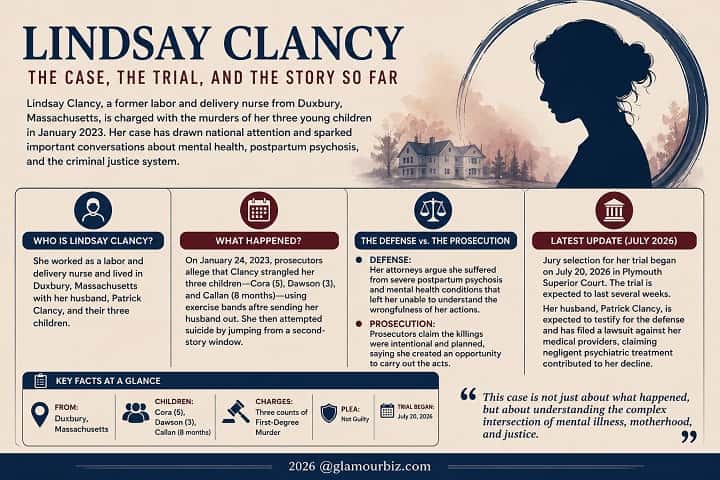
On January 24, 2023, Lindsay Clancy asked her husband to run what seemed, on its surface, like an unremarkable errand: pick up takeout for dinner and stop by the pharmacy. Patrick left their home in Duxbury, a coastal town about 30 miles south of Boston, unaware that he was walking into what would become the darkest day of his family's life.
While he was gone, prosecutors allege, Lindsay used exercise resistance bands to strangle all three of their children — 5-year-old Cora, 3-year-old Dawson, and 8-month-old Callan — inside the family home. Prosecutors have gone further, alleging that she used a mapping app to calculate exactly how long her husband's errand would take, timing her actions so she would have enough time to harm each child before he returned.
When Patrick came home, he found his wife severely injured on the ground outside; she had jumped from a second-story window in an apparent suicide attempt, an act that left her with serious spinal injuries and, for a time, paralysis. His 911 call from that scene — described by prosecutors as capturing a father in shock and agony — is expected to be played for jurors during the trial.
First responders found the three children in the basement, unconscious and showing signs of severe trauma. Cora and Dawson were pronounced dead; Callan, initially reported in critical condition, later died as well. The Massachusetts Office of the Chief Medical Examiner determined the causes of death were asphyxia for the two older children and complications from asphyxia for the youngest.
Clancy was initially treated at a Boston hospital before being transferred for ongoing psychiatric and physical care, at one point being held at a facility where a judge determined she remained at serious risk of harming herself. She was arraigned in October 2023, appearing via video from her hospital bed, on charges including murder and strangulation. A plea of not guilty was entered on her behalf. In the years since, as her physical recovery has continued alongside ongoing psychiatric treatment, the case has moved slowly and painstakingly through the Massachusetts court system — arraignments, competency evaluations, and a series of pretrial hearings — before finally arriving at trial in the summer of 2026, more than three years after that January afternoon.
The Mental Health Debate: Why Lindsay Clancy's Defense Has Sparked National Discussion
What makes the Clancy case unusual, even among high-profile criminal trials, is that there is no dispute over the central fact: both prosecutors and Clancy's own defense team agree that she caused her children's deaths. The entire case instead hinges on a single, far murkier question — what was happening inside her mind when she did it.
Prosecutors, led by attorneys from Plymouth County District Attorney Timothy Cruz's office, argue that the killings were the product of cold, deliberate planning rather than a break from reality. They point to her alleged use of a mapping app to time her husband's absence as evidence of premeditation, describing the acts as carried out "with deliberate premeditation and extreme atrocity and cruelty."
Clancy's defense, led by attorney Kevin Reddington, tells a dramatically different story—one of a woman failed by the very medical system she had spent her career working within. According to court filings, in the roughly four months before the killings, Clancy had been prescribed more than a dozen different psychiatric medications as providers tried, and repeatedly failed, to stabilize her worsening condition. Just weeks before the tragedy, after telling her husband she was having thoughts of wanting to die and experiencing what she described as intrusive thoughts about harming her children, she voluntarily admitted herself to a psychiatric hospital. She was discharged days later with a new antidepressant prescription. According to reporting on her subsequent civil lawsuit, on the day of the killings she reported hearing a voice telling her, in essence, that this was her last opportunity to act.
Both Lindsay and Patrick Clancy have since filed medical malpractice lawsuits against the psychiatric providers who treated her, alleging they misdiagnosed her, failed to recognize bipolar disorder with postpartum onset, and prescribed a shifting cocktail of medications that made her condition worse rather than better. The lawsuits describe a woman who did everything within her power to seek help — visiting emergency rooms, calling crisis hotlines, admitting herself for inpatient care, and repeatedly telling her providers that her symptoms were escalating.
The case has reignited a broader national conversation about postpartum psychosis, a rare but severe condition that can produce delusions and hallucinations in the weeks after childbirth, and about how equipped the American healthcare system is to catch warning signs before they become irreversible. In the years since the killings, the story has prompted extensive social media discussion among mothers sharing their own postpartum struggles, as well as legislative proposals in Massachusetts aimed at strengthening postpartum mental health screening and treatment.
Lindsay Clancy's Trial Begins: What to Expect
More than three years after the deaths of Cora, Dawson, and Callan, Lindsay Clancy's trial is now formally underway. Jury selection began the week of July 20, 2026, in Plymouth Superior Court, with 18 jurors — including six alternates — expected to be seated over several days. The trial itself is anticipated to stretch on for several weeks, with more than 200 potential witnesses on the list, including Patrick Clancy himself.
In the days leading up to trial, prosecutors dropped three strangulation charges against Clancy, citing their redundancy alongside the first-degree murder charges already filed — a procedural move that does not change the core of the case but streamlines what jurors will ultimately be asked to weigh.
Clancy's attorney has been clear that he does not intend to dispute the basic facts of what happened that day. Instead, the defense plans to pursue a not-guilty-by-reason-of-insanity argument, asking the jury to find that Clancy's severe postpartum psychiatric break rendered her legally unable to understand or control her actions. Prosecutors, in turn, are expected to present the case as a calculated act, pointing to evidence they say demonstrates planning rather than psychosis.
Presiding Judge William Sullivan has already ruled on several pretrial disputes, including denying a defense request to split the trial into two separate phases. Patrick Clancy, who has publicly maintained that his wife was failed by her medical providers rather than acting out of malice, is expected to testify, and jurors will hear the harrowing 911 call he made upon discovering his children.
As the trial unfolds over the coming weeks, it is expected to test not only the specifics of Massachusetts' insanity law but also the public's willingness to hold two difficult truths at once: that three children lost their lives and that the woman responsible may have been suffering from an illness that went catastrophically unrecognized until it was too late.