
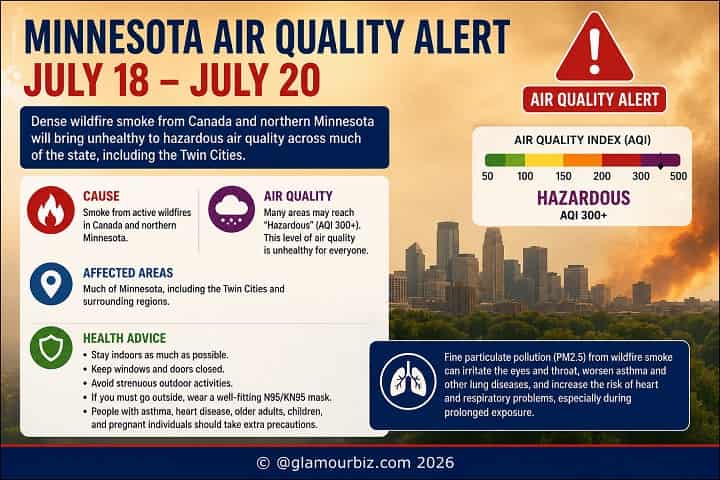
There's a particular kind of unease that settles over a place when the sky turns the wrong color in the middle of summer. Not stormy gray, not the soft haze of humidity, but a dull, ash-tinted orange that makes the sun look like it's being viewed through a welder's mask.
That's the scene playing out across large parts of Minnesota this weekend, as wildfire smoke drifting down from the Boundary Waters Canoe Area Wilderness has pushed air quality into territory that's unhealthy for absolutely everyone, not just the usual at-risk groups. For a state that prides itself on outdoor living, from lake days to evening bike rides, that's a big deal. Here's a closer look at what's happening, why it's happening, what it means for your health, and when things are expected to finally clear up.
Minnesota Air Quality Alert: What's In Effect and Where (July 18–20)
The Minnesota Pollution Control Agency didn't mince words when it issued its latest air quality alert. Starting at 2 p.m. on Saturday, July 18, and running through 2 p.m. on Monday, July 20, a wide swath of the state is under advisory: east central, southeast, south central, and northeast Minnesota.
That's not a small pocket of the map. It stretches from river towns like Winona and Albert Lea in the south, up through the Twin Cities' outer edges, and all the way north to Duluth, Ely, and the shores of Lake Superior. Tribal Nations including Prairie Island, Grand Portage, and Fond du Lac are also named in the alert, along with cities like Rochester, Hibbing, and Two Harbors.
What makes this alert stand out is the severity classification attached to it. The affected areas are expected to sit in the red category on the Air Quality Index, which is the tier reserved for conditions considered unhealthy for the general population, not just people with asthma or heart conditions. Usually these advisories single out sensitive groups. This one applies the caution to everybody.
It's worth remembering that air quality alerts like this aren't unusual for Minnesota in recent summers, as smoke from both local and Canadian wildfires has become something of a recurring visitor. But the scale of this particular event, both in geography and in how many people it touches, has made it one of the more attention-grabbing advisories of the season so far.
Why the Smoke Is So Bad: Inside the Boundary Waters Wildfires
To understand why the sky looks the way it does right now, you have to rewind to July 6. That's when a dry thunderstorm rolled through northern Minnesota and unleashed more than 1,000 lightning strikes across the region. Dry thunderstorms are the kind that produce plenty of electrical activity but little to no rain, which makes them notoriously good at sparking fires and notoriously bad at helping put them out.
In the days that followed, numerous fires broke out across the north woods. Some were caught and contained relatively quickly by ground crews. Others, fueled by dry vegetation and unpredictable wind patterns, kept growing. As of the latest reporting, the cumulative damage has topped 70,000 scorched acres, much of it within the Boundary Waters Canoe Area Wilderness, one of the most beloved and heavily visited wilderness regions in the country.
Firefighting agencies haven't been sitting on their hands. Additional resources have been funneled into the region, including engine crews, aerial support, and personnel brought in from outside the immediate area to relieve exhausted local teams. Progress has been made in certain pockets, particularly where recent rain and shifting winds gave crews a window to get ahead of the flames. But wildfires of this scale rarely resolve in a matter of days, and the smoke plumes they generate can travel far beyond the fire line itself, which is exactly what's happening now as that smoke drifts south and east into more densely populated parts of the state.
Health Risks and Safety Precautions During the Smoke Advisory
Wildfire smoke isn't just an inconvenience for visibility. It's a genuine health hazard, and the fine particulate matter it carries is small enough to slip deep into the lungs and even the bloodstream. The Minnesota Pollution Control Agency has been direct about what residents might experience, noting that anyone could develop irritation in the eyes, nose, and throat, along with coughing, chest tightness, or shortness of breath.
For people who fall into higher risk categories, meaning those with asthma, COPD, heart disease, or other pre-existing conditions, along with older adults, pregnant women, and young children, the stakes climb even higher. Prolonged exposure to smoke this thick has the potential to trigger more serious complications, including asthma flare-ups, heart attacks, or even strokes in vulnerable individuals.
So what should people actually do about it? The guidance is fairly consistent with past smoke advisories, but it bears repeating because it's easy to underestimate just how much cumulative time spent outside can add up over a weekend. Everyone in the affected areas is being urged to cut back on prolonged or heavy exertion outdoors. That means postponing that long run, mowing the lawn another day, or moving a workout indoors if possible. Sensitive groups are being told to go a step further and avoid extended time outside altogether during the worst stretches of smoke.
There are some simple, practical steps that tend to help during events like this. Keeping windows closed, running air conditioning or an air purifier if one is available, and checking in on elderly neighbors or family members who might not be tracking the news as closely are all reasonable moves. If you notice a persistent cough, tightness in your chest, or unusual fatigue, it's worth taking that seriously rather than pushing through it.
When Will the Air Clear? Regional Timing and Forecast Outlook
Here's where things get a little more nuanced, because not every part of the alert zone is expected to clear at the same pace. The timeline actually varies quite a bit depending on where you are in the state. In northeast Minnesota, heavy smoke is expected to hang around through Sunday morning. Relief is on the way in the form of increasing southwesterly winds Sunday afternoon, which should help push a lot of that haze out and noticeably improve conditions for much of the region.
That said, areas closer to the shoreline of Lake Superior, along with communities sitting near the active fire zones themselves, may not get that same reprieve and could continue dealing with poor air well into the afternoon. The alert covering northeast Minnesota is currently set to expire around 7 p.m. Sunday, though some lingering, localized smoke wouldn't be a surprise even after that.
Meanwhile, the story looks a bit different for southeastern and far eastern central Minnesota. Smoke is expected to move into those areas early Sunday morning, essentially arriving just as the northeast starts to see improvement. For residents in that part of the state, unhealthy air is expected to persist all the way through Monday morning, meaning the full brunt of the advisory period applies there.
In short, this isn't a single wave that rolls through and exits on the same schedule everywhere. It's more like a slow-moving curtain, lifting in one region while settling in on another. Anyone with weekend plans, whether that's a lake trip, a youth sports tournament, or simply mowing the yard, would do well to check localized conditions rather than assuming the whole state is on the same clock.
For now, the safest bet across most of Minnesota is to treat this weekend the way you might treat a heat advisory: plan around it, keep outdoor exertion light, and don't be shy about heading indoors if your eyes start to sting or your chest feels tight. The wildfires themselves are still an active situation, and until containment improves and winds shift more favorably, smoky skies are likely to remain part of the forecast for at least a little while longer.