
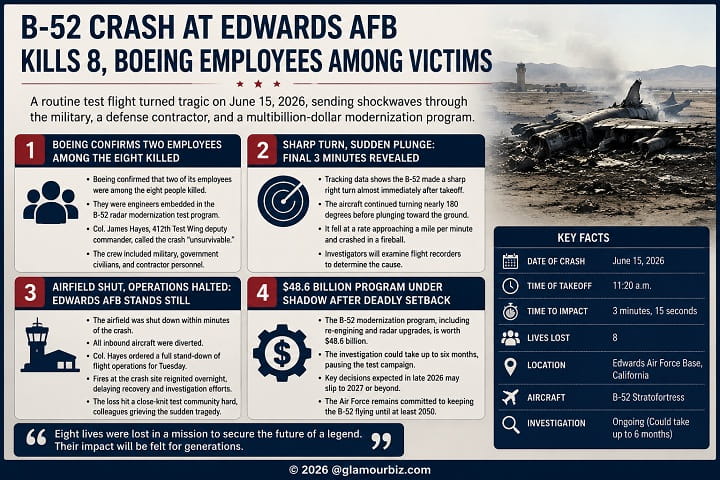
Monday, June 15 2026, started like any other morning at Edwards Air Force Base. Test crews checked their schedules. Engineers reviewed pre-flight data. The Mojave Desert sun was already climbing over the runway.
By 11:20 a.m., a B-52 Stratofortress lifted off for what was logged as a routine test mission. Three minutes and fifteen seconds later, it was gone, and with it, eight lives that no investigation report will ever fully account for. What followed was a cascade of grief, questions, and consequences that touched a defense contractor, a military community, an airfield, and a multibillion-dollar program all at once.
Boeing Confirms Two Employees Among the Eight Killed in Edwards AFB B-52 Test Flight Disaster
When Boeing released its statement on Monday evening, it was brief and carefully worded, the kind of language that corporate communications teams craft when the truth is too heavy for a press release to carry. Two of the company's employees were among the eight people killed when the B-52 went down. The company offered its deepest condolences and pledged full cooperation with the investigation. And then, largely, it went quiet.
What the statement did not say, and could not say, was who those two people actually were. They were not passengers riding along to observe. They were not visitors on a field trip to a famous air base. They were engineers embedded in a test program they had likely spent years helping to build, working on an aircraft they probably understood better than most people know their own professions.
Boeing has been central to the B-52's radar modernization effort, delivering a newly equipped aircraft to Edwards in 2025 for a full year of rigorous flight evaluation. Their people were on that plane because the mission required people who understood the technology from the inside, who could spot a problem in real time, who knew which data points mattered and why, and who simply could not do that work remotely from a ground station.
Col. James Hayes, deputy commander of the 412th Test Wing, described the crew at his afternoon briefing as a mix of uniformed military, government civilians, and government contractors. He said the crash was unsurvivable after reviewing footage of the impact. He said they had lost eight great Americans. He did not separate them by employer or title, and he was right not to. Whatever the organizational chart said, they were all there doing the same thing, pushing a seventy-year-old aircraft toward its next chapter, and they all paid the same price.
Sharp Turn, Sudden Plunge: Flight Data Reveals Final 3 Minutes of Doomed B-52 Mission
The tracking data that became available the following day is limited, as flight data near a military base often is. But what it shows is striking enough that investigators will spend months working to explain it. According to AirNav Systems, the B-52 made a sharp right turn almost immediately after takeoff, not a gradual bank, but a hard deviation from any expected departure path. It continued turning until it had nearly completed a full 180-degree arc. And then it fell at a rate approaching a mile per minute, until it struck the desert floor and exploded in fire.
Three minutes and fifteen seconds from wheels up to impact. In aviation terms, that is almost nothing. In human terms, it was everything. That initial sharp turn is what investigators will examine most carefully. In the immediate post-takeoff phase, a large bomber like the B-52 is at its most vulnerable. It is heavy with fuel, still gaining airspeed, and close to the ground. A sudden hard reversal in this environment could mean the crew recognized an emergency and attempted to turn back to the runway, or it could mean the aircraft was already starting to slip beyond controlled flight.
Either scenario is serious. Attempting a 180-degree return to the field in a heavy aircraft at low altitude is one of the most dangerous decisions a crew can face, because the margins for error disappear almost instantly once the bank begins. Whether the crew made that call deliberately or whether the aircraft was already taking that decision out of their hands, only the flight data recorders, assuming they survived the fire, will be able to say for certain.
Airfield Shut, Operations Halted: Edwards AFB Grinds to a Standstill Following Monday's Fatal Crash
Edwards Air Force Base does not stop easily. It is built around continuous, high-stakes flight operations, with aircraft cycling through at all hours and engineers working across shifts. The entire institution is calibrated to a pace of activity that rarely breaks. On a normal day, test missions launch multiple times before noon. Monday broke that rhythm hard.
The airfield closed within minutes of the crash. Inbound aircraft were diverted. Col. Hayes announced a full stand-down of all flight operations for Tuesday. Fires at the crash site reignited overnight, keeping recovery teams from entering the wreckage for hours and slowing the early stages of physical evidence collection. By the following morning, crews were still working to make the area safe enough for investigators to begin their work on the ground.
The stand-down was more than procedural caution, though it was certainly that too. In a world as specialized and close-knit as military flight testing, eight deaths are not an abstraction. They are colleagues, familiar faces, and people who shared briefing rooms, hangar floors, and the same worn coffee machine. A community that small does not absorb loss from a distance. It feels it immediately and personally. Telling people not to fly on Tuesday while they were still processing what happened on Monday was not a sign of weakness. It was, by any honest measure, the only sensible thing to do.
A $48.6 Billion Upgrade Program Now Under Shadow: B-52 Modernization's Future Questioned After Deadly Setback
The Air Force has committed to keeping the B-52 flying until at least 2050, nearly a century of continuous service for an aircraft first designed in the late 1940s. Anchoring that commitment is a re-engining initiative worth $48.6 billion, alongside the radar modernization program that Monday's flight was directly supporting. It is a massive bet on an airframe that stopped being manufactured in 1962, grounded in a simple and uncomfortable truth: nothing currently in production can replace what the B-52 provides at the range, payload, and operational cost it delivers today.
That program is now on pause. The investigation could take up to six months. Until the cause of the crash is established and investigators determine whether the experimental radar hardware on board played any role, the test campaign cannot responsibly move forward. Production decisions expected in late 2026 may slip to 2027 or beyond. Contractor staffing, supply chain schedules, and congressional budget assumptions will all need to be recalibrated.
The program will survive. The strategic logic behind it has not changed, and the Air Force's commitment to the B-52 is not the kind of thing that bends under a single accident, however devastating. But it will continue carrying something new, the memory of eight people who were part of building it and did not live to see where it lands. The road to 2050 now runs through June 15, 2026, and no modernization plan will ever reroute it around that morning.