
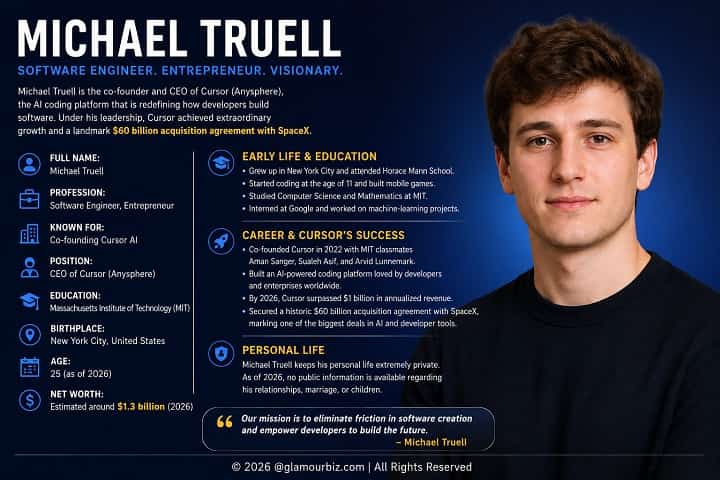
SpaceX just made a huge move that has nothing to do with rockets. On June 16, 2026, it announced it's buying the AI coding startup Cursor, along with its parent company Anysphere, in an all-stock deal worth $60 billion, a massive number for a four-year-old company.
Cursor started as a coding assistant built by a few MIT dropouts and grew into something Nvidia and Salesforce now rely on daily, pulling in nearly $3 billion a year. Rather than just pay a $10 billion fee to collaborate, SpaceX bought the whole thing outright, folding it in alongside sister company xAI, and turned Cursor's 25-year-old CEO, Michael Truell, into one of the youngest self-made billionaires around.
Who Is Michael Truell? Inside the Early Life of the MIT Dropout Turned AI Billionaire
Every so often, someone comes along in tech who makes you stop and think, "wait, how old is this guy again?" Michael Truell is one of those people. While most founders spend years grinding through corporate jobs before they even think about starting a company, Truell skipped most of that and went straight for it.
He grew up in New York City, and from what people who knew him back then say, he was into computers way before it was cool to call yourself a "tech kid." Teachers and friends noticed he had a knack for this stuff early on. Like a lot of programmers-in-the-making, he spent a ton of time just messing around with code, building random little projects, and figuring out how software actually solves problems instead of just reading about it.
That curiosity eventually got him into MIT, which, let's be honest, isn't easy for anyone. Getting in says a lot about how hard he'd worked and how much he wanted to push himself. Once he was there, he dove into computer science and math, surrounded by people who were just as obsessed with building things as he was. MIT has a way of throwing smart, ambitious people together, and for Truell, that environment ended up mattering more than any single class he took. It's where he met the people who'd later become his co-founders.
Truell isn't the type to overshare. He's kept his family life and personal background pretty private, and there isn't much public info about his parents or upbringing. But whatever that upbringing looked like, it clearly gave him the kind of discipline and curiosity that doesn't show up overnight.
As AI started reshaping entire industries, Truell saw something a lot of people hadn't quite connected yet. He didn't just want to watch the change happen from the sidelines; he wanted to be the one building it. That instinct ended up shaping pretty much everything that came next.
From Classroom to Cursor: The Bold Decision That Changed Michael Truell's Future
For most people, getting into MIT feels like the finish line after years of hard work. For Truell, it turned out to be more like the starting block. While he was there, he met Aman Sanger, Sualeh Asif, and Arvid Lunnemark, and the four of them clicked over a shared obsession with AI and how it could change software development. As large language models started getting genuinely useful, they began wondering, "What if coding could be way faster and less painful with the right AI tools?"
They quickly picked up on something most developers were already feeling. Writing code involved a lot of repetitive, tedious work, and the tools available at the time only solved part of the problem. The group felt like they could build something better.
So in 2022, they did something pretty drastic. Instead of finishing up their degrees and going the safe route, they dropped out of MIT to build their own thing full-time. That "thing" became Cursor, an AI-powered coding tool built to help developers write and understand code faster, built under a company called Anysphere.
Walking away from MIT wasn't a small decision. Most startups fail, and the AI space was only getting more crowded and competitive. But the four of them were convinced they were onto something real, and it turned out they were right. Cursor caught on fast. Developers liked that it actually made their workflow smoother instead of just being another flashy AI gimmick, and that combination of solid tech with an interface people didn't hate using set it apart from a lot of competitors.
As more people started using it, investors started paying attention too. Funding rounds came in, the team grew, and what had started as a side project between college friends turned into one of the most talked-about companies in AI. None of that happens by accident. Building something at that pace takes more than a good idea; it takes the ability to keep a team together and make smart calls when things get chaotic. Truell seemed to handle that part just as well as the technical side.
Is Michael Truell Married? A Look at His Relationship Status and Private Life
Truell's work is public knowledge at this point, but his personal life? Not so much. Unlike a lot of founders who post their whole lives online, he's kept things close to the chest. There's no confirmed info out there about a wife, a partner, or anything like that.
That kind of privacy is honestly pretty rare these days, especially for someone running a company this high-profile. It seems like he's just drawn a clear line between his work life and everything else. Sure, people speculate online sometimes, but nothing about his dating life has ever actually been confirmed by a credible source.
A lot of people assume that building Cursor simply hasn't left much room for anything else. Scaling a company that fast tends to eat up basically all of someone's time and energy. Outside of work, he's probably into the usual stuff a lot of founders are: tech, AI research, that kind of thing, but he doesn't really talk about hobbies or his personal life publicly.
That mystery has actually added a bit of intrigue to his public image. It's an interesting contrast: people know exactly what he's built, but almost nothing about who he is outside of it. And honestly, that seems to be exactly how he wants it. His reputation is built on what he's accomplished, not on being a public personality.
Building a Multibillion-Dollar AI Company: Michael Truell's Career, Net Worth, and the SpaceX Deal
Not many founders get to watch their company grow as fast as Truell has with Cursor. In just a few years, it went from a scrappy idea between college friends to one of the most influential names in AI. The reason it worked is pretty simple: it actually made developers' lives easier, and that resonated with both individual coders and big enterprise teams.
As more companies adopted it, Cursor hit milestones that usually take other startups a decade to reach. Revenue climbed fast, big enterprise clients signed on, and the company's valuation kept jumping. Then came the moment that really put Truell on the map: SpaceX agreed to acquire Anysphere, the company behind Cursor, in a deal valued at around $60 billion, paid out in SpaceX stock.
It's one of the biggest acquisitions in AI startup history, and for Truell, it was basically the payoff for years of risk and grinding. At 25, he's now one of the youngest self-made billionaires out there, with his stake in the company putting his net worth at roughly $1.3 billion.
People in the industry see the deal as a smart move for SpaceX too, one that could strengthen its AI capabilities well beyond just coding tools. It says a lot about how central AI has become, not just in software but in fields like aerospace and advanced computing that you wouldn't necessarily expect.
At this point, Truell's name carries real weight in the tech world, and he's still only in the early chapters of his career. What he's built already says a lot about what happens when someone combines genuine technical skill with a willingness to take a real risk. Whatever he does next, it's safe to say people are going to be watching closely.