
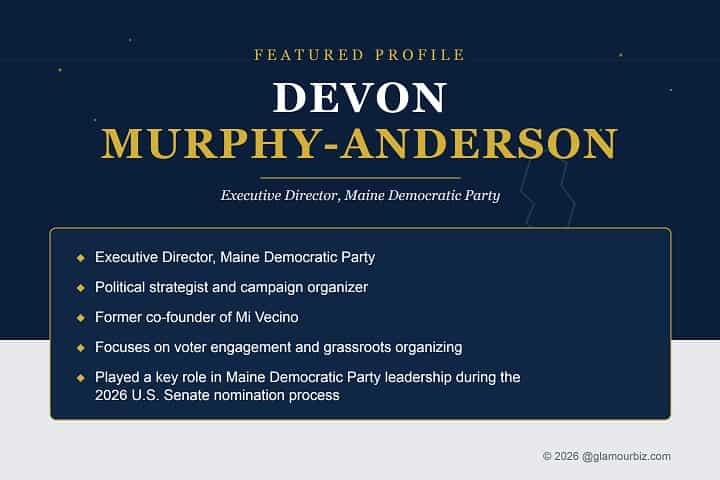
As Graham Platner exits Maine's 2026 Senate race amid controversy, Executive Director Devon Murphy-Anderson has emerged as the steady hand guiding the party through an unprecedented 600-delegate convention to choose his replacement.
The former Mi Vecino co-founder and Florida Democratic Party finance veteran is now at the center of one of the nation's most closely watched Senate battles against Republican incumbent Susan Collins.
Who Is Devon Murphy-Anderson? The Political Strategist Behind Maine Democrats
If you have followed Maine politics even loosely over the past year, chances are you have come across the name Devon Murphy-Anderson. As Executive Director of the Maine Democratic Party, she sits at the center of one of the most closely watched state party operations in the country, especially as Maine prepares for a pivotal U.S. Senate contest against longtime Republican incumbent Susan Collins.
But Murphy-Anderson is not a typical party insider who rose through the ranks of committee meetings and fundraising dinners alone. Her path into politics has been shaped by hands-on organizing, financial stewardship during turbulent times, and a personal history rooted in Maine's working coastline. Long before she was issuing statements about Senate nomination processes, she was hauling lobster traps on her father's boat in Casco Bay.
That blend of blue-collar upbringing and high-level political strategy is part of what makes her an interesting figure to profile right now. She represents a newer generation of state party leadership: pragmatic, media savvy, and unafraid to speak bluntly when she believes the integrity of a political process is at stake. In recent weeks, she has done exactly that, publicly pushing back against attempts by a Senate campaign to influence how the party selects its next nominee.
Understanding who she is means looking beyond her current title. It means tracing how a young woman who once ran her own small fishing business ended up managing multimillion-dollar fundraising operations, co-founding a voter engagement nonprofit in another state, and eventually returning home to lead her home state's Democratic Party through one of its most turbulent election cycles in recent memory.
From Grassroots Organizing to Statewide Leadership
Murphy-Anderson's professional story did not begin in a state party headquarters. It began in the kind of unglamorous, door-knocking, phone-calling work that most political operatives cut their teeth on. After finishing her studies at Guilford College in North Carolina, she moved directly into campaign work, starting as a finance director on a congressional campaign in New York back in 2018.
From there, her career took a significant turn when she joined the Florida Democratic Party as finance director in December 2019. It was a demanding stretch. The 2020 election cycle arrived in the middle of a global pandemic, and state parties across the country were forced to rethink how they raised money and organized supporters almost overnight. Despite those obstacles, Murphy-Anderson is credited with helping raise a record-breaking amount of money for the Florida Democratic Party during that cycle, a notable achievement given how disrupted traditional fundraising channels were at the time.
After her tenure with the Florida party wrapped up in 2021, she did not step away from the work of voter engagement. Instead, she helped launch something new. Alongside co-founder Alejandro Berrios, she started Mi Vecino, a nonprofit focused on registering and engaging Hispanic and Latino voters in Florida. The organization distinguished itself by operating year round rather than only ramping up activity during election season, a model that was relatively uncommon at the time. Mi Vecino built a reputation for direct, face-to-face conversations with voters, particularly in communities that had often been overlooked by traditional campaign outreach.
The organization expanded its footprint over time, opening offices in areas with large Puerto Rican and broader Hispanic populations and eventually growing its work into other states as well. It also became a vocal critic of legislative changes in Florida that organizers argued made voter registration more difficult for communities of color. Through Mi Vecino, Murphy-Anderson built a track record not just as a fundraiser, but as someone capable of building an organization from the ground up and sustaining it through a politically hostile environment.
That grassroots credibility followed her back to Maine. When the Maine Democratic Party announced her as its new executive director, party leadership pointed specifically to her combination of Maine roots and deep, on-the-ground political experience as a reason for the hire. It was framed as a return home for someone who had proven she could organize communities and manage serious money, two skills that translate directly into running a state party apparatus.
Devon Murphy-Anderson's Role in Maine's 2026 Senate Race
Nowhere has Murphy-Anderson's leadership been more visible than in the unfolding drama surrounding Maine's 2026 U.S. Senate race. The contest was already shaping up to be one of the most consequential in the country, with Democrats hoping to unseat Senator Susan Collins in a race widely viewed as central to the battle for Senate control.
Then came the complication. Democratic Senate candidate Graham Platner faced serious allegations, including an accusation of sexual assault reported by Politico, which he denied. As pressure mounted and questions swirled about his path forward, the process for potentially replacing him on the ticket became its own political flashpoint.
This is where Murphy-Anderson stepped firmly into the spotlight. In a video statement posted to social media, she accused Platner's campaign of repeatedly attempting to influence how the party would go about selecting a replacement nominee. She made clear that the party viewed this as unacceptable, stating that the fairness of the process mattered just as much as its outcome and that voters across Maine needed to trust both. She emphasized that Platner's team had no authority in shaping who would ultimately become the party's next nominee for the Senate seat.
Not long after, Platner ended his campaign, dropping out just days before a critical filing deadline. That decision opened the door for the Maine Democratic Party to move forward with identifying a new candidate to face Collins in what remains one of the most watched Senate races in the country.
To manage the replacement process, Maine Democrats approved an unusually large nominating convention involving roughly 600 delegates, reportedly the first time the state party has used a convention of that scale to select a statewide nominee. In a letter sent to state committee members, Murphy-Anderson underscored the significance of the moment, telling members that the eyes of the nation were on them as they worked to finalize a fair and transparent path forward.
Her handling of this episode says a lot about her approach to leadership. Rather than allowing outside campaigns to dictate internal party procedure, she drew a clear line and defended it publicly, even under significant national media attention. For a state party executive director, that kind of visibility is not always comfortable, but it has reinforced her role as a steady hand during a chaotic stretch for Maine Democrats.
Career, Education, and Public Service Journey
To really understand Murphy-Anderson's approach to politics, it helps to go back to where she started, on the water rather than on a campaign trail. She grew up lobstering alongside her father in Casco Bay, and by the age of fifteen she had already purchased her own lobster skiff and started a small fishing business of her own. That early experience, working in an industry long dominated by men, shaped her later commitment to equity and fairness, values that would eventually carry over into her political career.
After graduating from Guilford College, she moved into political work almost immediately, starting with campaign finance roles before eventually landing at the Florida Democratic Party. Her time there was not without controversy. Reporting has noted that the Florida party faced significant financial strain during her tenure as finance director, including scrutiny over pandemic-era loan programs and mounting year-end debts. Critics have pointed to that period as a rocky chapter in her professional record, while supporters note that state parties across the country faced similar financial pressures during an unprecedented election cycle shaped by COVID.
Rather than let that experience define her, she used it as a launching point to build something of her own with Mi Vecino, an organization that continues to operate voter engagement programs in multiple states, including Florida, Arizona, Texas, and Maine.
Now, as Executive Director of the Maine Democratic Party, she oversees a broader staff structure that includes organizing, political strategy, digital outreach, and data operations. Her journey, from a teenage lobsterwoman in Casco Bay to a national campaign finance director to a nonprofit co-founder and now a state party executive, reflects a career built on adaptability. She has moved between grassroots organizing and high-level political management more than once, and each transition has added a new layer to how she leads.
As Maine barrels toward one of its most important Senate elections in years, all eyes remain on how she guides the party through the selection of a new nominee. Whatever happens next, her career so far suggests she is not someone who shies away from pressure, whether that pressure comes from the deck of a lobster boat or the middle of a national political storm.