
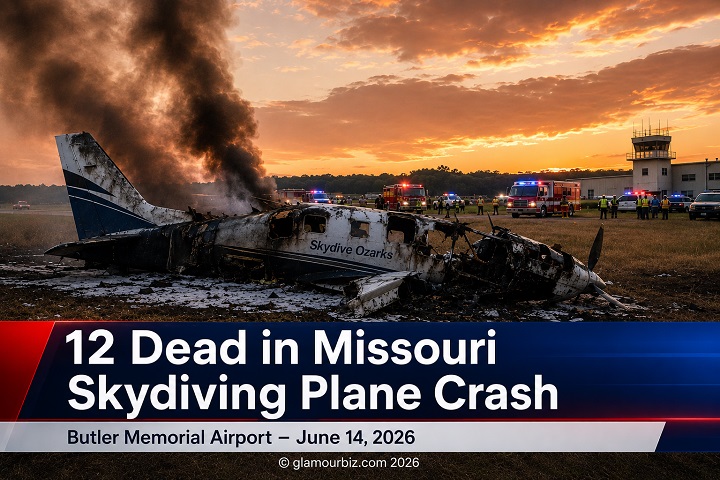
A skydiving aircraft crashed shortly after takeoff near Butler Memorial Airport in Missouri on June 14, 2026, killing all twelve people on board. The Pacific Aerospace P750XL went down in a nearby field after struggling to gain altitude, leaving no survivors.
Families waiting at the airport to welcome their loved ones home were met with devastating news. Grief counseling has been made available to those affected. The FAA and NTSB have launched formal investigations, with early suspicion pointing toward engine failure during takeoff. Results are expected in the coming weeks.
Missouri Skydiving Plane Crash Leaves 12 Dead Near Butler Airport
Sunday was supposed to be a good day. Twelve people boarded a skydiving aircraft at Butler Memorial Airport in Missouri on June 14, 2026, ready for what should have been a straightforward recreational jump. None of them made it back. The plane went down shortly after takeoff, killing everyone on board, one pilot and eleven skydivers, and leaving an entire community struggling to make sense of a loss that nobody saw coming.
The aircraft was a Pacific Aerospace P750XL, a workhorse plane popular in the skydiving world for its capacity and ability to get airborne on short runways. By all accounts, the departure looked normal. But moments after leaving the ground, something went wrong. People standing near the airport watched as the plane seemed to fight for altitude, wobbling and straining before it dropped out of the sky and slammed into a field just beyond the airport boundary.
First responders were on the scene quickly, but there was nothing to be done. The impact had been too severe. All twelve people were gone. Investigators moved in to secure the area and begin piecing together what happened. Both the FAA and the NTSB have opened formal investigations. Nobody is pointing fingers yet, it is far too early for that, but early thinking centers on some kind of mechanical failure, possibly the engine cutting out during those critical first moments of climb. In skydiving aviation, that window right after takeoff leaves almost no room for error. The people who know this industry well have been vocal about their grief, not just because lives were lost, but because these operations are supposed to be tightly run, with seasoned pilots and layered safety checks.
Back at the airport, families had been waiting. They had expected to see their loved ones walk off that plane, buzzing from the adrenaline of a jump. Instead, they watched emergency vehicles pour toward a field in the distance. Local authorities have since set up grief counseling for anyone affected, though no support service can really soften a blow like this.
What We Know About the Butler Plane Crash: Timeline, Victims, and Investigation
The morning of June 14th was calm and clear, the kind of day made for flying. The P750XL lifted off from Butler Memorial Airport carrying a full skydiving group, twelve people in total, heading up for a scheduled jump session. It was routine. It was supposed to be routine.
It wasn't. Within minutes of getting airborne, the plane began to struggle. Witnesses described watching it fail to climb properly, hanging low in the sky before losing control entirely. It came down fast, hitting the ground just a few hundred yards from the end of the runway. There was no time to react, no chance for anyone to get out.
All twelve died. The NTSB hasn't released names yet, families are still being notified, but authorities confirmed the passengers were a recreational skydiving group, most likely a mix of experienced and casual jumpers. The pilot, also killed, was reportedly well-familiar with this type of aircraft.
The human side of this tragedy is hard to overstate. Some family members weren't just told about the crash later, they saw it unfold. They had come to the airport to watch the landing, to clap and cheer and hear about the jump. What they witnessed instead will stay with them for the rest of their lives. Grief counselors have been made available, and the local community has rallied around those affected.
The NTSB is leading the investigation, with the FAA providing support. Investigators are digging into the plane's maintenance logs, the pilot's background, the flight data, and any communications from those final moments. A preliminary report should surface within a few weeks, though anyone hoping for a full picture will likely be waiting several months at minimum.
NTSB Investigates Possible Cause of Deadly Missouri Skydiving Flight Disaster
The people charged with figuring out what brought this plane down are doing what they always do: starting from scratch and following the evidence wherever it leads. The NTSB doesn't rush, and in a case this tragic, that patience matters.
Right now, the engine is high on the list of things to examine. Skydiving planes lead punishing lives, they go up, they come down, they go up again, all day long. That kind of relentless cycling puts real strain on mechanical systems, and any weakness can surface at the worst possible moment. If the engine lost power during that initial climb, the pilot would have had almost nothing to work with, too low for options, too fast for a safe landing. The maintenance records will tell investigators a lot about whether the aircraft was truly airworthy.
The operational picture is being scrutinized too. Did the plane fly more trips than it should have that day? Were all the scheduled checks actually done? These are the kinds of questions that don't always make headlines but often end up being central to understanding what went wrong.
Weather isn't expected to be a factor, conditions were described as favorable, but investigators will still pull meteorological data. Subtle things like wind shear or changes in air density can catch small aircraft off guard, so nothing gets ruled out without confirmation. The pilot's actions in those final seconds are also part of the inquiry. Did they try to turn back? Did they radio in a distress call? Flight data and communications, if recoverable, will help reconstruct those last moments and show what the pilot knew and when.
The broader skydiving community is watching this investigation closely. Depending on what the NTSB finds, there could be new guidelines coming for aircraft like the P750XL, changes to maintenance schedules, operational limits, or crew procedures. Those conversations will matter. But before any of that, there are twelve families waiting for answers. That's who this investigation is ultimately for.