
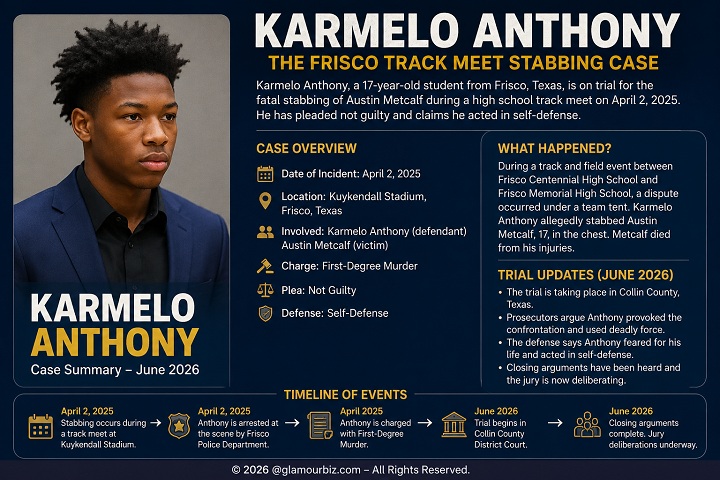
The issue regarding Karmelo Anthony has gained quite a lot of media coverage because of the severity of the issues at stake and the current legal proceedings taking place.
As more information gets out about the issue, the discussion about Karmelo Anthony's past, his conduct within the court, and the defense and prosecution has been of major importance in the analysis of the case. The following is an outline of what is known so far.
Who Is Karmelo Anthony? His Age, Family & Education
Karmelo Anthony is a Texas teenager who became known in the media due to a 2025 criminal case involving a fatal stabbing at a high school track meet in Frisco, Texas. At 17 years old, Anthony was involved in the murder case that occurred during a high school track meet in April 2025. Now at the age of 19, he is the center of one of Texas’s most controversial murder cases.
Mr. Anthony's family background and information are yet to be revealed in the public media. Very little has been officially shared about his parents or home life, and given that he was a minor at the time of his arrest, much of that personal information has been protected.
Karmelo Anthony went to Frisco Centennial High School in the Frisco Independent School District, where he played sports and lived an uneventful life. What is clear is that before that afternoon at the track meet, Anthony was living an ordinary student life, one that was completely derailed the moment that confrontation escalated.
Karmelo Anthony's Silence During the Trial
One of the biggest talking points throughout this trial has been what Karmelo Anthony has not said. The defense rested its case without ever putting him on the stand, and that decision has sparked plenty of debate. This is actually a very common legal strategy. Every defendant has the constitutional right to stay silent and not testify against themselves. In a case this serious, his attorneys likely made a deliberate and calculated choice to keep him off the witness stand and away from cross-examination.
The logic is simple. Once a defendant testifies, the prosecution gets to ask questions too. One wrong answer, one moment of contradiction, and it can do far more damage than saying nothing at all. Legal analyst Joshua Ritter noted that the defense may have been carefully reassessing its strategy after watching the prosecution build its case witness by witness.
That said, silence is not without risk either. Jurors are people, and even when told not to, some will quietly wonder why the accused never stood up and told his own story. It does not prove guilt, not even close, but it does leave a gap that lingers in the back of people's minds.
Self-Defense Claim and Legal Strategy Under Scrutiny
This case revolves around the defense’s claim of self-defense, where the defendant claimed he was genuinely afraid due to the fact that the whole incident occurred very quickly. Though it is a valid claim, people analyzing the trial believe it to be a tough one for the defense, as self-defense, according to the law, cannot just mean that you felt threatened. It means that your fear was reasonable, the threat was immediate, and you responded appropriately to the danger posed to you.
The problem for the defense is the witness testimony. Multiple students who were there that day recalled Anthony being repeatedly asked to leave the Memorial High School tent before things turned violent. They also remembered him saying things like "Touch me and you'll find out," words that do not exactly paint the picture of someone trying to walk away from trouble.
The defense will need to work hard to reframe that narrative. Their best chance is convincing the jury that in the heat and chaos of that specific moment, Anthony genuinely had no other option. Whether that argument lands with the jury remains to be seen.
Prosecution Arguments and Growing Courtroom Pressure
While the defense has been fighting to create reasonable doubt, prosecutors have been quietly and methodically doing the opposite. They brought 21 witnesses to the stand, including student athletes, coaches, police officers, investigators, and the medical examiner, and used each one to reinforce a single consistent story. Their message has been clear from the start. This was not self-defense. It was an unjustified attack inside a team tent at a school sporting event, and a 17-year-old boy paid for it with his life.
Legal analyst Todd Shapiro put it plainly just before closing statements, saying the prosecution is "way out in front." " That is not a small observation, and it reflects what many people watching the trial have felt day by day. For the defense, the challenge now goes beyond countering individual pieces of evidence.
They need to challenge the entire story the prosecution has constructed, because juries do not just weigh facts; they respond to narratives. And right now, the prosecution's narrative is the one with the most witnesses, the most consistency, and the most momentum behind it. The jury now holds everything. With a potential sentence ranging from 5 years all the way up to life in prison, the weight of what they decide in that deliberation room could not be heavier.