
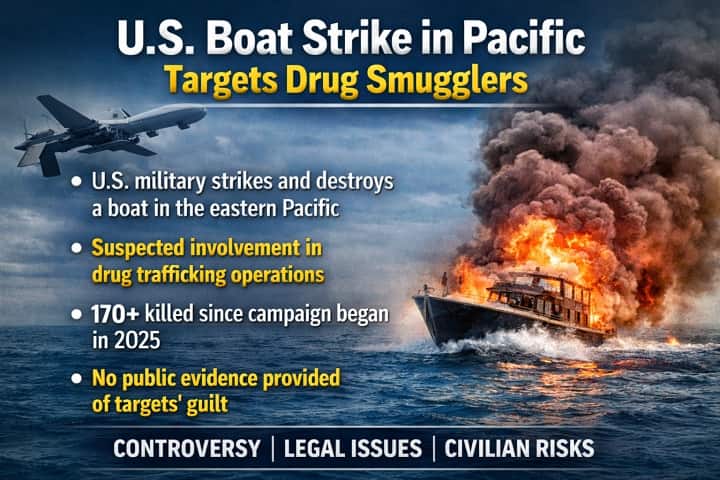
A recent U.S. military strike on a suspected drug-trafficking vessel in the eastern Pacific Ocean has drawn international attention and sparked renewed debate over how far governments should go in combating narcotics networks. Officials say the operation targeted a boat linked to drug-smuggling routes, resulting in multiple deaths.
U.S. authorities describe the strike as part of a wider effort to disrupt transnational criminal organizations operating at sea. However, critics argue it represents an expansion of military power into law-enforcement roles, raising concerns about legality, transparency, and the use of lethal force in international waters.
The incident exemplifies a broader trend in maritime operations that blurs the distinction between policing and warfare. As such actions become more frequent, they continue to raise important questions about accountability, proportionality, and international law in the global fight against drug trafficking.
U.S. Military Launches Deadly Strike on Suspected Drug Boat in the Pacific
The latest strike reportedly took place in international waters in the eastern Pacific, a region frequently used by drug trafficking networks moving narcotics from South America toward North America and beyond. According to defense officials, intelligence identified a vessel suspected of transporting illegal drugs. A military strike was then carried out, resulting in the destruction of the boat and the deaths of those onboard. Authorities have referred to the individuals involved as members of organized trafficking groups engaged in transnational crime.
However, details remain limited. The identities of those killed have not been publicly released, and no independent verification of the cargo or affiliations has been provided. This lack of transparency has fueled debate over how targets are selected and what level of evidence is required before lethal force is used.
Supporters of the operation argue that drug trafficking organizations have become heavily armed and increasingly violent, requiring a stronger response than traditional law enforcement can provide. They claim maritime interdiction is necessary to disrupt supply chains that fuel addiction and crime globally.
Still, the use of military force at sea against suspected criminals represents a major step forward compared to standard coast guard or naval boarding operations, which typically involve interception and arrest rather than destruction.
Inside America’s Expanding War on Maritime Drug Trafficking
The United States has long relied on coordinated efforts between the Coast Guard, Navy, and international partners to intercept drug shipments in transit. These operations usually involve tracking suspect vessels, boarding them, seizing contraband, and arresting crew members.
The level of force used in some recent operations is changing. Authorities have reportedly destroyed certain suspected boats, identified as drug trafficking targets, instead of intercepting them. Officials justify this shift by pointing to evolving tactics used by criminal organizations. Traffickers increasingly use fast boats, remote routes, and sophisticated surveillance to evade capture. Some vessels are also believed to be armed, creating potential risks for boarding teams.
In response, the U.S. has expanded surveillance and strike capabilities in key maritime corridors, particularly in the eastern Pacific and parts of the Caribbean. These regions are considered major transit zones for cocaine and other illicit substances originating in South America.
The broader strategy appears to focus on disrupting supply chains before drugs reach land. However, critics argue that destroying vessels does not address the root causes of drug demand or dismantle the leadership structures of trafficking organizations. Instead, they say, it may simply push routes further offshore or into more remote waters.
This evolving approach reflects a larger global trend: the militarization of drug enforcement. What was once primarily a policing issue is increasingly being treated as a national security threat.
Rising Concerns Over Legality and Civilian Risk in Sea Strikes
The most controversial aspect of these maritime strikes is the question of legality under international law. Traditionally, the use of lethal military force is governed by strict conditions, often requiring a recognized armed conflict or immediate threat.
Critics argue that suspected drug trafficking, while criminal, does not automatically justify military engagement or summary destruction of vessels. Human rights advocates are concerned that individuals on these boats had no opportunity to surrender or face trial.
Another major concern is the risk of misidentification. In busy maritime corridors, fishing boats and small commercial vessels can resemble smuggling craft from a distance. Without transparent evidence, it is difficult to verify whether those killed were actually involved in trafficking or were civilians in the wrong place at the wrong time.
International legal experts have also questioned whether labeling criminal networks as “terrorist organizations” could be used to justify the expansion of military authority beyond traditional boundaries. If such classifications become more flexible, it could lower the threshold for the use of lethal force in non-combat situations. Additionally, there are concerns about oversight. Military operations in international waters are often classified, limiting public access to information about intelligence sources, targeting decisions, and post-strike assessments.
Supporters of the strikes argue that traffickers themselves operate outside the law and pose significant harm to society through addiction, violence, and corruption. They claim that traditional enforcement methods have not been sufficient to stop the flow of drugs. Still, the ethical debate remains intense: whether the urgency of combating narcotics justifies the use of military force that can result in immediate loss of life without judicial process.
A Shift in Policy: Using Military Force Against Drug Networks
This incident reflects a broader shift in how some governments approach transnational crime. Instead of viewing drug trafficking purely as a criminal justice issue, it is increasingly being treated as a security threat comparable to terrorism or armed insurgency.
This shift has major repercussions. Framing criminal groups as enemy combatants paves the way for military engagement, expanded surveillance, and preemptive strikes. While such an approach may increase operational effectiveness, it also raises serious questions about proportionality and oversight.
The use of force at sea is particularly complex. International waters are governed by maritime law that emphasizes freedom of navigation but also allows limited enforcement actions against piracy, trafficking, and other illicit activities. The boundaries of what is permissible, however, remain subject to interpretation.
Policy analysts note that this approach may reflect frustration with the long-standing “war on drugs,” which has struggled to reduce global drug consumption significantly despite decades of enforcement efforts. By targeting supply chains more aggressively, policymakers hope to disrupt the availability of narcotics before they reach consumer markets.
Yet history suggests that supply-side crackdowns alone usually fail to eliminate demand. Instead, trafficking networks often adapt quickly, shifting routes and methods to avoid detection. The challenge moving forward will be balancing effectiveness with legality, transparency, and respect for human rights. As military involvement in drug enforcement increases, so too will scrutiny from international observers and legal institutions.
FAQ about the U.S. Military Boat Strike in the Pacific and Maritime Drug Enforcement
1. Why did the U.S. military strike a boat in the Pacific?
A: Officials say the vessel was suspected of involvement in drug trafficking networks operating in international waters.
2. Is the U.S. military allowed to conduct strikes on drug boats?
A: It depends on legal justification and intelligence classification. However, the practice remains controversial under international law.
3. What is Operation Southern Spear?
A: It is a reported U.S. campaign targeting suspected drug trafficking vessels operating in the Pacific and Caribbean regions.
4. Are these strikes considered legal?
A: Critics argue they may violate international law if carried out without due process or a clear armed conflict framework.
5. Why is this operation controversial?
A: Concerns include limited transparency, potential civilian risk, and the use of military force instead of traditional law enforcement methods.