
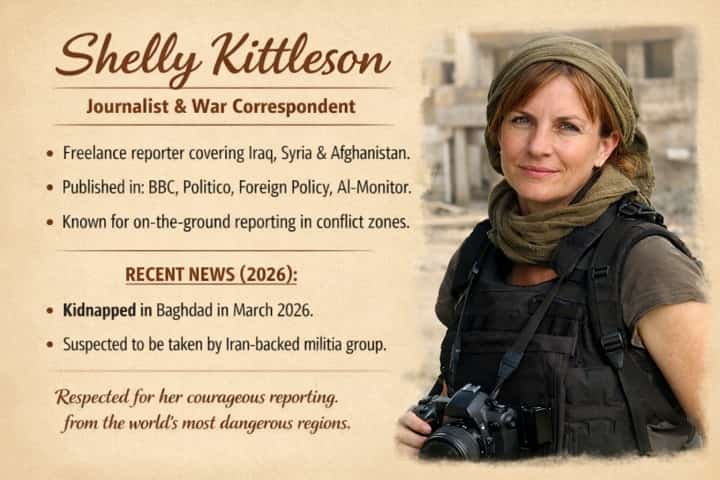
Shelly Kittleson, an American freelance journalist and war correspondent, is known for reporting from conflict zones in Iraq, Syria, and Afghanistan. She was recently abducted in Baghdad, prompting a search by the FBI and Iraqi authorities.
Shelly Kittleson: A Veteran Journalist Covering Conflict Zones
Shelly Kittleson is an American freelance journalist, war correspondent, and writer whose career has been defined by her deep commitment to reporting from some of the most dangerous and politically complex regions of the world. She has spent years covering conflicts, humanitarian crises, and the often overlooked human stories behind headline‑grabbing events. Though not tied to a single major news network as a staff correspondent, Kittleson has written for a wide range of respected international outlets, including Al‑Monitor, Foreign Policy, Politico, and the BBC, among others.
Raised in the rural Midwest of the United States, Kittleson was drawn early in her career to international reporting, particularly in regions where everyday life is shaped by war, instability, and geopolitical pressure. Her work has taken her to Afghanistan, Iraq, and Syria — places where the risks are high and the stories are profoundly human. Instead of focusing purely on military movements or political declarations, she often centers her writing on how conflict affects families, communities, and the social fabric itself.
Over the years, she has developed a reputation for courage and empathy. Colleagues and editors have praised her ability to build trust with local sources, navigate areas with limited security, and communicate complex circumstances to audiences far removed from the frontlines. Her articles seamlessly combine on‑the‑ground observation with deep context, helping readers better understand why conflicts continue and what they mean for people on the ground.
Ground‑Level Reporting: Stories from Iraq, Syria, and Afghanistan
What has distinguished Shelly Kittleson’s career is not just her willingness to travel to conflict zones but her dedication to telling stories that go beyond headlines. In Syria, for instance, she spent significant time inside opposition‑held territories during periods of active conflict, providing firsthand perspectives on how ordinary Syrians were managing life under bombardment and siege. In Iraq, she embedded with Kurdish peshmerga fighters and explored the human toll of decades of warfare and insurgency. Her work in Afghanistan included radio documentaries and extended reporting on the long‑term impacts of war on communities once at the center of global military focus.
These assignments were often fraught with danger. Reporting in conflict zones requires constant situational awareness, negotiation with local authorities and armed groups, and the emotional resilience to document suffering while upholding journalistic integrity. Kittleson has spoken in interviews about how such experiences have shaped her both professionally and personally—providing her with a profound sense of purpose, as well as confronting her with the dark realities of war and human loss.
Her writing style reflects this depth of experience. Rather than relying on sterile dispatches focused on military strategy or political proclamations, she brings readers into the lived experiences of those affected by conflict. Through narrative storytelling, personal interviews, and carefully observed detail, her reports give a voice to people whose stories might otherwise go unheard in global media. This approach has earned her respect among peers and readers alike and has underscored the importance of human‑centered journalism in international reporting.
Recognition and Impact: Freelance Work That Makes a Difference
Although Kittleson is a freelancer — meaning she is not employed full‑time by any single media organization — her work has appeared in some of the leading outlets covering international and geopolitical affairs. Her contributions to Al-Monitor—a publication focused on Middle East reporting—have been particularly prominent, offering in-depth coverage of regional developments that might be overlooked by broader news services. Her writing has also been featured in Foreign Policy, Politico, and reports for the BBC, where her experience on the ground has helped contextualize global reporting.
Freelance journalism, especially in war zones, is not widely understood outside media circles. Unlike staff journalists who may have institutional support, freelancers often work with limited resources, personal risk, and irregular assignments. Yet this independence can also be a strength: it allows reporters like Kittleson to work across publications, follow stories with flexibility, and cover topics that larger outlets might not prioritize.
Her work has contributed to wider awareness of key regional issues—from the ongoing instability in Iraq and Syria to the long‑term consequences of international military actions in Afghanistan. Editors and readers alike have noted how her storytelling brings nuance to complex geopolitical issues, grounding political developments in real human experiences. It is this ability to connect global audiences with local realities that defines her impact as a journalist.
Shelly Kittleson’s Abduction in Baghdad: FBI and Iraqi Forces Pursue Suspects Amid Militia Links
On March 31, 2026, American freelance journalist Shelly Kittleson was abducted in central Baghdad, Iraq, in an alarming incident that sent shockwaves through the international journalism community. According to reports from The Statesman, Kittleson was taken by a group of unidentified armed individuals while navigating the busy streets of the city, highlighting the extreme risks faced by reporters covering conflict zones.
Iraqi security forces immediately launched a pursuit, and during the chase, the abductors’ vehicle reportedly overturned, leading to the arrest of one suspect and the confiscation of the vehicle involved in the kidnapping. Despite these efforts, Kittleson’s whereabouts remained uncertain, prompting an urgent operation by both Iraqi authorities and U.S. officials. The U.S. State Department confirmed that the FBI is actively involved, working in coordination with Iraqi security agencies to ensure her safe release.
Assistant Secretary of State Dylan Johnson noted that Kittleson had been previously advised about the dangers posed by Iran-backed militia groups, including Kataib Hizballah, a paramilitary organization suspected to have links to the abduction. The incident has drawn widespread international concern, with media organizations such as Al-Monitor calling for her immediate and safe release, underlining not only the personal danger she faces but also the broader threats to press freedom in volatile regions.
The kidnapping underscores the perilous environment in which journalists operate in Iraq, where armed militias, political tensions, and ongoing security challenges make frontline reporting a high-risk profession, even for experienced correspondents like Kittleson.
Top 5 FAQs About Shelly Kittleson
1. Who is Shelly Kittleson?
Shelly Kittleson is an American freelance journalist and war correspondent known for her extensive reporting from conflict zones such as Iraq, Syria, and Afghanistan. Her work has appeared in major international and U.S. publications, where she focused on human‑centered stories within global conflicts.
2. What kind of journalism does she do?
Kittleson specializes in frontline reporting from dangerous and politically complex areas. Rather than focusing only on military or diplomatic developments, she often highlights how conflicts affect everyday lives and communities.
3. Has she worked for major news outlets?
Yes. While she is a freelancer, her reporting has been published by outlets like Al‑Monitor, Foreign Policy, Politico, and the BBC.
4. What happened to her in Baghdad in March 2026?
On March 31, 2026, Shelly Kittleson was kidnapped in central Baghdad by unknown armed individuals. Iraqi security forces launched a search and arrested one suspect, and both U.S. and Iraqi authorities were working to secure her release.
5. Why was her kidnapping significant?
Her abduction highlighted the ongoing dangers faced by journalists covering conflicts, especially foreign correspondents in volatile regions. It also drew international attention and calls from media freedom groups and government officials for her safe return.