
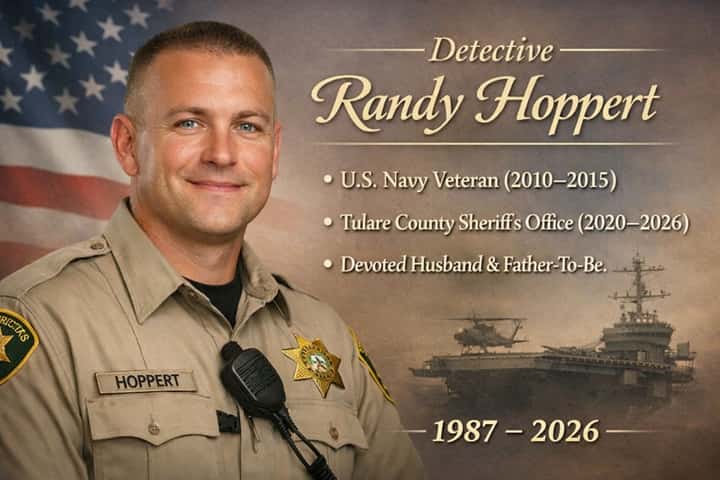
Tulare County Detective Randy Hoppert was killed in Porterville while responding to an eviction notice. The situation turned deadly when a suspect opened fire, prompting a SWAT response and a major police operation.
Detective Randy Hoppert Dies After Ambush During Routine Eviction Enforcement Call
What began as a routine civil enforcement assignment in Porterville, California, ended in tragedy when Tulare County Sheriff’s Detective Randy Hoppert was fatally shot while assisting deputies in serving an eviction notice. The incident unfolded in a quiet residential neighborhood, an environment where law enforcement calls typically involve paperwork, communication, and compliance rather than violence. However, within moments of officers arriving at the scene, the situation escalated in a way no one anticipated.
According to officials, Detective Randy Hoppert was part of a team assisting deputies in executing the legal eviction process at a home near Newcomb and Grand Avenues. As officers approached the property, a suspect inside the residence allegedly opened fire without warning. Detective Hoppert was struck during the initial exchange of gunfire. Fellow officers immediately moved to provide aid while also seeking cover and returning fire. Emergency medical services rushed him to a nearby hospital, but despite all efforts, Detective Randy Hoppert succumbed to his injuries.
The news of his death sent shockwaves through the Tulare County Sheriff’s Office, where he was described as a dedicated investigator and a respected colleague who served with professionalism and commitment. For many in law enforcement, eviction-related calls are considered unpredictable—not because they are inherently violent, but because they often involve individuals under extreme emotional and financial stress. Still, few could have imagined that such a call would end in the loss of a veteran detective. Officials later described the incident as a sudden ambush that turned a standard duty into a deadly confrontation in seconds.
Suspect Opens Fire, Triggering Massive SWAT Response in Residential Neighborhood
As Detective Randy Hoppert was rushed for medical care, the situation outside the residence continued to deteriorate. The suspect reportedly remained inside the home and continued firing at responding officers, creating a highly dangerous and unstable environment.
Law enforcement agencies from across the region quickly mobilized. SWAT teams, tactical units, and crisis negotiators were deployed to contain the situation and prevent further loss of life. The residential neighborhood soon became the center of a large-scale police operation.
Armored vehicles lined the streets, helicopters circled overhead, and drones were used for surveillance. Residents were ordered to shelter in place as authorities worked to secure the area and assess the threat. The standoff lasted for hours, with law enforcement carefully coordinating their response. Officers maintained containment around the property while attempting to neutralize the armed suspect, who continued to resist.
Eventually, authorities confirmed that the suspect was killed during the confrontation after ongoing exchanges of gunfire. The exact sequence of tactical decisions is still under investigation, but officials stated that the priority was to prevent further casualties following the death of Detective Randy Hoppert. Even after the situation was resolved, the emotional impact remained heavy. One officer had already lost his life, and dozens of responders were left processing a traumatic and unexpected event.
Community Mourns Detective Randy Hoppert as Law Enforcement Honors His Service
In the aftermath of the tragedy, tributes began pouring in from law enforcement agencies, public officials, and community members across California. The Tulare County Sheriff’s Office publicly mourned Detective Randy Hoppert, describing him as a committed public servant who dedicated his career to protecting others. Fellow officers spoke of his professionalism, calm demeanor, and willingness to step into difficult situations when needed.
Flags at law enforcement buildings were lowered to half-staff, and memorial arrangements began to be organized to honor his service. Colleagues shared personal memories, reflecting on moments of teamwork, mentorship, and shared duty. Beyond the sheriff’s office, community members expressed deep sorrow over the loss. Many were struck by the fact that Detective Hoppert died while performing what is typically a non-violent administrative duty. The incident raised renewed awareness of how unpredictable law enforcement work can be.
Local residents near the incident site described confusion and fear during the standoff, followed by sadness once the outcome became clear. Social media platforms filled with messages of sympathy and support for the detective’s family. Law enforcement leaders across the region also emphasized the broader implications of the tragedy. Eviction-related enforcement, welfare checks, and civil duties are often overlooked in discussions of police risk, yet they can become unexpectedly dangerous depending on the circumstances inside a home.
A Routine Duty That Turned Into a Fatal Encounter
The death of Detective Randy Hoppert has become a painful reminder that not all dangerous police work happens during high-speed chases or major criminal investigations. Sometimes, it begins with a simple knock on the door.
Eviction enforcement is a legally required process, but it can place officers in unpredictable environments. Individuals facing eviction may be under severe emotional distress, financial pressure, or mental health challenges. While most situations are resolved peacefully, law enforcement officers must always prepare for the unexpected. In this case, what should have been a structured and controlled procedure escalated into a deadly ambush within seconds of arrival.
Experts in policing note that incidents like this often prompt internal reviews of procedures, staffing levels, and tactical approaches. Some agencies have already begun incorporating additional safety measures such as increased backup presence, coordination with social services, and risk assessments before serving eviction notices. However, even with protocols in place, the unpredictability of human behavior means that risk can never be fully eliminated.
As investigations continue, authorities are expected to review all aspects of the incident, including officer positioning, communication, and the suspect’s actions leading up to the shooting. The goal is not only accountability but also learning—so future tragedies can be prevented where possible. For now, the focus remains on honoring the life and service of Detective Randy Hoppert, a man who lost his life while carrying out his duty.
Top 5 FAQs
1. Who was the officer killed in the Porterville incident?
The officer was Tulare County Sheriff’s Detective Randy Hoppert, who was fatally shot while assisting with an eviction enforcement call.
2. What was Detective Randy Hoppert doing when he was killed?
He was assisting deputies in serving a routine eviction notice at a residence in Porterville, California, when the suspect opened fire.
3. Was the eviction notice considered a high-risk operation?
No, it was a civil enforcement task, which is typically routine. However, it escalated unexpectedly into a violent situation.
4. What happened to the suspect involved in the shooting?
The suspect engaged in a standoff with law enforcement and was later killed during the confrontation, according to officials.
5. How is the community responding to Detective Hoppert’s death?
The community and law enforcement agencies have expressed deep grief, honoring his service and supporting his family and colleagues.