
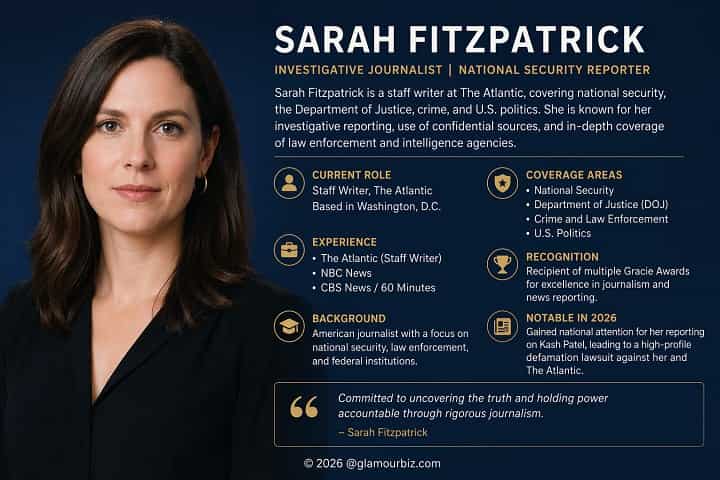
Investigative journalist Sarah Fitzpatrick and The Atlantic are facing a major legal challenge after FBI Director Kash Patel filed a $250 million defamation lawsuit over a report alleging concerns about his conduct and leadership. The publication stands by its story, while the case raises broader questions about anonymous sourcing and press freedom in political journalism.
Who Is Sarah Fitzpatrick? A Profile of The Atlantic’s Investigative Reporter
Sarah Fitzpatrick is an investigative journalist known for her work with The Atlantic, one of the most influential long-form journalism publications in the United States. In the modern media landscape, where speed often competes with accuracy, Fitzpatrick represents a traditional but increasingly rare journalistic archetype: the deep-dive reporter who builds stories through layered sourcing, long interview processes, and careful editorial scrutiny.
Her reporting style is associated with national security, political accountability, and institutional behavior—areas that require both persistence and caution. Rather than focusing on surface-level political commentary, her work tends to explore how decisions are made behind closed doors and how public institutions function when under pressure.
Fitzpatrick has recently come into wider public attention due to her involvement in a high-profile Atlantic report that became the center of a legal dispute involving FBI Director Kash Patel. The article, which relied heavily on anonymous sourcing, sparked significant political reaction and ultimately led to a defamation lawsuit filed against both the publication and the reporter.
While her professional profile is primarily defined by investigative journalism, the recent controversy has placed her in a broader conversation about press freedom, sourcing ethics, and the legal risks of reporting on powerful public figures.
Sarah Fitzpatrick and Her Role in High-Profile Political Investigations
Investigative journalism often sits at the intersection of public accountability and institutional sensitivity. Sarah Fitzpatrick’s reporting for The Atlantic reflects this balance, focusing on political leadership, federal agencies, and internal government dynamics.
In high-profile political investigations, journalists like Fitzpatrick often rely on confidential sources—individuals who may speak only under anonymity due to professional or legal risk. These sources can include current or former officials, aides, or individuals with indirect access to relevant information. While such sourcing is standard in investigative reporting, it also places the journalist in a position where credibility depends heavily on verification, corroboration, and editorial oversight.
Her most widely discussed work to date involves reporting that raised concerns about behavior and operational stability within a federal law enforcement leadership context. The article gained significant traction not only because of its subject matter but also because it touched on the leadership of a high-ranking government official.
This type of reporting is inherently high-risk. When journalism examines powerful institutions such as federal agencies, it often triggers strong public and political responses. In this case, the reporting led to legal escalation, with the subject of the article challenging its accuracy through a defamation lawsuit.
Regardless of legal outcomes, such investigations underscore the role of journalists like Fitzpatrick in shaping public understanding of government accountability. They operate in a space where information is contested, narratives are disputed, and every published word carries potential legal and reputational consequences.
Inside the Reporting Style of Sarah Fitzpatrick: Sources, Methods, and Controversy
Sarah Fitzpatrick’s reporting approach reflects the core principles of investigative journalism: sourcing depth, cross-verification, and editorial rigor. In major political reporting, especially involving national security or federal leadership, journalists rarely rely on a single source. Instead, they build narratives through multiple interviews, document analysis, and corroborative evidence.
One defining feature of her reporting style is the use of anonymous sources. This is a common and sometimes necessary tool in political journalism, particularly when individuals fear professional retaliation or legal exposure. However, it also introduces a layer of public skepticism, as readers cannot independently evaluate the credibility of unnamed contributors.
This tension between transparency and protection of sources is at the heart of many modern journalism debates. Fitzpatrick’s recent reporting brought this issue into sharper focus, as critics questioned the reliability of anonymous claims while supporters emphasized the importance of protecting whistleblowers and insiders.
The controversy surrounding her reporting escalated further when it became the subject of a defamation lawsuit filed by FBI Director Kash Patel. The lawsuit alleges that the published claims were false and damaging, while The Atlantic has publicly maintained that it stands by its reporting and intends to defend its journalistic process in court.
This situation highlights a broader reality in investigative journalism: even well-sourced reporting can lead to legal challenges when it involves powerful figures. For journalists, the process is not only about uncovering information but also ensuring that every claim meets editorial and legal standards before publication. Fitzpatrick’s work, therefore, sits within a larger professional framework where journalism, law, and public accountability intersect—often contentiously.
Sarah Fitzpatrick in the Spotlight: The Kash Patel Lawsuit and Media Scrutiny
The most widely publicized moment in Sarah Fitzpatrick’s career to date stems from her involvement in a 2026 investigative article published by The Atlantic that led to a major legal confrontation.
Following the article’s release, FBI Director Kash Patel filed a $250 million defamation lawsuit against The Atlantic and Fitzpatrick, alleging that the reporting contained false statements that harmed his reputation. The case quickly drew national attention due to both the prominence of the official involved and the scale of the damages sought.
At the center of the dispute is a familiar but complex legal question: where is the line between protected investigative journalism and defamation? In the United States, public figures must meet a high legal threshold—known as “actual malice”—to succeed in defamation claims. This means proving that the journalist either knew the information was false or acted with reckless disregard for the truth.
The Atlantic has stated that it stands by its reporting and intends to defend its journalistic integrity. Meanwhile, the case has reignited broader debates about press freedom, especially in politically sensitive reporting environments. For Fitzpatrick, the lawsuit represents more than just a legal challenge; it places her work under intense public scrutiny. Every aspect of the reporting process—from sourcing decisions to editorial review—may be examined in court.
Regardless of the outcome, the case illustrates the increasingly adversarial relationship between investigative journalism and political power. It also highlights the risks journalists face when reporting on high-level officials, where factual disputes can quickly evolve into legal battles. In this context, Fitzpatrick’s role extends beyond individual reporting. She becomes part of a larger discussion about the boundaries of journalism, the protection of sources, and the responsibility of the press in democratic societies.
Top 5 FAQs about Sarah Fitzpatrick
1. Who is Sarah Fitzpatrick?
Sarah Fitzpatrick is an investigative journalist known for her work with The Atlantic, focusing on political and national security reporting.
2. Why is Sarah Fitzpatrick in the news recently?
She has gained attention due to her involvement in a 2026 investigative report that led to a defamation lawsuit filed by FBI Director Kash Patel.
3. What type of journalism does she specialize in?
She specializes in investigative journalism, particularly political accountability and government-related reporting.
4. What is the lawsuit involving her about?
The lawsuit alleges that a report she co-authored contained false statements about a public official. The Atlantic has denied wrongdoing and is defending the article.
5. Why are anonymous sources used in her reporting?
Anonymous sources are often used in investigative journalism to protect individuals who provide sensitive information that could impact their careers or safety.