
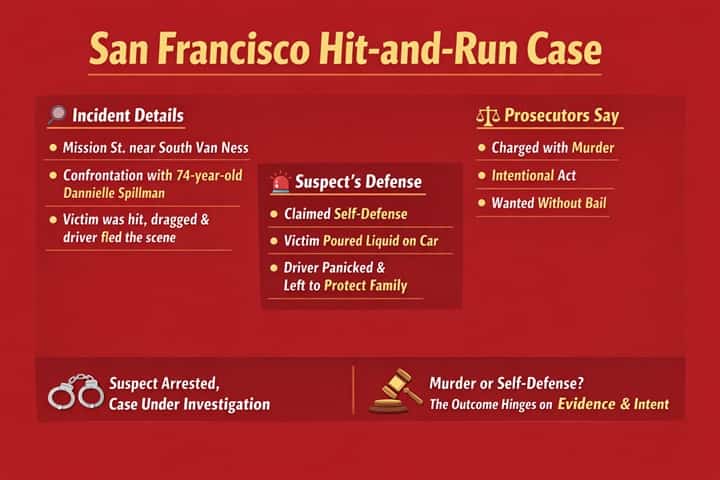
A tragic hit-and-run incident in San Francisco’s SoMa district has turned into a murder case after a 74-year-old woman, identified as Dannielle Spillman, was killed near Mission Street and South Van Ness Avenue.
Authorities say the 30-year-old driver allegedly struck the pedestrian and fled the scene, leading to his arrest and murder charges based on surveillance video and witness accounts. While prosecutors argue the act shows extreme recklessness, the defense claims the driver acted in self-defense during a confrontation. The case is now moving through court as investigators continue to examine the disputed events.
Fatal Hit-and-Run Incident in San Francisco’s SoMa District
A tragic incident in San Francisco has drawn widespread attention after a deadly hit-and-run in the busy South of Market area turned into a murder investigation. The incident unfolded near the intersection of Mission Street and South Van Ness Avenue, an area known for heavy traffic, commercial activity, and frequent pedestrian movement throughout the day. According to early reports and court documents, the situation began after a 30-year-old driver had just left a nearby gas station when an interaction with a pedestrian escalated into a fatal encounter.
What makes this case particularly disturbing is how quickly an everyday urban moment turned into a life-ending tragedy. Witness accounts and video evidence reviewed by investigators suggest that a confrontation occurred between the driver and the 74-year-old woman before the vehicle struck her. The driver allegedly fled the scene immediately afterward, leaving the victim critically injured on the street. Emergency responders arrived quickly, but despite their efforts, the woman was pronounced dead at the scene. The incident has since raised serious questions about road rage, urban safety, and how quickly conflicts in public spaces can spiral out of control.
In a city like San Francisco, where pedestrians and vehicles constantly share tight urban space, incidents like this highlight the fragile balance between mobility and safety. The SoMa district, in particular, is a densely populated neighborhood where residential buildings, businesses, and transit routes intersect. The tragedy has left many residents shaken, especially those who frequently walk through the area. What was once a routine corner of the city has now become the center of a deeply unsettling criminal case.
Victim Identified as 74-Year-Old Dannielle Spillman
Authorities have identified the victim as 74-year-old Dannielle Spillman, a woman whose life was cut short in what investigators are calling a devastating and preventable incident. While full personal details about her life have not been widely released, her death has already sparked community sympathy and renewed concern about pedestrian safety, especially for elderly residents who are more vulnerable in high-traffic urban environments.
Spillman was reportedly walking in the area when the incident occurred. According to investigators, she became involved—either directly or indirectly—in an interaction with the driver shortly before the crash. Within moments, the situation escalated in a way that ended in fatal consequences. Emergency personnel responded promptly after receiving reports of a collision, but despite immediate medical attention, she did not survive her injuries.
The loss of a senior pedestrian in such a sudden and violent manner has deeply impacted the community. Elderly pedestrians often rely on predictable traffic behavior and safe crosswalks to navigate busy city streets. When those expectations are disrupted, the consequences can be fatal. In this case, the incident has become a painful reminder of how vulnerable older adults are in urban traffic environments like those found in San Francisco.
Residents of the SoMa district have expressed concern not only about this specific tragedy but also about broader issues such as aggressive driving, pedestrian right-of-way enforcement, and the need for better street safety infrastructure. While investigations continue, the memory of Dannielle Spillman has become central to discussions about how such tragedies might be prevented in the future.
Driver Charged with Murder Following Police Investigation and Video Evidence
Following an extensive investigation, authorities arrested the 30-year-old driver involved in the incident and formally charged him with murder, along with additional hit-and-run-related offenses. The decision to elevate the case to murder charges reflects the seriousness of the evidence gathered, which reportedly includes surveillance footage and witness statements that contradict the driver’s initial account of events.
In California, a hit-and-run can escalate to murder charges under certain conditions, particularly when prosecutors believe there was implied malice—meaning the driver’s actions showed a conscious disregard for human life. In this case, investigators argue that the evidence suggests the driver intentionally struck the pedestrian or acted with extreme recklessness before fleeing the scene.
Court documents indicate that video footage played a crucial role in shaping the prosecution’s case. While the defense has not yet fully presented its arguments in court, prosecutors maintain that the visual evidence shows the vehicle striking the victim in a manner inconsistent with an accident or momentary panic. The driver was later arrested and brought before the court, where he has so far not entered a plea.
The legal process is still in its early stages, but the murder charge significantly raises the stakes. If convicted, the defendant could face a lengthy prison sentence under California law. The case is expected to proceed through multiple hearings as both sides present their interpretations of what happened in those critical moments on Mission Street.
Beyond the courtroom, the case has also drawn public attention to how quickly urban traffic incidents can escalate into criminal investigations involving severe charges. It also underscores how surveillance technology—now widespread in cities like San Francisco—plays a decisive role in reconstructing events and determining legal accountability.
Defense Claims Self-Defense Amid Disputed Circumstances of the Crash
The defense team representing the accused driver has presented a very different interpretation of the incident. According to their argument, the driver acted out of fear during a confrontation with the pedestrian and did not intentionally attempt to harm her. They claim that the situation escalated unexpectedly, leading to a split-second reaction that resulted in the fatal collision.
This claim of self-defense introduces a key point of dispute in the case: whether the driver’s actions were intentional, reckless, or a panicked response to an immediate threat. The defense maintains that the driver believed he was in danger during the encounter and reacted instinctively. However, prosecutors strongly disagree, arguing that the evidence—including video footage and witness accounts—does not support the idea of justified self-defense.
Self-defense claims in vehicle-related incidents are complex and often heavily scrutinized in court. Prosecutors typically look for consistency in behavior, the presence of immediate threat, and whether the response was proportionate. In this case, the prosecution argues that striking a pedestrian with a vehicle and then leaving the scene cannot reasonably be justified as self-defense.
As the case moves forward, the court will likely examine multiple angles, including the exact sequence of events, the behavior of both individuals before the collision, and whether the driver had alternative options to de-escalate the situation. The outcome will depend heavily on how the evidence is interpreted by a jury or judge.
For the community in South Van Ness Avenue and surrounding areas, the legal debate is unfolding alongside emotional reactions. Many residents are left grappling with the broader implications of the case—how quickly conflict can turn deadly in public spaces, and how justice is determined when accounts of an incident sharply differ.
Frequently Asked Questions (FAQs)
1. What happened in the San Francisco hit-and-run case?
A 74-year-old woman was struck and killed during an incident involving a 30-year-old driver in the SoMa district. The driver allegedly fled the scene afterward, leading to a murder investigation.
2. Who was the victim in this case?
The victim was identified as Dannielle Spillman, a 74-year-old pedestrian who died at the scene following the collision.
3. Why was the driver charged with murder instead of manslaughter?
Prosecutors believe the evidence suggests implied malice or extreme recklessness, which can elevate a hit-and-run case to murder under California law.
4. What is the defense argument?
The defense claims the driver acted in self-defense during a confrontation and did not intend to harm the victim.
5. Where did the incident take place?
The incident occurred near Mission Street and South Van Ness Avenue in the SoMa district of San Francisco.
6. What happens next in the case?
The case will proceed through court hearings, where both prosecution and defense will present evidence before a final verdict is reached.