
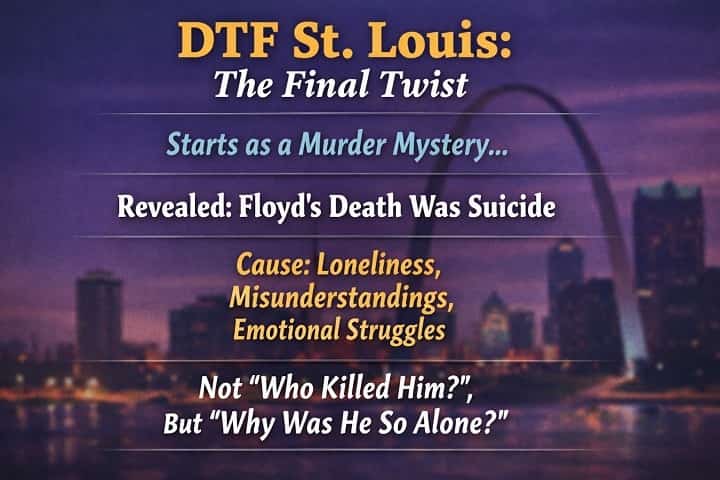
The finale of DTF St. Louis raises one major question: who killed Floyd? What begins as a mystery filled with suspicion and secrets slowly shifts into a more tragic truth. As the investigation unfolds, every character seems guilty, but the ending changes everything. Instead of a murder, the series reveals a deeper emotional collapse behind Floyd’s death, completely reframing the story.
The Shocking Finale of DTF St. Louis: What Really Happened to Floyd
The finale of DTF St. Louis delivers exactly what the series had been building toward all season: confusion, suspicion, emotional chaos, and finally a truth that feels both surprising and deeply tragic. From the very first episode, Floyd Smernitch’s death sets off a chain reaction in the St. Louis social scene, pulling friends, family, and lovers into a tangled investigation that seems to promise a classic murder mystery. Every character appears to have a motive, every relationship hides tension, and every conversation feels like it might contain a clue.
The finale trains the audience to anticipate a dramatic reveal of a killer. Instead, the show takes a sudden turn. Instead of confirming a calculated murder, the final episode gradually reveals Floyd's emotional state. We see fragments of his final days reinterpreted through conversations, flashbacks, and investigative findings. What once looked like suspicious behavior from others begins to shift into something more inward-looking: Floyd’s own emotional unraveling.
The episode reveals that Floyd was not the victim of a traditional homicide. Instead, his death is ultimately tied to a deeply personal psychological collapse. A combination of emotional distress, strained relationships, and inner shame pushes him toward a final, irreversible decision. The “mystery,” which once seemed external, becomes painfully internal. The poolside tragedy that sparked the entire investigation is reframed not as a crime scene of violence, but as the aftermath of emotional overload and isolation.
Was Floyd Murdered or Not? The Truth Behind the Death Mystery
For most of the series, the central question driving DTF St. Louis is simple: who killed Floyd? The storytelling cleverly encourages viewers to suspect almost everyone around him. Suspicious text messages, secret affairs, financial tension, and emotional betrayals all stack up like evidence in a courtroom. The narrative heavily leans into the notion that Floyd was a deliberate target, with each episode reinforcing the illusion of a meticulously orchestrated crime.
However, the finale dismantles that expectation. The truth is not a traditional whodunit resolution but rather a psychological revelation. Floyd’s death is ultimately revealed to be a suicide, not a murder. This reframing changes everything the audience thought they understood about the story. The clues that once pointed outward toward suspects are recontextualized as reflections of Floyd’s internal struggles.
In the final sequence, the show highlights Floyd’s deteriorating mental state. He is shown grappling with humiliation, emotional rejection, and an increasing sense of isolation from the people closest to him. His relationships, rather than grounding him, seem to amplify his insecurities. The pressure gradually intensifies, culminating in a breaking point that is not solely triggered by a single event, but rather by the cumulative emotional weight.
The use of the “Bloody Mary” drink mixed with a stimulant becomes symbolic rather than purely forensic. It represents the blurred line between control and collapse, highlighting Floyd’s inability to stabilize his emotional world. Rather than a planned attack by another person, the circumstances surrounding his death suggest self-destruction fueled by overwhelming psychological distress.
This revelation reframes the entire series. What initially felt like a mystery about external wrongdoing transforms into a commentary on internal suffering. A killer's absence signifies resolution; it's the show’s core message: not all tragedies are caused by someone else.
Key Suspects Explained: Clark, Carol, and Richard Under Scrutiny
One of the most compelling aspects of DTF St. Louis is how it constructs a believable lineup of suspects, each with enough emotional complexity to seem potentially responsible. The finale carefully examines these characters, not to convict them but to clear the misunderstandings that have followed them throughout the season.
Clark Forrest is the most obvious suspect for much of the series. His affair with Carol and his complicated friendship with Floyd make him appear deeply entangled in the victim’s life. Clark’s behavior often seems defensive, and his emotional reactions during the investigation only heighten suspicion. However, the finale ultimately reframes him as someone caught in a web of poor decisions rather than malicious intent. While he contributed to emotional tensions, there is no evidence that he caused Floyd’s death.
Carol, Floyd’s wife, is another central figure in the suspicion spiral. Her strained marriage, financial considerations, and emotionally charged interactions with Floyd make her a natural suspect in the eyes of both investigators and viewers. At times, her demeanor suggests detachment, even coldness, which further fuels theories about her involvement. Yet the finale carefully dismantles the idea of her as a perpetrator. Instead, she is portrayed as someone navigating a collapsing relationship, not orchestrating a fatal outcome.
Richard, Floyd’s stepson, represents a different kind of emotional pressure point. His confrontation with Floyd after discovering the dating app situation is one of the most intense moments in the series. It is fueled by anger, disappointment, and a sense of betrayal. While this confrontation clearly contributes to Floyd’s emotional spiral, the show makes it clear that Richard’s actions are reactive rather than destructive. He is not a killer, but rather a catalyst in an already unstable emotional environment.
By the end of the finale, all three suspects are effectively cleared of wrongdoing. What remains is not a list of perpetrators but a portrait of interconnected relationships strained by miscommunication, emotional neglect, and unresolved personal conflict. The brilliance of the storytelling lies in how it leads viewers to suspect individuals, only to reveal that the true “culprit” was never a person at all.
The Hidden Meaning of the Ending: Love, Shame, and Emotional Collapse
Beyond the mystery element, the finale of DTF St. Louis ultimately serves as a meditation on emotional vulnerability and human disconnection. Once the question of “who did it” is removed, the story opens up into something more reflective and somber. It asks not who is guilty, but what kind of emotional environment allows a person to reach such a breaking point.
At its core, the ending is about shame. Floyd’s journey is marked by a growing sense of personal inadequacy and embarrassment, particularly in relation to intimacy and identity. His use of the dating app becomes more than a plot device; it symbolizes a search for validation that ultimately backfires. Instead of connection, he experiences exposure. Instead of relief, he feels judged.
Love, in the world of the series, is portrayed as complicated and imperfect. Nearly every relationship in Floyd’s life is marked by misunderstanding. Clark’s friendship is clouded by betrayal, Carol’s marriage is eroded by distance, and Richard’s connection is defined by anger and disappointment. These fractured relationships do not directly cause Floyd’s death, but they create an emotional landscape in which he feels increasingly alone.
The final message of the show is not about blame but about accumulation. Emotional distress does not always arrive in a single moment. Instead, it builds slowly through unresolved conversations, unspoken feelings, and repeated disappointments. Floyd’s collapse is depicted as the endpoint of many small fractures rather than one catastrophic event.
Visually and narratively, the finale reinforces this idea by stripping away the procedural elements of the investigation. What remains is quieter and more introspective. The absence of a killer shifts attention toward the emotional aftermath rather than the crime itself. The show closes not with justice or punishment, but with reflection.
In the end, DTF St. Louis challenges the audience’s expectations of storytelling. It begins like a murder mystery but ends like a character study about loneliness, emotional pressure, and the fragile nature of human connection. The final message is subtle but powerful: sometimes the most devastating outcomes are not caused by external violence but by internal battles that no one else fully sees.
Top 5 FAQs about DTF St. Louis Finale
1. Who killed Floyd in DTF St. Louis?
Floyd was not killed by anyone. The finale reveals that his death was a result of suicide after a deep emotional and psychological breakdown, rather than a planned murder.
2. What was the main cause of Floyd’s death?
Floyd’s death is linked to emotional distress, personal shame, and relationship struggles. The series shows that his mental state gradually deteriorated due to isolation and unresolved personal conflicts.
3. Was Clark responsible for Floyd’s death?
No. Clark Forrest is initially treated as a major suspect due to his affair and close connection to Floyd, but the finale clears him of any direct involvement in Floyd’s death.
4. Did Carol or Richard play a role in Floyd’s death?
Neither Carol nor Richard directly caused Floyd’s death. While both contribute to emotional tension in Floyd’s life, the show confirms they are not responsible for any criminal action.
5. What is the meaning behind the ending of DTF St. Louis?
The ending shifts the story from a murder mystery to a psychological drama. It highlights themes of emotional collapse, miscommunication, and the hidden impact of shame and loneliness rather than focusing on a traditional “killer reveal.”