
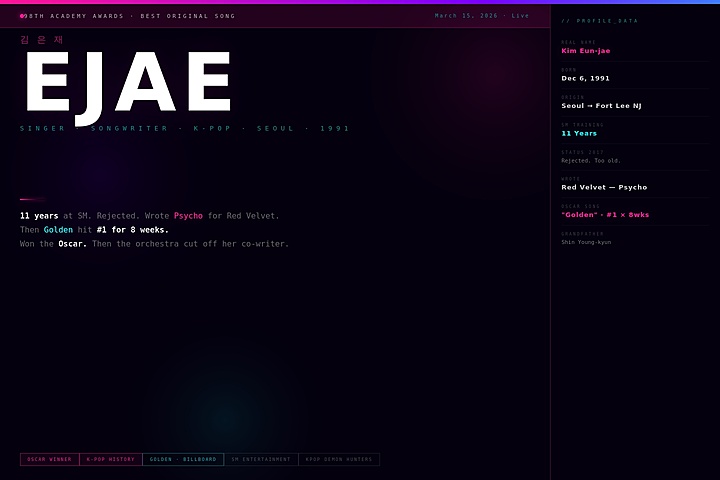
The orchestra at the Dolby Theatre did not wait.
Songwriter Yu-Han Lee had just walked to the microphone to thank the people who helped make "Golden" the first K-pop song to win an Academy Award. The music started before he finished his first sentence. His microphone cut. The spotlight went dark. Six people stood onstage holding Oscars — one of the most significant wins in the history of the ceremony for Korean artists — and the show moved on as if nothing had happened.
EJAE, standing beside him, called out for them to let him speak. Nobody listened.
What happened in the moments before was different. When EJAE took her own microphone, she was crying. She had composed herself enough to say what she needed to say — about growing up in America, being made fun of for loving K-pop, about singing "Golden" in all its Korean lyrics to a room full of people who knew every word. "I realized this award is not about success," she told the audience. "It's about resilience."
That word — resilience — is not an awards speech abstraction for Kim Eun-jae. It is a biography.
EJAE Age, Real Name, and the Childhood Split Between Two Countries
Kim Eun-jae was born on December 6, 1991, in Seoul, South Korea. Her grandfather is Shin Young-kyun, one of the most decorated actors in Korean cinema history — a man who appeared in over 300 films and whose donations to the Korean film industry became legendary. When EJAE was six months old, the family relocated to Fort Lee, New Jersey. At eight years old, she moved back to South Korea, where she attended Seoul Foreign School.
The back-and-forth between American and Korean identity became the defining tension of her childhood, and later, her career. Growing up in New Jersey, she hid her Korean side. She did not talk about the music she loved. When she eventually wrote "Golden" — a song about shining, about refusing to disappear — her mother's voice was in it.
"My mom has always told me, what you say out loud is very important," she said. "Whatever you say out loud will become a story."
She returned to the United States for high school, then enrolled at New York University's Tisch School of the Arts, graduating with a BFA from the Clive Davis Institute of Recorded Music in 2014. By then, she had already been a trainee at SM Entertainment for eleven years.
Eleven Years at SM Entertainment — and the Rejection That Redirected Everything
EJAE signed with SM Entertainment at the age of eleven in 2003. For the next decade, she trained before school and after school, on weekends and during summer breaks, working toward the specific goal of debuting as a K-pop idol. She was not lazy. She was not untalented. She was, by the time SM eventually made their decision, deemed too old to debut.
She was dropped in 2017. She was 25 years old.
"I wasn't a good enough singer, I wasn't a good enough dancer, I was way too old, and I was also too tall," she said later at a Chapman University event hosted by The Hollywood Reporter. The people making those decisions were not wrong about what the industry wanted. They were simply wrong about what she could do outside of it.
The pivot to songwriting happened through a connection with composer and SM alumnus Andrew Choi, who invited her to SM's songwriting camps. In 2018, she wrote her first cut. In 2019, her fifth-ever written song was "Psycho" for Red Velvet — one of the most celebrated K-pop tracks of the decade, later certified gold in the United States. She had gone from rejected trainee to writing hits for the label that rejected her in under two years.
How "Golden" Became the Biggest K-Pop Song of the 21st Century
In April 2025, Netflix and Sony Pictures Animation brought EJAE into the KPop Demon Hunters project. Director Maggie Kang attributed EJAE's early demos as one of the reasons the film was greenlit. EJAE co-wrote and recorded most of the demos herself, eventually becoming the official singing voice for Rumi — one third of Huntrix, the fictional K-pop girl group at the film's center.
"Golden" became something that nobody predicted. The song hit number one on the Billboard Hot 100 and held the position for eight weeks between August and October 2025. The soundtrack spent weeks in the Billboard 200 top ten. KPop Demon Hunters became the most-watched film in Netflix history. "Golden" became the longest-running number one girl group song of the 21st century.
In February 2026, "Golden" won the Grammy for Best Song Written for Visual Media — the first Grammy ever awarded to a K-pop song. In January, it won the Golden Globe and Critics Choice for Best Original Song. On March 15, at the 98th Academy Awards, it won the Oscar. Three months of consecutive wins. The sweep was not a surprise to anyone who had been watching.
The Oscars Mic Cut — What EJAE Said Afterward
The moment that went viral on March 15 was not EJAE's speech. It was what happened after it.
Rolling Stone confirmed that after EJAE finished speaking, co-writer Yu-Han Lee stepped to the microphone, and the orchestra immediately began playing. His microphone was muted. The spotlight was cut. EJAE called out for the show to let him speak. The Oscars moved on.
Speaking to reporters afterward, EJAE was measured. She told E! News that what she had wanted to say in those final moments was a thank-you to her Huntrix bandmates Rei Ami and Audrey Nuna. "They killed it with their singing, and they're just incredible people, and I love them so much."
She also described the performance earlier in the evening — Huntrix performing "Golden" live for the Oscars audience, audience members waving light sticks — as something she had never considered possible. "It was not on my bucket list because I didn't think it was possible."
For those following the careers of other Korean-American performers navigating the space between two cultures and two industries, Ryan Kiera Armstrong's story of a cancelled show and a very public response to it offers a different angle on what it looks like to handle a major career moment in front of an audience — composure as its own kind of statement.
Frequently Asked Questions About EJAE
Who is EJAE?
EJAE is the professional name of Kim Eun-jae, a 34-year-old Korean-American singer, songwriter and record producer born on December 6, 1991, in Seoul. She is the singing voice of the character Rumi in the Netflix animated film KPop Demon Hunters and co-wrote its breakout song "Golden," which won the Academy Award for Best Original Song at the 98th Oscars on March 15, 2026. She is a graduate of NYU's Tisch School of the Arts and the granddaughter of celebrated Korean actor Shin Young-kyun.
What is EJAE's real name?
EJAE's real name is Kim Eun-jae. She adopted the stage name EJAE because people in the United States had difficulty pronouncing her Korean name. She was born in Seoul, South Korea, and grew up between Fort Lee, New Jersey, and South Korea before attending New York University.
Why was EJAE rejected by SM Entertainment?
EJAE trained at SM Entertainment for approximately ten years, starting at age eleven in 2003. She was ultimately not debuted as a K-pop idol because SM deemed her too old to launch as a solo artist or group member. She has said she was also told she was not a strong enough singer or dancer at the time of the decision. After being dropped in 2017, she transitioned into songwriting and went on to write hits, including Red Velvet's "Psycho," before her breakthrough with "Golden."
What songs has EJAE written?
EJAE's songwriting credits include Red Velvet's "Psycho" (2019), Aespa's "Drama," and multiple songs for the KPop Demon Hunters soundtrack, including "Golden," "How It's Done," and "Your Idol." "Golden" topped the Billboard Hot 100 for eight weeks in 2025, won the Grammy for Best Song Written for Visual Media in 2026, and won the Academy Award for Best Original Song at the 98th Oscars.
What happened when EJAE's mic was cut at the Oscars?
After EJAE finished her acceptance speech at the 98th Academy Awards, co-writer Yu-Han Lee stepped to the microphone, and the orchestra immediately began playing him off. His microphone was muted, and the spotlight was cut before he could finish speaking. EJAE called out for the show to let him speak, but the ceremony moved on. Speaking to reporters afterward, he said she had wanted to thank her Huntrix bandmates Rei Ami and Audrey Nuna in those final moments.