
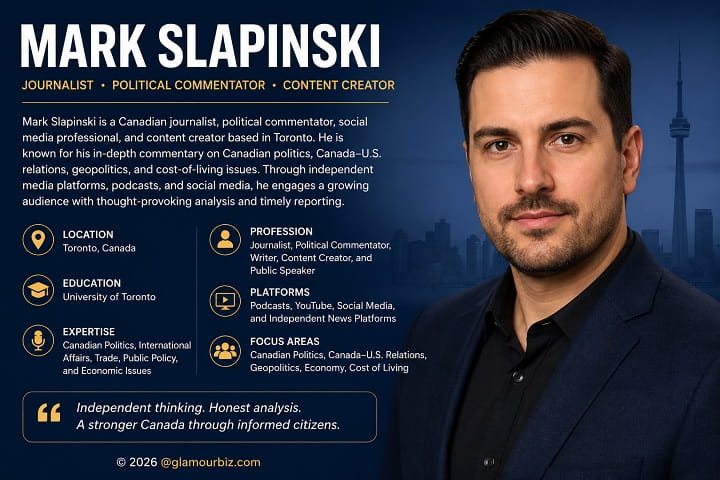
Mark Slapinski, a Canadian political commentator, is a familiar name for a lot of us who love political discussions in the digital space. Recently, a social media post Mr. Mark shared that criticized the 'staged Trump distraction' theory led to a very intense exchange of opinions on various political platforms.
Speculative Social Media Post Sparks Claims of a "Staged Trump Distraction" Narrative
A post recently making the rounds on X, credited to Mark Slapinski, has stirred up quite the conversation in political circles online. The post hinted at what some readers took as a suggestion that a "staged distraction strategy" was at play involving Donald Trump, though the language was far from conclusive, leaning more toward speculation than any concrete claim.
What happened next was predictable, in the way that politically charged posts often are: it spread. Fast. People who had never heard of Slapinski were suddenly sharing it, arguing over it, and reading entirely different things into the same few sentences. Some took it at face value as a direct accusation, while others saw it as a broader meditation on how political stories get spun and amplified until they barely resemble their starting point.
That's the nature of political content online, especially when a name like Trump is involved. The original message almost becomes secondary, and what takes over is the interpretation game, where intent gets debated just as fiercely as the substance.
Slapinski's style leans into this space deliberately. He writes with sharp framing and isn't afraid of speculative territory, which tends to provoke reaction rather than quiet agreement. Whether you find that refreshing or irresponsible probably says more about where you sit politically than anything else, but either way, it gets people talking, which in today's media landscape is often the whole point.
A Bold Voice in Canadian Federal Politics: Mark Slapinski's Media Presence
Mark Slapinski, a Canadian political commentator, made a name for himself not through a major network or a mainstream publication but through consistency alone and a readiness to say things with great emphasis. He is interested in Canadian federal politics and international affairs, and he is not a neutral observer, so to speak.
That's actually part of the appeal for many of his followers. Where traditional journalism often bends toward balance, Slapinski leans into interpretation. He tells you what he thinks is happening and why it matters, and he does it quickly, usually before the news cycle has had time to fully digest the story itself.
Social media is his primary stage, and he uses it well. Direct audience engagement, rapid response to breaking developments, no editorial gatekeepers slowing things down. It's a format built for the moment we're living in politically.
Within Canadian media, he represents a growing wave of independent voices who don't fit neatly into old categories. They're not quite journalists in the traditional sense, not quite pundits, but something in between, and audiences are clearly finding value in that middle ground. Critics will argue the lines between fact and opinion get blurry in this format, and that's a fair concern. But the engagement numbers suggest plenty of people aren't bothered by that trade-off. They want a voice with a point of view, and that's exactly what he delivers.
Inside the Making of a Commentator: Mark Slapinski's Journalism and Media Career
Slapinski changed into a political commentator, not at once but over time. His story is an example of a transformation that has become quite typical for independent media people consciously starting a career in journalism and communication and then, over time, changing their values and modes of operation, eventually discarding the traditional structures that once defined the profession. Instead of confining himself to a single newsroom or organization, he developed his presence on blogs, social media, and digital publications.
What defines his career most is that blending of straight reporting and personal commentary. He'll cover a political development and then tell you exactly what he makes of it, sometimes in the same breath. This hybrid approach is increasingly common in digital media, where readers often want context and perspective bundled together rather than delivered separately. Beyond written content, he's also worked in media production, experimenting with short-form analysis and multimedia formats that suit the attention spans and habits of online audiences.
The independence he's built comes with real freedom, as he controls the narrative, the timing, and the tone. But it also comes with real responsibility. Without the checks that traditional editorial structures provide, the burden of accuracy and fairness falls entirely on the creator. In a media environment that rewards speed and visibility above almost everything else, that's a tension every independent commentator has to navigate, and how well they manage it tends to define their long-term credibility.
Beyond the Camera Lens: Mark Slapinski's Private Life and Marriage Away From the Spotlight
For someone who spends a considerable amount of time in the public eye, Mark Slapinski keeps his personal life remarkably quiet. There are no regular glimpses into his home life, no family milestones shared for audience engagement, and no blurring of the line between the commentator and the private person behind him.
Details about his marriage or family are largely absent from his public content, and that appears to be a deliberate choice rather than an oversight. In an era where personal branding and oversharing have become almost standard practice for anyone building an online audience, that kind of restraint stands out.
It's genuinely not easy to maintain privacy when you're active in political discourse, as the internet has a way of collapsing those boundaries whether you want it to or not. But Slapinski seems committed to keeping those two worlds separate, which means most people who follow his work know his opinions far better than they know anything about the man himself.
In a way, that separation shapes how he's perceived. His public image is built almost entirely on ideas: what he thinks, what he argues, and what he notices. Biography barely enters the picture. For some commentators, that would feel like a missed opportunity to connect. For others, it's exactly the right call, letting the work speak without the noise of personal exposure getting in the way. It's a quieter kind of credibility, built on substance over personality, and in the current media climate, that's actually rarer than it sounds.