
Some names carry a strange kind of magnetism, showing up again and again in entirely different corners of the professional world. Chris McDonough is one of them.
Search this name and four distinct careers surface: a homicide investigator turned podcast storyteller, a Missouri judge presiding over civil and criminal dockets, a New York attorney who has spent decades guarding the ethics of the legal profession, and a cold-case specialist coordinating law enforcement relationships across the country. Each carries the same name yet walks a completely different path. Here is a closer look at all four.
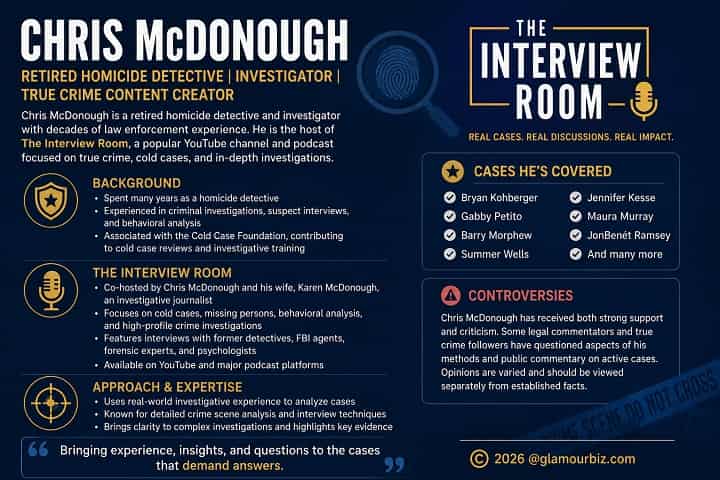
Chris McDonough: Retired Homicide Detective & True Crime Podcast Host
For nearly a quarter of a century, investigative work defined Chris McDonough's daily rhythm. Public safety became his calling in 1982, and he spent close to twenty-five years with the Oceanside Police Department in California, thirteen of those years working homicide cases directly. That kind of tenure builds more than experience. It builds instinct, the sort that television producers and true crime audiences cannot get enough of.
His reputation eventually reached far beyond southern California. Recognized nationally as an expert in criminal behavior, he became a sought-after guest on programs built around protecting children, appearing on the Oprah Winfrey Show, Dateline NBC, CBS's 48 Hours, and the BBC, among other outlets. His specialty sits at the intersection of forensics and human psychology, the kind of work that requires reading a crime scene the way a linguist reads a difficult sentence, searching for meaning buried beneath the surface details.
The cases attached to his name read like a syllabus for anyone studying modern criminal investigation. Over the years, he consulted on some of the most closely watched child homicide and kidnapping investigations in American history, including the JonBenét Ramsey case, the disappearance of Elizabeth Smart, the murder of Stephanie Crowe, the death of Matthew Cecchi, and the West Memphis Three case. Few investigators can claim a resume touching that many headline-making mysteries, and fewer still can say their theories reshaped how an entire field thinks.
That last point deserves its own spotlight. Back in 1995, this detective identified a disturbing pattern he termed the "White Collar Predator," describing an intellectually sophisticated sexual deviant whose reach was amplified by the internet, a concept that has since become foundational to modern criminal profiling. Long before cybercrime dominated headlines, he was already mapping the shadowy overlap between technology and predatory behavior.
Retirement from the force did not mean retirement from purpose. Alongside his wife Karen, a veteran investigative journalist, he now hosts The Interview Room, a true crime podcast that revisits cold cases and infamous trials with the kind of insider perspective only a seasoned investigator can provide. Episodes have walked listeners through the Alex Murdaugh murder trial, the Susan Smith case, and the chilling videotaped confession of Matthew Cecchi's killer. The show blends narrative storytelling with procedural detail, giving audiences a front-row seat to conversations that once happened only behind closed interrogation room doors.
Family history may explain some of his drive toward service. His father, John McDonough, served as a decorated United States Marine across three wars, World War II, the Korean War, and Vietnam, while his mother Mary also served in the Marine Corps, with both later laid to rest at Arlington National Cemetery. He also carries that legacy of protection into advocacy work, having spent years supporting a nationally recognized child safety program tied to Major League Baseball.
Judge Chris McDonough: Missouri's 11th Judicial Circuit
A different Chris McDonough wears a robe rather than a badge. This one presides over courtrooms in St. Charles County, Missouri, where his rise through the legal system reads like a steady climb rather than a single dramatic leap. He was elected as an associate circuit judge in 2020, then appointed circuit judge by Governor Michael L. Parson in 2022, and later won election to a full six-year term in 2024. Today he serves as the presiding judge for the 11th Judicial Circuit, handling both civil and criminal matters from Courtroom 509 on the fifth floor.
His path to the bench began with a strong academic foundation. Born in St. Louis County, Missouri, he holds a law degree from St. Louis University School of Law, a master's in business administration from Fontbonne University, and a bachelor's degree from Maryville University, and he later completed the Harvard Law School Judicial Executive Leadership Program. That combination of legal training and business acumen gives him an unusually broad toolkit for managing a busy circuit court docket.
Before ascending to the judiciary, his career moved through several chapters of private practice. He started at the St. Louis office of a large global law firm before founding his own practice, The McDonough Law Firm, and he also served as a prosecuting attorney and municipal judge across the 11th, 12th, and 21st Judicial Circuits. That breadth of experience, prosecuting cases in one chapter and defending them in another, likely sharpened the balanced judicial temperament he now brings to the bench. Attorneys who appear before him often note his methodical approach, a trait that seems to trace directly back to years spent on both sides of the courtroom aisle.
Chris McDonough: Legal Ethics Attorney at Foley Griffin
New York's legal community knows a third Chris McDonough, one whose entire career orbits around professional ethics rather than criminal trials or civil disputes. He now serves as a consultant to Foley Griffin, bringing decades of experience representing attorneys and advising law firms throughout New York. Ethics work rarely makes headlines, yet it quietly shapes whether the legal profession maintains public trust.
His early career placed him directly inside the disciplinary machinery of the profession. Before joining Foley Griffin, he served as assistant counsel to the Grievance Committee for the Tenth Judicial District, prosecuting grievance matters before the Appellate Division, Second Judicial Department. That kind of role demands a rare blend of diplomacy and rigor, holding fellow attorneys accountable while still respecting the presumption of good faith that underlies professional conduct.
By the early 2000s, he shifted toward private practice with a sharpened focus. Starting in January 2003, he entered private practice, concentrating exclusively on grievance defense, judicial defense, admissions, character and fitness representation, and risk management, eventually becoming a trusted ethics resource for small and mid-sized law firms across New York. Fourteen years later, he joined Foley Griffin as special counsel in 2017, a position in which he continues to serve today.
Teaching has run parallel to his legal practice for much of his career. He has taught ethics as an adjunct law professor, developed and delivered hundreds of continuing legal education courses for bar associations and other providers, and authored numerous articles for law reviews, the New York Law Journal, and various bar association publications. He has also lent his expertise to organizations including the Nassau Academy of Law and ethics committees for both the Nassau County and New York State Bar Associations. Outside the courtroom and classroom, colleagues describe a man who treats mentorship as seriously as litigation, quietly shaping the next generation of ethical lawyers one seminar at a time.
Chris McDonough: Cold Case Foundation, Director of Investigations & Law Enforcement Relations
The fourth Chris McDonough operates at the crossroads of law enforcement, nonprofit leadership, and community trust building. He currently serves as Director of Investigations and Law Enforcement Relations at the Cold Case Foundation, based in the San Diego metropolitan area, and has built a professional network exceeding five hundred connections.
Colleagues who have worked alongside him describe someone whose leadership style leans on encouragement rather than command. Peers have praised him as a deeply caring advocate for law enforcement professionals and community protection, someone widely regarded as one of the good guys within the field, and as an empowering leader whose professionalism and years of experience help others think beyond conventional solutions. That reputation for approachable confidence appears to be a defining thread throughout his career, whether he is mentoring a younger investigator or building bridges between agencies.
Beyond his foundation role, he has continued expanding his footprint in investigative media. He has been actively recruiting criminal analysts and behavioral experts for a long-form investigative podcast called Alternative Eye: Beyond the File, seeking professionals interested in joining discussions covering topics such as the behavioral profile of serial killer Dennis Rader and the investigative complexities surrounding the JonBenét Ramsey case. His involvement with major policing organizations, from the International Association of Chiefs of Police to the FBI National Academy Associates, underscores just how deeply embedded he remains in the broader law enforcement ecosystem.