
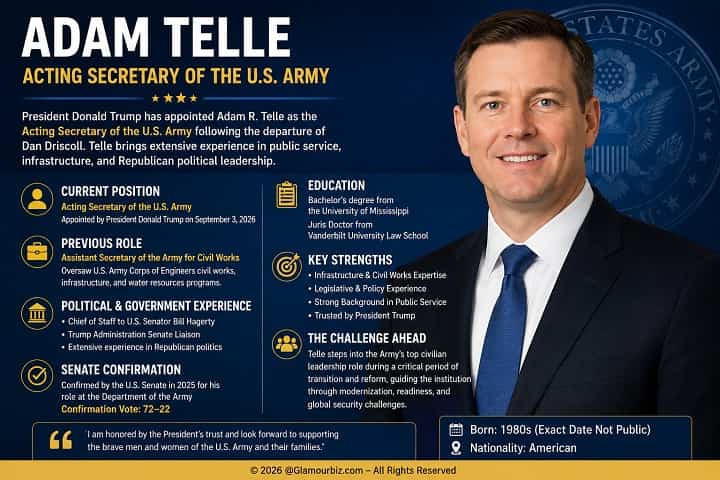
U.S. President Donald Trump has appointed Adam Telle as Acting Secretary of the U.S. Army, placing him in the service’s top civilian leadership position following the departure of Dan Driscoll.
Adam Telle previously served as Assistant Secretary of the Army for Civil Works and brings years of experience in Washington. His appointment comes as the Army undergoes leadership changes and prepares for important decisions about its future priorities.
Adam Telle's Early Career and Rise Through Republican Politics
Adam Telle didn't grow up dreaming of running the Army. He's an Alabama native who went to Mississippi State University, and after graduating, he did what a lot of ambitious young people do: he moved to Washington and started looking for a job on Capitol Hill.
He found one in the office of Alabama Senator Richard Shelby. That's a pretty solid place to cut your teeth in politics. Shelby was a heavyweight when it came to appropriations and defense spending, so working for him meant learning the real mechanics of how Congress operates, not the version you read about in textbooks, but the actual back and forth of getting a bill funded and passed.
From there, Telle moved to the office of Mississippi Senator Thad Cochran, and this is where he really settled in. He stayed for about ten years, working his way up through titles like deputy chief of staff and legislative director. He also became Cochran's main person on national security issues, which meant he had to get comfortable with defense budgets and the tangle of agencies that all touch military policy in one way or another.
Here's the interesting part. Telle never served in the military. He doesn't have an engineering background either, even though his career would eventually land him in charge of major infrastructure projects. What he built instead was a reputation as someone who understood the system inside and out. He wasn't the guy giving speeches or chasing headlines. He was the guy senators relied on to actually get things done. That pattern followed him for the rest of his career.
Inside Telle's Work on Capitol Hill and in the White House
Telle's résumé on the Hill goes beyond just working for Cochran. He also served as the lead staffer for the Senate Appropriations Committee's Homeland Security Subcommittee. People outside Washington don't usually pay much attention to appropriations work, but honestly, that's often where the real decisions get made. Whoever controls the money tends to have more influence day to day than the senators whose names end up in the news.
When Trump's first term began, Telle got pulled into the White House. He led the Senate team inside the Office of Legislative Affairs for about a year and a half, working as a special assistant to the president. His job was basically to keep the lines open between the administration and the Senate on national security and appropriations matters, translating what the White House wanted into something senators would actually vote for, and doing the same in reverse.
That White House stint mattered because it gave him something a lot of congressional staffers never get: a firsthand look at how an administration functions from the inside, not just how Congress reacts to it after the fact. Understanding both sides of that relationship became one of the defining traits of his career.
After leaving the White House, Telle went back to the Senate, this time as chief of staff for Tennessee Senator Bill Hagerty, a job he held from 2021 through 2025. Chief of staff is not an easy gig. You're not just handling policy; you're running an entire office and managing every political relationship that comes with it. By the time this chapter ended, Telle had put in roughly twenty years total between Congress and the executive branch. That's two decades built almost entirely on institutional knowledge, not public visibility.
The Civil Works Portfolio That Put Adam Telle in the National Spotlight
In 2025, Telle's career shifted in a way that finally pulled him into public view. Trump nominated him to be Assistant Secretary of the Army for Civil Works, a role that oversees the Army Corps of Engineers' civilian responsibilities. That includes ports, waterways, and flood control infrastructure across the entire country. The Senate confirmed him 72 to 22, and almost all the opposition came from Democrats, with one independent joining them.
Think about that for a second. Telle spent his whole career around legislative strategy and appropriations. He had no formal engineering training and no military background. When he first showed up in Washington as a fresh graduate, none of that was part of his résumé. And yet he ended up in charge of massive infrastructure decisions that affect flood protection, shipping lanes, and water systems used by millions of people.
In this position, he focused on things like commercial navigation, flood damage reduction, and permitting for major projects. These aren't small administrative tasks. Decisions made in this office have direct consequences for coastal towns, farmers who depend on river transportation, and cities that need flood protection to function. This was the point where Telle stopped being a behind-the-scenes operator and became someone with real operational authority.
A New Chapter for Telle as Washington Watches the Army's Next Move
Telle's jump to acting secretary of the army happened for a specific reason. Dan Driscoll resigned, and reports point to growing tension between him and Defense Secretary Pete Hegseth. Driscoll, who describes himself as a third-generation Army veteran, kept his exit statement gracious. He thanked the soldiers and civilians he worked with and expressed pride in his time leading the Army. Still, the circumstances behind his departure hint at deeper friction at the top of the Pentagon.
And Driscoll wasn't the only senior leader affected. Hegseth has also removed several high-ranking Army officers recently, including the Army's chief of staff and the general who led U.S. Army forces across Europe and Africa. Put all of that together and you get a picture of real instability at the top of one of the country's most important military branches right now.
Telle is stepping into this job during a genuinely tense period. The U.S. is still involved in an active conflict with Iran, and a large number of Army troops are stationed throughout the Middle East. That conflict has strained military resources, especially when it comes to critical systems like the Patriot and THAAD missile interceptors, both of which fall under the Army's responsibility. So this isn't a quiet administrative role he's walking into. It's an active, high-stakes situation with real strategic consequences.
Nobody knows yet whether Telle will stay in this role long-term or if he's simply a placeholder while the administration searches for a permanent nominee. What's clear right now is that his career, built quietly through decades of staff work in Congress and the White House, has suddenly placed him in one of the most important leadership positions in the U.S. military. He spent years mastering appropriations bills and legislative strategy behind closed doors. Now he's leading the Army during an active overseas conflict, and that's a completely different kind of test, one that will show whether his political instincts can hold up under real military pressure.