
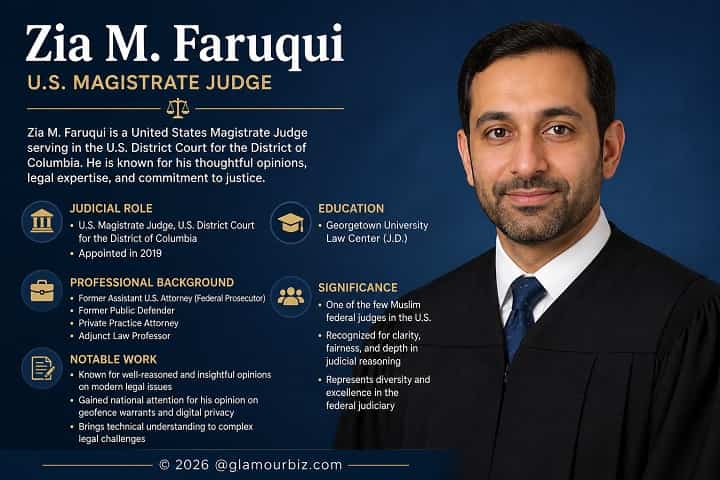
U.S. Magistrate Judge Zia M. Faruqui has drawn national attention after questioning the jail treatment of a federal detainee accused in a high-profile Trump assassination attempt case. During a recent court hearing in Washington, D.C., the judge raised concerns about whether the suspect’s conditions of confinement—including isolation and suicide watch—were justified or excessively restrictive for a pretrial detainee.
While prosecutors defended the measures as necessary security precautions, Faruqui emphasized that even individuals facing serious charges must be treated in line with constitutional protections and due process rights. The case has reignited debate over how federal detention facilities balance security with humane treatment standards.
Zia Faruqui in the News: Judge Questions Jail Treatment of Trump Assassination Attempt Suspect
U.S. Magistrate Judge Zia M. Faruqui recently drew national attention after expressing serious concern over the treatment of a federal detainee accused in a high-profile political violence case involving an alleged assassination attempt on former President Donald Trump.
During a courtroom hearing in Washington, D.C., Judge Faruqui questioned whether the conditions in which the suspect, Cole Tomas Allen, was being held met constitutional and legal standards for pretrial detention. His remarks focused on reports that the detainee had been placed under strict suicide watch, kept in prolonged isolation, and subjected to restrictive confinement conditions that the judge suggested may not have been medically or legally justified.
What made the moment especially notable was the judge’s unusually direct tone. He reportedly described the situation as “concerning” and emphasized that even individuals accused of extremely serious crimes must still be treated in accordance with constitutional protections. His comments also included a request for jail officials to provide justification for the level of restriction imposed on the detainee.
This judicial intervention sparked wider public discussion about how federal detention facilities handle high-risk or politically sensitive suspects. The case also highlighted the ongoing tension between institutional security protocols and the rights of individuals who have not yet been convicted of a crime.
While prosecutors defended the jail’s actions as precautionary measures, the judge’s concerns underscored a key legal principle: pretrial detention is not meant to be punitive. Instead, it is intended to ensure court appearance and public safety while respecting due process rights.
Judicial Career of Zia M. Faruqui in the U.S. Federal Court System
Zia M. Faruqui serves as a U.S. Magistrate Judge in the U.S. District Court for the District of Columbia, one of the most legally significant jurisdictions in the United States due to its proximity to federal agencies, political institutions, and national security cases.
As a magistrate judge, his role is not to preside over full jury trials but to oversee the early stages of federal criminal and civil cases. This includes issuing search warrants, conducting bail hearings, handling detention reviews, and managing preliminary legal proceedings that shape the direction of major cases.
Over the course of his career, Faruqui has been involved in a wide range of federal matters, many of which carry national importance. These include terrorism-related investigations, complex financial crimes, and cases involving political or governmental implications. Because of the nature of the D.C. federal court system, magistrate judges often encounter cases that quickly become part of national news cycles.
Faruqui’s judicial work is widely recognized for its careful attention to procedural detail. He is known for ensuring that government actions—especially those involving detention or surveillance—are properly justified under law. This consistent approach has positioned him as a judge who plays a crucial gatekeeping role in the early phases of federal justice.
Known for Strong Stance on Civil Liberties and Due Process Rights
One of the defining characteristics of Judge Faruqui’s judicial approach is his strong emphasis on civil liberties and constitutional protections. In many of his courtroom interactions, he has highlighted the importance of ensuring that government authority does not override individual rights, even in cases involving serious allegations.
This perspective is particularly significant in the context of federal detention. Pretrial detainees are legally presumed innocent, and their confinement conditions must align with constitutional standards. Faruqui has repeatedly shown interest in whether those standards are being met, especially when it comes to isolation, mental health precautions, and detention severity.
His questioning style in court often reflects a broader concern about proportionality. In other words, he appears to evaluate whether the government’s actions are appropriate for the level of risk posed by the individual case, rather than accepting standard procedures without scrutiny.
Legal observers have noted that this approach helps maintain balance in a system where security concerns can sometimes lead to overly restrictive measures. At the same time, it also places Faruqui in a position where his courtroom comments can attract public attention, particularly in politically sensitive cases. Overall, his judicial philosophy aligns with a core principle of American constitutional law: that rights do not disappear at the jailhouse door.
Role in High-Profile Federal Cases in Washington, D.C. Courts
Serving in the U.S. District Court for the District of Columbia means that Judge Faruqui regularly handles cases with national implications. Unlike many federal districts, Washington, D.C. is a central hub for cases involving federal agencies, political figures, national security investigations, and major public events.
Faruqui’s courtroom has seen a range of complex legal matters, including cases tied to terrorism investigations, cybercrime, public corruption, and politically sensitive allegations. In such cases, magistrate judges often make early decisions that influence bail conditions, investigative authority, and the treatment of defendants in custody.
Because of this environment, his judicial decisions are frequently scrutinized by both legal experts and the public. Even preliminary rulings can attract media coverage when they involve issues of political violence or government accountability.
His involvement in such cases highlights the important but often underappreciated role of magistrate judges in the federal system. While district judges typically receive more attention for final rulings, magistrate judges like Faruqui are often the first to assess the legal boundaries of a case.
Top 5 FAQs About Zia Faruqui
1. Who is Zia M. Faruqui?
He is a U.S. Magistrate Judge serving in the U.S. District Court for the District of Columbia, handling federal pretrial matters and hearings.
2. What type of cases does he oversee?
He handles early-stage federal cases, including detention hearings, bail decisions, search warrants, and preliminary motions in criminal and civil matters.
3. Why has he recently been in the news?
He gained attention after questioning the treatment of a detainee involved in a high-profile alleged assassination attempt case and raising concerns about jail conditions.
4. What is his judicial focus?
He is known for emphasizing civil liberties, due process rights, and ensuring that pretrial detention conditions meet constitutional standards.
5. Does he conduct full criminal trials?
No. As a magistrate judge, he does not preside over full jury trials but plays a key role in early federal proceedings.