
Ramzi Kassem, chief counsel to New York City Mayor Zohran Mamdani, has faced criticism after Mamdani handed him a ceremonial signing pen following a 9/11 remembrance ceremony at City Hall.
The gesture drew controversy because Kassem previously represented former Guantánamo detainee Ahmed al-Darbi, who pleaded guilty to terrorism-related war crimes. Critics called the moment insensitive to 9/11 victims and their families.
City Hall defended Kassem’s role, explaining that he and his legal team helped draft the executive orders signed during the ceremony. The controversy has renewed attention on Kassem’s career as a civil-rights lawyer and his work involving national security, immigration, and Guantánamo detainees.
Mamdani Faces Backlash Over 9/11 Pen Handoff to Chief Counsel Ramzi Kassem
New York City Mayor Zohran Mamdani is facing sharp criticism after a small, symbolic gesture at a solemn ceremony turned into a full-blown political headache. Ahead of the 25th anniversary of the September 11 attacks, Mamdani signed a set of executive orders designating the date a citywide day of remembrance and service, while also strengthening the city's efforts to prevent future terrorist threats. It was the kind of routine mayoral signing that usually passes without much notice.
But what happened right after the ink dried is what set things off. Mamdani handed the ceremonial pen to NYPD Commissioner Jessica Tisch and asked her to pass it along to his chief counsel, Ramzi Kassem. On its own, that might have been a quiet gesture of thanks to a staffer who helped draft the orders. Instead, it became a flashpoint.
The reason is Kassem's legal history. Years before joining City Hall, he represented Ahmed al-Darbi, a man who pleaded guilty to war crimes connected to al Qaeda's maritime terror plots, including a 2002 bombing of a French oil tanker off the coast of Yemen. Al-Darbi was held at Guantanamo Bay for years before his conviction. To make the connection even more charged for critics, al-Darbi's sister was married to Khalid al-Mihdhar, one of the hijackers aboard the plane that struck the Pentagon on September 11, 2001.
Once that detail started circulating, the backlash came fast. New York State Assemblyman Kalman Yeger posted an image of the handoff and called the gesture disturbing. Joyce Cohen Day, whose mother died in the South Tower, said she believed the mayor had deliberately handed a memento of the day to a man she associates with defending al Qaeda. Commentators like Benny Johnson amplified the outrage online, framing it as disrespectful to victims' families just as the city prepared to mark the anniversary. Former state senate candidate Maria Danzilo added her voice too, saying the moment reflected how difficult it has become to navigate city politics under this mayor, especially around such a sensitive date.
City Hall pushed back on the framing. A spokesperson told the New York Post that Kassem was present and involved because he and his team had actually drafted both executive orders as part of his official duties as chief counsel. In other words, from the administration's point of view, this wasn't a political statement. It was simply a lawyer being recognized for doing his job. Mamdani's office did not immediately respond to further requests for comment from other outlets covering the story.
Whatever the intent, the controversy has thrust Kassem, a name mostly known in legal and academic circles, into the middle of a very public and very charged news cycle. So who exactly is the man at the center of it?
Who Is Ramzi Kassem, Mayor Mamdani's Chief Counsel Under Fire?
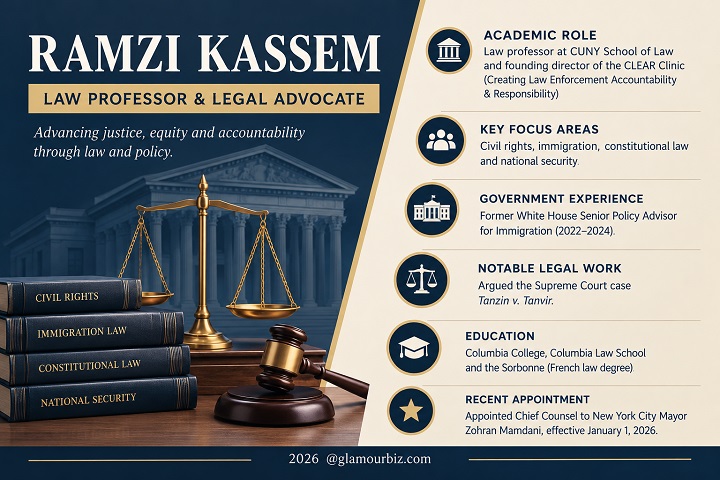
Ramzi Kassem is not new to controversy, and he is certainly not new to hard cases. For most of his career, he has been a law professor at the City University of New York, where his teaching, writing, and clinical work have focused on what he has often described as the excesses of the American security state, both at home and abroad.
Born in Beirut during Lebanon's civil war, Kassem's early life was shaped by displacement. His family relocated to Baghdad, then briefly to Damascus during the Iraq-Iran War, before eventually settling elsewhere as the fighting continued. He finished high school in Switzerland on a scholarship, then came to the United States for college. He has lived in New York, on and off, ever since, and has described himself as a proud immigrant and an unapologetic New Yorker.
Academically, Kassem is a graduate of Columbia College and holds law degrees from both Columbia Law School, where he served as a senior editor of the Columbia Law Review, and the Sorbonne in Paris. Before joining CUNY's faculty in 2009, he taught at Yale Law School and Fordham Law School, working in clinics focused on civil liberties, national security, and immigrant rights.
It's this background in national security law that eventually led him to some of the most difficult and controversial legal work in the country, representing detainees held at Guantanamo Bay, including Ahmed al-Darbi, the case now at the heart of the current controversy. He has also represented Mahmoud Khalil, a Columbia University pro-Palestinian activist detained by immigration authorities, and Yunseo Chung, another case that drew national attention.
In late 2025, Mamdani tapped Kassem, then 48 years old, to serve as his administration's chief legal counsel, a role that put a longtime academic and civil rights litigator into the middle of city government for the first time.
Inside Ramzi Kassem's Relationship With Partner Darializa Avila Chevalier
Away from courtrooms and City Hall, Kassem's personal life has also drawn attention recently, largely because of who he is dating. His partner is Darializa Avila Chevalier, a 32-year-old CUNY Graduate Center doctoral student in sociology who also works as a public defense investigator.
The two first crossed paths in 2019, not through the law school, but through activism. Avila Chevalier was doing immigrant defense organizing with a group called Families of Freedom, work that intersected with CLEAR, the legal clinic Kassem founded. According to Avila Chevalier, the two actually met outside an ICE detention facility, both working toward the same goal of freeing someone who had been unjustly detained. She has said their professional connection slowly grew into a friendship and eventually into a romantic relationship, describing Kassem as a steady and supportive presence in her life over the past several years.
Interestingly, the two never worked together directly. Kassem was teaching at the law school campus in Queens, while Avila Chevalier was a student based in Manhattan. Still, their paths kept crossing through organizing work, and the relationship developed from there.
Avila Chevalier has recently become a political figure in her own right, having pulled off an upset win over a longtime member of Congress in a Democratic primary. That victory, combined with Kassem's own City Hall role, has led some in New York political circles to describe the couple as a rising power duo within Mamdani's broader political orbit. Both are described as openly Muslim, pro-Palestinian, and critical of ICE's immigration enforcement practices. For their part, the couple has asked for privacy regarding their relationship, a request that has largely been respected even as their public profiles have grown.
Ramzi Kassem's Career: From CUNY Law Professor to NYC Chief Counsel
Kassem's career is, in many ways, a story of steadily escalating stakes. He began as a teaching fellow at Yale, moved into adjunct work at Fordham, and by 2009 had joined the CUNY School of Law full-time. That same year, he founded CLEAR, short for Creating Law Enforcement Accountability and Responsibility, a clinic aimed at supporting Muslim, Arab, South Asian, and other communities in New York who found themselves caught up in national security and counterterrorism investigations. He also spent more than a decade directing or co-directing the law school's Immigrant and Non-Citizen Rights Clinic.
Over the years, Kassem and his students took on an unusually wide range of cases, touching civil rights law, constitutional law, criminal defense, immigration, and international humanitarian law. Their work brought them before federal courts at every level, as well as before military commissions at Guantanamo Bay and international tribunals. Perhaps his most notable legal victory came in Tanzin v. Tanvir, a case he argued before the U.S. Supreme Court challenging the federal government's misuse of terrorism watchlists. The court ruled unanimously in favor of his clients, a rare and significant outcome in national security litigation.
In 2022, Kassem stepped away from CUNY temporarily to take on a role as Senior Policy Advisor at the White House, becoming the first CUNY faculty member ever appointed to a White House position. There, he worked within the Domestic Policy Council, leading interagency committees on issues ranging from the immigration court backlog to watchlisting and screening policy, and even efforts to counter the growing threat of commercial spyware. He also collaborated with National Security Council teams on intelligence and transborder policy issues. He returned to CUNY in 2024.
His most recent career shift came when Mamdani appointed him as the city's chief counsel, a move that brought his decades of national security and civil rights litigation experience directly into city government. It's a position that has already tested him, not through courtroom battles this time, but through the far messier arena of public perception, symbolism, and political optics, as the recent 9/11 pen controversy has shown.
Throughout his career, Kassem has also been recognized by his peers, having been elected to the American Law Institute and named to the inaugural cohort of Freedom Scholars, an honor given to those working toward social, racial, and economic justice. Whether the current controversy will overshadow that body of work or simply become another chapter in a career defined by controversy and hard cases remains to be seen.