
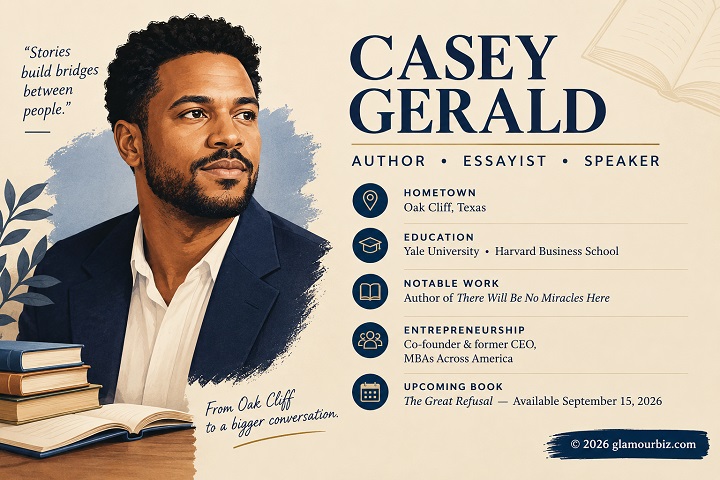
Casey Gerald is having a moment again. The author sat down with NPR's Fresh Air on September 8, 2026, to talk about his new book, The Great Refusal: A New Vision of Resistance, and why he's walked away from success twice in his career instead of holding onto it.
The book hits shelves September 15. In it, Gerald digs into resistance, freedom, and what it actually means to quit something once it stops serving you, ideas he's been circling since his 2018 memoir made him a name people recognized. It's the same move he's made before: build something people notice, then leave it behind when it no longer fits.
Who Is Casey Gerald? Inside the Life of the Acclaimed Author
Casey Gerald is a writer, speaker, and former nonprofit leader whose life reads like something out of a novel, except every part of it actually happened. He was born and raised in Oak Cliff, a working-class, historically Black neighborhood on the south side of Dallas, Texas. His childhood was shaped early by loss. His father, once a college football star at Ohio State, drifted in and out of his life. His mother struggled with severe mental illness and disappeared from a psychiatric ward when Gerald was just 13 years old. For years, he assumed she was dead. She resurfaced nearly five years later, though the reunion brought its own complications.
What kept him standing during those years was community, not any single household. His older sister dropped out of college at 19 to raise him when he was 15. Both of his grandmothers played a role in keeping him fed and housed. Teachers, aunts, and neighbors filled in the gaps his parents couldn't. Gerald has said he doesn't take much credit for his own resilience during that period. Instead, he points to the people around him, particularly two of his fifth-grade teachers, who noticed a struggling kid and simply refused to let him fall through the cracks.
That early instability is part of what makes his later trajectory so striking. In 2005, Gerald left South Oak Cliff High School for Yale University, a move so unusual for his community that the Dallas public school system put up posters celebrating it. He went on to play football at Yale, co-found the Yale Black Men's Union, and eventually earn an MBA from Harvard Business School. On paper, he became exactly what elite institutions promise to produce: a success story, proof that the system works if you're talented and driven enough.
But Gerald has spent much of his adult life complicating that story rather than simply living it out. He's now known just as much for stepping away from success as for achieving it, a theme that runs through both of his books and nearly every interview he gives.
Casey Gerald's Career: From Wall Street to Social Impact
Gerald's professional path started in one of the most conventional places imaginable for an ambitious Ivy League graduate: Wall Street. He took a job at Lehman Brothers, the investment bank that would later become a symbol of the 2008 financial crisis. It was a fitting, if unplanned, education in how quickly the institutions people trust most can collapse.
After business school, Gerald pivoted away from finance and into something closer to grassroots work. He co-founded and served as CEO of MBAs Across America, a nonprofit that sent young business school graduates to work directly with small business owners in overlooked communities across the country, rather than funneling that talent straight into consulting firms and banks. The idea captured attention quickly. Gerald became a fixture at conferences and on magazine covers, delivered TED Talks that have since been viewed more than four million times, and in 2016 opened for President Barack Obama at South by Southwest. New York Magazine ran a headline asking whether Casey Gerald had figured out how to fix America.
By any conventional measure, he had built a genuinely impressive career in a short amount of time. He wasn't just working within the system that had elevated him out of Oak Cliff; he was actively trying to redirect its resources toward communities like the one he came from. It was meaningful work, and it made him a recognizable name in social entrepreneurship circles well before he turned 30. And then, at what looked like the peak of that career, he shut it all down.
Why Casey Gerald Walked Away From Success — Not Once, But Twice
The first time Gerald walked away was in 2016. He closed MBAs Across America, left New York, stopped returning phone calls, and moved into a small rented house in Austin, Texas, largely alone. He has described the decision as desperate, though not in the sense of running from something specific. As he's put it, he wasn't escaping anything; he was moving toward something he couldn't yet name. He didn't read the messages piling up from people trying to reach him. He wasn't trying to seem too busy or important to respond. He simply needed to listen to something quieter than his own reputation.
That two-year retreat produced his 2018 memoir, "There Will Be No Miracles Here," which became a Best Book of the Year selection from both NPR and The New York Times and a finalist for a Lambda Literary Award. The book traced his path from Oak Cliff through Yale, Lehman Brothers, and the nonprofit world, while also questioning whether that entire ladder of achievement was worth climbing in the way American culture insists it is.
Gerald has talked openly about what he calls the "dead-end bargain" offered by elite institutions: they hand you access, credentials, and opportunity, but only if you're willing to leave parts of yourself behind to fit in. He recalls a college advisor telling him to remove his baseball cap and reminding him he was "at Yale now," a small moment that stuck with him as an example of the quiet self-erasure elite spaces often demand, whether or not anyone intends harm by it.
After the memoir's success, Gerald went quiet again, this time for years. That second withdrawal wasn't about escaping fame exactly, but about figuring out what came after being publicly praised for surviving hardship and outrunning a difficult childhood. He has said that sometimes a person has to ruin their own reputation in order to save their life, a phrase he borrows in part from watching his mother walk away from a psych ward that was, in her words, killing her. He credits her decision, however painful its consequences, as the model that gave him permission to make his own escapes later on.
Casey Gerald's The Great Refusal Set for September 15, 2026 Release
That long second silence has now produced a new book. "The Great Refusal: A New Vision of Resistance" is scheduled for release on September 15, 2026, through Little, Brown and Company, with an accompanying audiobook narrated by Gerald himself running just under five hours.
Where his first book was structured as a memoir, this one reads more like an argument, drawing on figures as varied as Odysseus, Sun Tzu, D'Angelo, and Simone Biles to build a case for a different kind of resistance, one rooted less in fighting institutions on their own terms and more in reclaiming a sense of purpose that those institutions never granted in the first place. The book grew partly out of a 2019 television appearance in which Gerald spoke about reclaiming "the strategy of flight, of escape" as a legitimate response to a country that has never fully made room for people like him. When his interviewer asked where exactly that flight was supposed to lead, "The Great Refusal" is essentially his answer, arriving several years later.
Gerald has described the book's message less as a call to give up on the world and more as an invitation to stop performing exhaustion and start trusting it. In a recent Fresh Air interview with Tonya Mosley, he explained that refusal, as he defines it, isn't the opposite of caring about change; it's actually a form of devotion. Every time someone says no to something that's hurting them, he argues, they're quietly betting on something else they actually want, even if they haven't named it yet.
Now a New America fellow based in Texas, Gerald continues to split his attention between writing and public conversation, treating both his silences and his returns as part of the same ongoing project: figuring out, in full view of the public, what a genuinely self-directed life actually looks like.