
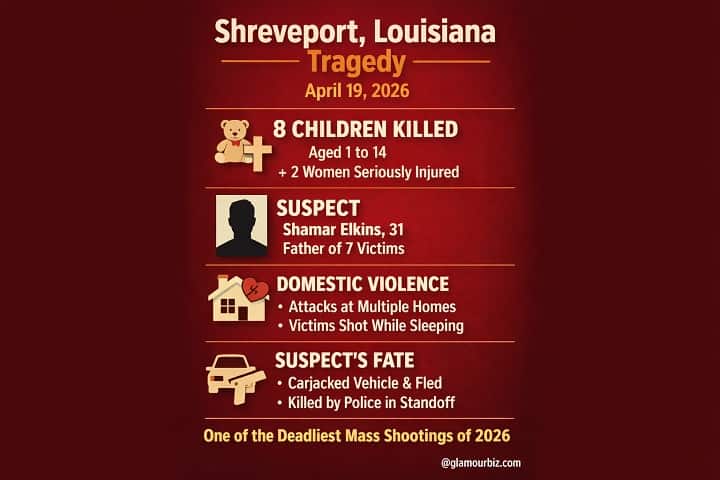
A tragic mass shooting in Shreveport, Louisiana, has left eight children dead and two women critically injured in what authorities believe was a domestic violence-related incident. The violence unfolded across multiple locations within a residential neighborhood, prompting a large police response.
The suspect, who was reportedly connected to the victims, fled the scene and was later killed during a confrontation with law enforcement. Officials are continuing to investigate the motive while the community mourns one of the most devastating incidents in the city’s history.
Horror in Shreveport: Eight Children Killed in Devastating Mass Shooting
Shreveport, Louisiana, a city more often associated with quiet neighborhoods and close-knit community life, was abruptly pulled into national headlines following an unimaginable act of violence. In a single morning, what should have been an ordinary start to the day turned into a scene of chaos, grief, and irreversible loss.
Authorities confirmed that eight children lost their lives in a mass shooting that unfolded across a residential area. The victims, ranging in age from toddlers to early teenagers, were found inside and around a home that had once been considered a place of safety. The brutality of the incident has left both investigators and residents struggling to comprehend how such devastation could occur within a family or domestic setting.
Neighbors described the morning as deceptively normal at first. Birds were chirping, children were expected to get ready for the day, and nothing seemed out of place. That illusion shattered in moments when emergency calls flooded local dispatch centers reporting gunfire. Within minutes, police units arrived at a scene that would later be described as one of the most disturbing in the city’s recent history.
The scale of the tragedy quickly became clear. Multiple young lives had already been lost before help could arrive. The emotional weight of the discovery extended beyond the immediate families and into the broader community, where grief began to spread almost instantly.
What makes this tragedy especially haunting is not just the number of victims but the innocence of those who were taken. Children, who should have been protected from the harshest realities of life, became central figures in a devastating act of violence that has left a permanent scar on the community.
Domestic Violence Turns Deadly: A Family Dispute That Escalated Beyond Control
As investigators began piecing together the timeline, early findings suggested that the incident was rooted in domestic conflict. What may have started as a personal or familial dispute escalated into an extreme and irreversible act of violence.
Authorities have emphasized that domestic violence cases often follow patterns of escalation, but few reach the level of destruction witnessed in Shreveport. In this case, the situation allegedly intensified rapidly, leaving little to no time for intervention once it turned deadly.
Law enforcement sources indicated that the suspect had personal ties to the victims, a detail that deepens the emotional complexity of the case. Instead of an external threat, the violence emerged from within a circle that should have been defined by trust and familiarity.
Experts in behavioral psychology note that domestic violence tragedies often involve long-standing emotional tension, unresolved conflict, and untreated mental health struggles. However, even with these factors considered, the scale of this incident remains extraordinarily rare.
Community advocates have used the tragedy to highlight the importance of recognizing early warning signs—such as escalating arguments, controlling behavior, or prior incidents of aggression. They stress that intervention, whether through family support, counseling, or law enforcement involvement, can sometimes prevent situations from reaching irreversible outcomes.
Still, in this case, opportunities for prevention appear to have been missed or insufficient. The result is a heartbreaking reminder of how quickly private conflict can become public catastrophe when warning signs are not addressed in time.
Police Chase Ends in Fatal Confrontation After Multi-Scene Shooting
Following the initial shootings, the suspect fled the scene, triggering a large-scale police response. Officers quickly established a perimeter and began searching for the individual believed to be responsible for the attacks.
What followed was a tense and fast-moving pursuit across nearby roadways. Law enforcement units coordinated efforts to track the suspect, who reportedly attempted to evade capture by moving through different areas of the city. The chase placed both officers and civilians at risk, further intensifying an already volatile situation.
Eventually, officers located the suspect, leading to a confrontation that ended in the suspect being fatally shot by police. Authorities have stated that the use of lethal force occurred during an active threat scenario, though a full review of the incident is being conducted in accordance with standard procedure.
No additional injuries to law enforcement personnel were reported during the confrontation. Officials have since emphasized that the primary objective was to prevent further harm to civilians, especially given the number of victims already involved.
This final act marked the end of the immediate threat but did little to ease the emotional aftermath. For investigators, the focus shifted from containment to understanding how the situation escalated so rapidly and whether any intervention earlier in the timeline could have changed the outcome.
The police response is now under routine review, as is standard in officer-involved shootings. However, early statements suggest that officers were responding to an urgent and highly dangerous situation involving an armed suspect who had already caused multiple fatalities.
Community in Shock: Mourning, Questions, and a Search for Healing
In the hours and days following the tragedy, Shreveport has transformed into a community defined by grief. Vigils have been held across neighborhoods, with residents gathering to light candles, share prayers, and support grieving families. The emotional toll is visible everywhere—from school closures to memorials forming near the site of the tragedy.
Local leaders have described the event as one of the darkest moments in the city’s history. Schools, churches, and community organizations have stepped forward to provide counseling services for those affected, particularly children who are struggling to process the violence.
What makes recovery especially difficult is the age of the victims. The loss of children creates a deeper emotional rupture, one that extends beyond immediate families and affects the entire social fabric of the community. Teachers, classmates, neighbors, and even strangers feel the impact in profoundly personal ways.
At the same time, difficult questions remain. Residents are asking how such violence could unfold unnoticed or unprevented. Some are calling for stronger community-based intervention programs, improved mental health services, and more proactive responses to domestic disputes.
Despite the pain, there is also a visible effort toward unity. Community members have come together not only to mourn but also to support one another. Fundraisers, food drives, and counseling initiatives have begun forming in response to the tragedy.
While healing will take time, the resilience of the community is evident. Shreveport is now facing the challenge of rebuilding emotional stability while honoring the memory of those lost.
Top 4 FAQs
1. What happened in the Shreveport shooting incident?
A mass shooting occurred in a residential area, resulting in the deaths of eight children and injuries to two adults, followed by a police pursuit and the suspect’s death.
2. Was the suspect related to the victims?
Authorities believe the suspect had personal or familial connections to the victims, suggesting the incident may have stemmed from domestic violence.
3. How did police handle the situation?
Law enforcement responded quickly, pursued the suspect after the shootings, and ultimately ended the threat during a confrontation that resulted in the suspect’s death.
4. What is being done for the community now?
Counseling services, memorial events, and community support programs have been established to help residents cope with grief and trauma.