
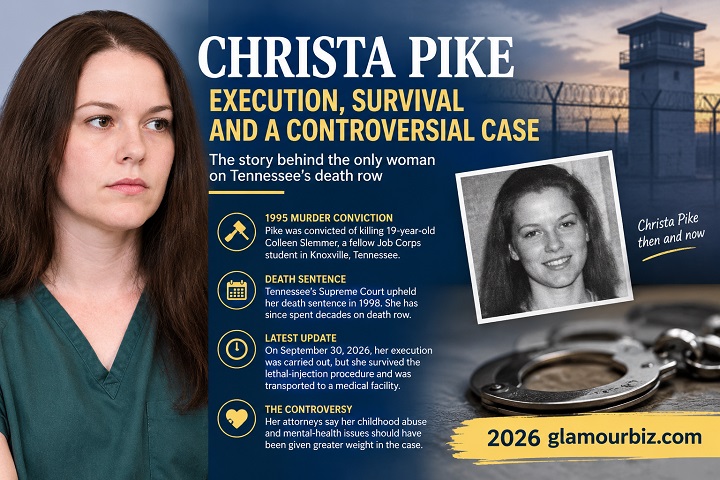
NASHVILLE, Tenn. Tennessee's attempt to execute Christa Pike on Wednesday night failed, and the 50-year-old was taken to an off-site medical facility, according to the Nashville Banner and the Tennessee Lookout.
Pike, the only woman on Tennessee's death row, was convicted of the 1995 murder of 19-year-old Colleen Slemmer. Reports say she kept breathing after two doses of pentobarbital, and the procedure was halted nearly two hours after it began.
The execution was first set for 10 a.m. A federal appeals court paused it about an hour earlier to review claims that her childhood abuse was never properly presented to the jury. The U.S. Supreme Court vacated that stay that evening, with Justices Sotomayor, Kagan, and Jackson dissenting.
Pike was 18 at the time of the crime. She would have been the first woman executed in Tennessee since 1820. It is not yet clear what the courts will do next, and her current condition has not been publicly detailed.
The Crime: Teenager Convicted in the 1995 "Job Corps Murder" of Colleen Slemmer
On January 12, 1995, a 19-year-old woman named Colleen Slemmer was led into a wooded area near the University of Tennessee's agricultural campus in Knoxville. She never came out. The person who brought her there was Christa Pike, who was 18 years old.
The case became known as the "Job Corps murder," after the training program where it began. Prosecutors said jealousy was at the heart of it. Pike believed Slemmer was a threat to her relationship with her boyfriend, Tiddell Shipp. What followed was an attack so brutal that people in Knoxville still talk about it three decades later. Slemmer was beaten and tortured, and she died after being struck on the head with a chunk of asphalt.
What shocked investigators most came afterward. Pike kept a piece of Slemmer's skull and showed it to classmates. When detectives questioned her, she showed them the fragment too. A retired detective later remembered how cheerful she seemed during the interview. It is the kind of detail that stays with a case forever, and it shaped how the public saw her from day one.
Three people were charged: Pike, Shipp, and a third young person, Shadolla Peterson. In 1996, a jury convicted Pike of first-degree murder and sentenced her to death. Shipp was given life with the possibility of parole. Peterson testified against Pike and received probation. So three people took part in the same killing, and only one of them was sentenced to die. For Slemmer's family, nothing about the sentence could undo what happened. They lost a daughter at 19, and they have lived with that loss through every hearing and appeal since.
Behind the Verdict: A Childhood of Abuse and Trauma That Her Lawyers Say the Jury Never Fully Heard
The crime is only one half of the story. The other half is the life Pike lived before it, and her lawyers say the jury in 1996 did not properly hear it. Pike's childhood was unstable from the start. Her family moved often, and she changed schools again and again, which hurt her grades and made it hard to build friendships. In third grade, she tried to overdose on acetaminophen. She was a small child, and she was already receiving psychiatric care. Over the years, she saw different counselors and therapists, but nothing seemed to give her a steady footing.
Pike has said she was sexually assaulted several times as a child. According to the accounts of her life, the abuse began when she was a toddler and continued until she was around kindergarten age, at the hands of her grandmother's boyfriend. Later, a man her mother dated also assaulted her. Her attorneys describe a childhood filled with physical and sexual abuse and neglect, and they argue that the state knew about the dangers she faced and did not protect her.
When Pike joined Job Corps, she hoped to become a nurse. For a girl with her background, it looked like a way out. Instead, the environment turned out to be unsafe, and she ended up in the middle of a violent and chaotic social circle.
Her lawyers also point to her mental health. She has since been diagnosed with bipolar disorder and post-traumatic stress disorder. Together with her age at the time of the crime, they say these facts should have weighed heavily against a death sentence. Pike was 18, barely an adult. Courts in the United States do not allow executions for crimes committed before age 18, and her defense has long argued that a person who is only a few months past that line is not so different from someone just under it.
The prosecution and the victim's family see it another way. A hard childhood explains a lot, they would say, but it does not excuse what was done to Colleen Slemmer. Reasonable people can hold both ideas at once: that Pike suffered terribly as a child and that she did something terrible as a young adult. The legal question is whether a jury that knew the full story would have chosen a different sentence.
Thirty Years of Appeals: The Final Legal Fight Over Tennessee's Only Woman on Death Row
Pike spent more than three decades on death row, the only woman there in Tennessee. Her time in prison was not quiet. In 2004, she attacked another inmate and tried to strangle her. She was convicted of attempted murder and received an extra 25-year sentence. For those who wanted her executed, this was proof that she remained dangerous.
Her lawyers kept filing appeals, and for years the courts kept turning them down. In 2023, a motion to reopen her case in the hope of avoiding the death penalty was denied.
Meanwhile, Tennessee itself was going through changes. In 2022, Governor Bill Lee paused executions after an investigation found that prison officials had been breaking their own lethal injection rules. The state reviewed its process, adopted a new protocol, and began carrying out executions again in 2025. Soon after, the Tennessee Supreme Court set a series of dates, and Pike's was September 30, 2026. If carried out, she would have been the first woman executed in Tennessee since 1820.
Her legal team fought the date on several fronts. They argued that her childhood abuse was never properly put in front of the jury, that her age and mental illness mattered, and that her co-defendants had received far lighter sentences. The U.S. Supreme Court and Governor Lee both declined to step in before the final day.
On the morning of September 30, with the execution set for 10 a.m., things changed. A three-judge panel of the 6th Circuit Court of Appeals ordered what it called a short stay, about an hour before the scheduled time. The judges said they needed more time to properly look at the issues raised by Pike's lawyers. One of the three judges disagreed strongly and called the effort a last-ditch attempt to delay a lawful execution.
The stay did not last. That evening, the U.S. Supreme Court vacated it, clearing the way for the state to proceed. Three justices dissented: Sonia Sotomayor, Elena Kagan, and Ketanji Brown Jackson. Sotomayor wrote that the Court had interfered with a lower court's normal handling of a death penalty case and that Tennessee's wish to hurry the execution by a few days or weeks could not outweigh Pike's fundamental interest in her own life.
A Failed Execution: Christa Pike Taken to Hospital After Two Lethal Injection Attempts
Then came the night itself. According to reporting from the Nashville Banner, Tennessee officials tried to carry out the execution on Wednesday night, but it did not work. Pike kept breathing after she was given two doses of pentobarbital. The Tennessee Lookout reported that the procedure was halted nearly two hours after the state began the lethal injection protocol.
Emergency vehicles arrived at Riverbend Maximum Security Institution in Nashville. Pike was taken to an off-site medical facility for care. At that point, a group opposed to the death penalty had filed an emergency appeal asking the courts to stop the execution and make sure she received medical treatment.
This was not the first time something had gone wrong. The Tennessee Lookout described it as the latest execution to be botched by the Tennessee Department of Correction. That matters because the state had paused executions in 2022 precisely because of problems with how lethal injections were being handled. A new protocol was supposed to fix that. Now there are fresh questions about whether it did.
Many things are still unclear. Reports on her current medical condition are limited, and there is no public answer yet on what the courts will do next. Legal experts will likely debate whether the state can try again and whether the Eighth Amendment, which bans cruel and unusual punishment, changes the picture after a failed attempt. The state Supreme Court could set a new date, or the courts could block one.
What is clear is that this case now sits at the center of several big debates in America: how we treat people who commit crimes as young adults, how much a traumatic childhood should count at sentencing, and whether the machinery of execution can be trusted to work as promised.
For the Slemmer family, it means yet another chapter in a wait that has lasted more than thirty years. For Pike's supporters, it is a reason to push harder for mercy. And for everyone else, it is a hard reminder that behind a famous case are real people living with the consequences.