
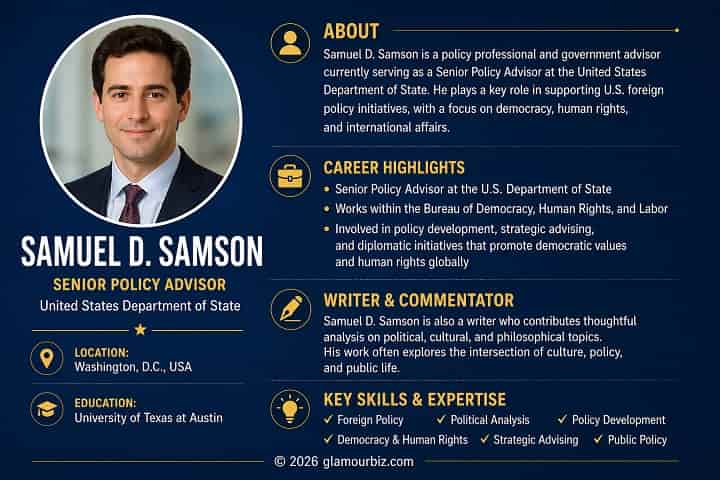
Samuel D. Samson is a policy professional with the U.S. Department of State, contributing to discussions on democracy, human rights, and international relations. His role reflects the work of behind-the-scenes advisors who help shape U.S. foreign policy through research, analysis, and strategic support.
From Classroom to Policy Circles: His Early Path
Samuel D. Samson’s early life and academic journey represent the foundational stage of a career shaped by political curiosity, disciplined study, and an interest in how governments operate both domestically and internationally. He pursued higher education at the University of Texas at Austin, an institution widely recognized for producing graduates who go on to careers in law, public service, and political analysis.
During his time at university, Samson developed a strong academic grounding in political theory, governance structures, and the philosophical frameworks that guide modern democratic systems. His academic environment exposed him to a wide spectrum of political ideas, ranging from classical political thought to contemporary debates about democracy, global governance, and international relations.
However, his development during this period was not limited to textbooks and lectures. Like many students who eventually enter policy careers, he likely engaged in discussions, research projects, and intellectual environments that challenged him to think critically about how political systems function in practice.
This stage of his life served as a bridge between theoretical understanding and real-world application. It is often during such formative years that future policy professionals begin to develop their worldview — how they interpret international events, how they evaluate political decisions, and how they understand the role of institutions in shaping societies.
By the time he completed his studies, Samson had built a foundation that positioned him well for entry into policy-oriented environments. His academic background provided him with the ability to analyze complex political systems, understand historical and ideological contexts, and engage with policy discussions that require both precision and intellectual depth. This early phase of his journey was not just educational—it was formative in shaping the trajectory of his professional identity.
Building a Career in American Political Strategy
After completing his academic foundation, Samuel D. Samson began transitioning into the professional world of policy and political strategy, a field that demands both analytical rigor and practical understanding of governance. His early career involved engagement with policy-focused organizations and research-driven institutions, which are often the first stepping stones for individuals aiming to enter government advisory roles in Washington, D.C.
These institutions play a critical role in shaping American political thought and foreign policy direction. They conduct research on international developments, evaluate geopolitical trends, and provide recommendations that often influence decision-making at higher levels of government.
Working in such environments requires not only subject knowledge but also the ability to interpret global events in real time and translate them into meaningful policy insights. For Samson, this phase of his career would have been instrumental in refining his analytical skills and expanding his understanding of how political strategy is developed outside formal government structures.
In these early professional settings, individuals like Samson are typically involved in drafting policy briefs, conducting research on international relations, and analyzing political developments across different regions. This kind of work builds the foundation for understanding how foreign policy decisions are made, how governments respond to global challenges, and how diplomatic relationships are maintained and adjusted over time.
Over time, his experience in these environments would have helped him transition into more formal roles within government institutions. This progression reflects a common pathway in U.S. policy careers, where professionals move from research and advisory positions into official government service. Each stage builds upon the last, gradually increasing responsibility and influence in shaping policy discussions. Samson’s career trajectory reflects this steady evolution from academic preparation to applied political strategy, positioning him within the broader ecosystem of American foreign policy development.
Inside the U.S. State Department Role
Samuel D. Samson currently serves in a policy advisory capacity within the U.S. Department of State, specifically under the Bureau of Democracy, Human Rights, and Labor (DRL). This bureau plays a vital role in shaping how the United States approaches some of the most important and sensitive aspects of foreign policy, including democratic governance, human rights advocacy, and political freedom across the globe.
Within this structure, Samson’s role involves contributing to the analysis, development, and coordination of policy initiatives that align with the United States’ diplomatic objectives. The work conducted in this bureau is both strategic and highly analytical, often requiring careful assessment of international political environments and their implications for U.S. foreign relations. His responsibilities are likely centered around evaluating political developments, preparing policy recommendations, and supporting broader diplomatic initiatives that promote democratic values and institutional stability.
A significant aspect of his work relates to U.S.–Europe relations, a critical area of modern diplomacy. The transatlantic relationship between the United States and European nations is built on shared values such as democracy, human rights, and rule of law, but it also involves complex discussions about governance, policy alignment, and strategic cooperation. In this context, policy advisors like Samson play an important role in ensuring that diplomatic communication remains informed, balanced, and aligned with long-term strategic goals.
Although his position is not publicly visible in the way elected officials or ambassadors are, it is nonetheless a key part of the internal machinery that drives U.S. foreign policy. Advisors in his role contribute to shaping discussions that influence how the United States engages with the world, particularly in areas where democratic principles and international cooperation intersect.
Shaping Conversations on Democracy and Global Affairs
One of the most defining aspects of Samuel D. Samson’s professional involvement is his engagement with broader global conversations about democracy, governance, and international relations. In the modern geopolitical landscape, these topics are not static—they are constantly evolving in response to global events, technological change, and shifting political dynamics.
Within this context, Samson’s work contributes to how the United States interprets and responds to democratic developments around the world. This includes evaluating political systems, analyzing governance trends, and supporting diplomatic initiatives that promote democratic stability. His focus on U.S.–Europe relations is particularly significant, as this partnership remains one of the most important pillars of global diplomacy. The transatlantic alliance influences economic policy, security cooperation, and responses to global political challenges.
Policy professionals in this space are often required to think beyond immediate political developments and instead focus on long-term strategic outcomes. They must consider how shifts in governance, public policy, or international relations in one region can affect global stability as a whole. This requires a deep understanding of both political theory and real-world dynamics, as well as the ability to adapt to rapidly changing global circumstances.
While the specifics of internal policy discussions remain confidential, the broader role of individuals like Samson is to ensure that diplomatic strategies are informed by accurate analysis and aligned with core democratic values. In this sense, his work reflects a larger mission within U.S. foreign policy: to support and strengthen democratic institutions while maintaining constructive international relationships.
Ultimately, his professional role highlights the importance of policy advisors in shaping global conversations that extend far beyond national borders. These individuals operate behind the scenes, but their influence is embedded in the decisions, strategies, and diplomatic engagements that define modern international relations.
Top 5 FAQs About Samuel D. Samson
1. Who is Samuel D. Samson?
He is a policy advisor working with the U.S. Department of State, involved in areas related to democracy, human rights, and international relations.
2. What is his educational background?
He studied at the University of Texas at Austin, focusing on political and related academic fields.
3. What does he do at the U.S. State Department?
He works in a policy advisory role within the Bureau of Democracy, Human Rights, and Labor, contributing to foreign policy analysis and development.
4. What regions or issues does he focus on?
His work is primarily connected to democracy-related policy and U.S.–Europe diplomatic relations.
5. Is Samuel D. Samson a public political figure?
No, he is not an elected official. He is a government policy professional working in an advisory capacity.