
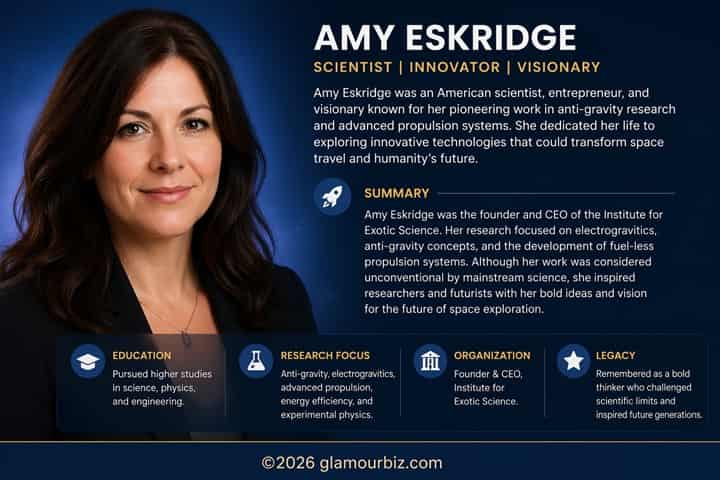
The name of aerospace engineer and futurist Amy Eskridge has resurfaced in 2026 media discussions after being mentioned in broader reports about scientists linked to aerospace research.
Eskridge, who passed away in 2022, was known for her interest in advanced space exploration concepts and long-term human spaceflight ideas. She was part of niche futurist discussions focused on propulsion and deep space travel. Recent attention around her name is largely driven by online speculation connecting multiple unrelated cases of scientists’ deaths and disappearances. However, there is no confirmed evidence linking her case to any broader pattern.
Family members have previously stated that they do not believe her death was suspicious, and official reporting has not confirmed any connection to the wider theories circulating online. Overall, her legacy remains tied to aerospace thinking and futurist ideas rather than the speculation now associated with her name.
Amy Eskridge: A Visionary Aerospace Engineer in Advanced Space Research
Amy Eskridge built her professional identity in the aerospace and engineering domain, with a focus on forward-looking concepts that often extended beyond conventional space industry timelines. Her interests included advanced propulsion theories, long-term human survival in space environments, and the engineering challenges associated with interplanetary travel. Within futurist and aerospace discussion circles, she was recognized for engaging with ideas that explored how humanity could eventually operate beyond Earth orbit in a sustainable way.
Unlike traditional aerospace engineers focused solely on near-term missions, Eskridge was associated with conceptual discussions that examined long-range possibilities. These included theoretical systems for deep space travel and infrastructure required for extended human presence in space. Her work placed her among a growing group of engineers and thinkers who blend science, imagination, and long-term planning to address humanity’s future beyond Earth.
Amy Eskridge’s Ambition for Deep Space Exploration and Human Future Beyond Earth
One of the most defining aspects of Amy Eskridge’s public identity was her interest in humanity’s expansion into deep space. She was connected to conversations around propulsion innovation and the challenges of sustaining human life on long-duration missions. These discussions often included topics such as energy efficiency in space travel, survival systems for extreme environments, and long-term colonization concepts.
Eskridge’s perspective reflected a broader futurist mindset: that human civilization may eventually need to become multi-planetary to ensure long-term survival. In this context, she engaged with ideas that were both scientific and speculative, bridging engineering fundamentals with visionary space exploration concepts. Her involvement in these discussions helped her gain recognition in niche circles interested in the intersection of aerospace engineering and future human evolution.
Amy Eskridge Dead: Her Passing and the Questions That Followed in Public Discussion
Amy Eskridge passed away in 2022, and her death was acknowledged within both professional and futurist communities. Following her passing, renewed public attention emerged in 2026 due to broader media discussions involving scientists connected to aerospace and advanced research fields. In some reports and online conversations, her name was included in lists of individuals whose deaths or circumstances were being revisited.
However, it is important to note that credible reporting and family statements have not supported claims of confirmed suspicious circumstances in her case. Her father and close family members have publicly indicated that they do not believe her death involved foul play.
The increased attention appears to be largely driven by broader social media narratives that link unrelated cases together. These discussions often combine aerospace research, government programs, and speculative theories, even when no verified connection exists. In contrast, available information suggests that Eskridge’s death should be understood within the context of an individual case rather than part of a coordinated or unexplained pattern.
Amy Eskridge’s Legacy and Family Response Amid Ongoing Online Speculation
Despite the attention that has followed her name after her passing, Amy Eskridge’s legacy remains rooted in her intellectual curiosity and her engagement with aerospace innovation concepts. Her contributions were primarily within discussion-based and conceptual areas of aerospace science and futurism. She is remembered by peers and community members as someone who engaged deeply with ideas about space expansion and technological advancement.
Family members have also played an important role in clarifying public perception. In response to circulating theories, they have emphasized that her death should not be misrepresented or linked to unverified narratives. The broader discussion surrounding her name highlights a modern challenge: how rapidly online speculation can reshape public perception of individuals involved in technical or scientific fields, especially when those fields overlap with topics like space research or defense technologies.
Ultimately, Eskridge’s legacy is better understood through her intellectual interests and contributions to futuristic aerospace thinking rather than through the lens of online theories.
Top 5 FAQs About Amy Eskridge
1. Who was Amy Eskridge?
Amy Eskridge was an American aerospace engineer and futurist known for her interest in advanced space exploration concepts.
2. What was Amy Eskridge known for?
She was known for discussing deep space travel, propulsion systems, and long-term human space survival ideas.
3. When did Amy Eskridge pass away?
She passed away in 2022.
4. Was there any confirmed suspicious circumstance in her death?
No confirmed evidence or official reports have established suspicious circumstances. Family members have also rejected such claims.
5. Why is Amy Eskridge being discussed again in 2026?
Her name resurfaced due to broader media and online discussions about scientists in aerospace and advanced research fields.