
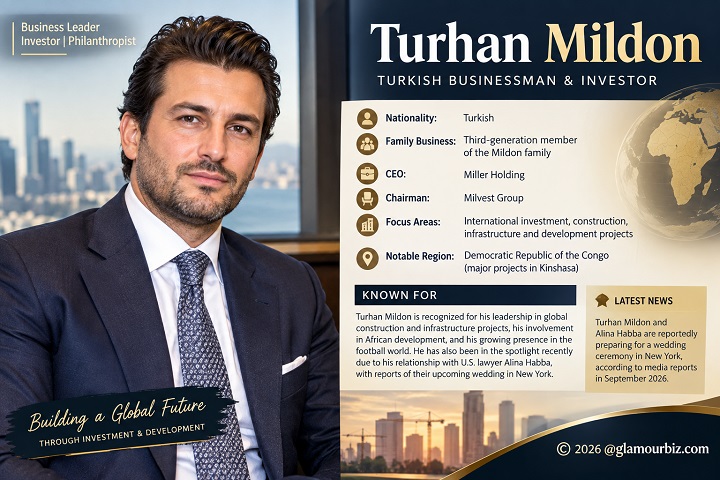
Turkish businessman Turhan Mildon (29), CEO of Miller Holding, is reportedly set to marry Alina Habba (42), Trump's former lawyer and ex-counselor to the president, in New York on September 26, 2026. It would be Habba's third marriage. The two reportedly met through a mutual friend; Mildon denies any political motive behind the union.
From Family Firm to Global Footprint: Turhan Mildon's Rise as Miller Holding's Third-Generation CEO
There's a particular kind of pressure that comes with being handed a company instead of building one. You don't get to invent the story. You inherit it, chapter and verse, and then you have to figure out what the next chapter looks like. That's roughly the position Turhan Mildon has found himself in for most of his adult life.
Miller Holding didn't start as a sprawling international operation. It began in 1967, founded by Muhsin Turhan Mildon, in an era when Turkish business was still finding its footing on the global stage. Over decades it grew into a multi-industry conglomerate touching construction, mining, energy, and international investment. By the time it reached Turhan Mildon's generation, the company was no longer just a domestic builder. It had become something with genuine reach across borders, particularly into Africa.
What makes Mildon's story a bit different from the usual "heir takes over the family business" narrative is how early he was folded into the operation. According to what's publicly known, he didn't wait until after university to start learning the ropes. He joined as a child, in the sense that the business was simply part of his upbringing, and gradually moved through roles tied to project development, investment management, and strategic partnerships. That's a very different education than an MBA program, and it shows in how he talks about the company: less theory, more operational instinct.
It's worth pointing out that his official biography is oddly quiet about formal education. No university named, no degree mentioned. That's unusual for someone in his position, especially compared to how other members of his family are described. Whether that's a deliberate choice to keep the focus on his professional track record or simply a gap in what's been made public isn't clear. Either way, it tells you something about how the family wants him presented: as a builder and operator, not a credentialed executive.
Today, Mildon holds the CEO title at Miller Holding, and the company's own materials describe him as someone deeply involved in international investment alongside infrastructure and project development. That's a broad mandate. It suggests he isn't simply signing off on decisions made by others but is actively steering where the group puts its money and its people. He's also connected to Milvest, which functions as the arm of the business most associated with big cross-border ventures, including its expansion into Central Africa.
Succession is always the trickiest part of any family conglomerate. Plenty of businesses fail to survive the jump from founder to grandchild, not because the money runs out, but because the next generation either can't hold the culture together or tries too hard to reinvent it. Miller Holding, at least from the outside, looks like it's trying to thread that needle by keeping Mildon rooted in the operational side rather than treating him as a figurehead. His father, Mert Mildon, remains chairman, which suggests a transition that's gradual rather than abrupt. That's common in Turkish family businesses, where leadership often overlaps across generations for years before a full handover happens.
There's also something to be said about timing. Mildon is stepping into serious leadership responsibility at a moment when Miller Holding is pushing hard into markets outside Turkey, particularly across the African continent. That's not a passive inheritance. It's an active bet that the next phase of growth for a company like this doesn't come from doing more of the same at home but from taking on bigger, riskier, more geopolitically complicated projects abroad. Whether that bet pays off long-term is still an open question, but it does explain why so much of the public conversation around Mildon centers on his international work rather than domestic Turkish projects.
None of this is to say the picture is complete. Public information about Mildon is patchy in places, and much of what circulates about him blends verified facts with speculation, particularly around numbers like net worth. What is consistent, though, is the throughline of a family business that's been building for nearly sixty years, now resting a good chunk of its future on someone who grew up inside it rather than around it.
It's also fair to ask what kind of leader that produces. Someone raised inside a company from childhood often has an intuitive feel for its rhythms, its risk tolerance, and its unwritten rules but sometimes lacks the outside perspective that comes from working somewhere else first. Mildon's career, as far as it's been reported, doesn't show much time spent outside the family orbit. That's neither a red flag nor a guarantee of success. It's simply the shape of the path he's taken, and it puts more weight on the mentorship and structure of the business itself to prepare him for decisions that increasingly involve foreign governments, cross-border logistics, and industries where mistakes are expensive and slow to fix.
There's a broader pattern here too, one that applies well beyond this one company. Family conglomerates in Turkey and similar economies have often expanded into Africa over the past decade, drawn by infrastructure gaps, lower competition from Western firms, and governments eager for construction and energy partners willing to take on large projects quickly. Miller Holding's push into places like the Democratic Republic of Congo fits that pattern closely. Mildon isn't inventing a new playbook so much as executing an established one at a larger scale than his predecessors attempted.
What comes next for him is less about proving he can run a company and more about proving he can run this particular company through a period of rapid, ambitious, and occasionally controversial expansion. The name recognition he's picked up recently, thanks to matters entirely unrelated to construction contracts, has put a spotlight on him that most third-generation CEOs never have to deal with. How he handles that attention, and whether it distracts from or complements the business itself, will likely shape how this next chapter of Miller Holding's story gets written.
The Kinshasa Gambit: Inside Turhan Mildon's High-Stakes Africa Expansion
Some business decisions look simple on paper and turn out to be anything but. Miller Holding's push into the Democratic Republic of Congo is one of those. On the surface, it's a straightforward story: a Turkish conglomerate spots opportunity in a resource-rich, infrastructure-hungry country and moves in. Underneath that, though, sits a web of political relationships, national interests, and public scrutiny that makes this one of the more complicated bets Turhan Mildon has taken on.
The entry point into the DRC wasn't a cold pitch or a market survey that led Milvest, the international arm of Miller Holding, to Kinshasa. It was, according to reporting, a door opened at the highest level, with introductions tied to Turkish President Recep Tayyip Erdogan and DRC President Felix Tshisekedi. That's not how most companies break into a new market. State-level introductions carry weight, but they also carry expectations, and they tend to invite exactly the kind of scrutiny that's now surrounding Mildon and his business.
Once in, Miller Holding didn't dip a toe in. The scale of what they've built is genuinely large. One flagship project, the Kinshasa Congress and Financial Center, reportedly involved thousands of workers on the ground, with figures cited around 3,000 Congolese laborers working alongside more than 2,300 Turkish professionals. That's the kind of workforce number you'd associate with a mid-sized industrial operation, not a single building project. Add to that an investment figure of more than $60 million tied to just the hotel component of the development, and you start to get a sense of how seriously the company is treating this market.
Mildon himself has described the DRC as the most important market for the company right now and has pointed to something like 14 separate projects underway or completed there. If accurate, that's a remarkably concentrated bet on one country, especially one that's had its share of political and economic instability over the years. It raises the obvious question of what happens to a portfolio like that if the political winds in Kinshasa shift or if the relationship between Ankara and Kinshasa cools even slightly.
That question isn't hypothetical. Businesses that expand into a country largely on the strength of head-of-state relationships are exposed in a way that companies entering through purely commercial channels aren't. If the personal or diplomatic relationship that opened the door changes, contracts negotiated under that relationship can become vulnerable, even if the underlying construction or infrastructure work is sound. This is part of why Mildon's African expansion has drawn attention beyond the usual business press. It's not just "company builds hotel"; it's "company builds hotel as part of a broader geopolitical arrangement between two governments."
There's also the matter of how these projects are perceived locally. Large foreign investment can be a genuine boon for a country like the DRC, bringing jobs, infrastructure, and capital that domestic firms might not be able to mobilize on their own. But it can also generate resentment if profits and decision-making power are seen as flowing almost entirely outward, or if local labor is viewed as secondary to imported workforces. The reported ratio on the Kinshasa project, with a majority Congolese workforce but a very substantial number of Turkish professionals brought in as well, sits somewhere in the middle of that spectrum. It's neither purely extractive nor purely local-first.
Mildon, for his part, has framed the DRC expansion as purely a business opportunity, distancing it from any political agenda. That's a reasonable thing to say publicly, and it may well be true in terms of day-to-day operations. But it doesn't erase the fact that the market entry itself was politically facilitated, which makes a clean separation between business and politics harder to maintain in practice, whatever the intent.
None of this means the expansion is doomed or improper. Plenty of successful multinational ventures have started with exactly this kind of high-level introduction and gone on to build genuinely valuable, mutually beneficial infrastructure. Turkish construction firms in particular have built a strong track record across parts of Africa over the past fifteen years, often filling gaps left by the retreat of older Western development financing models. Miller Holding's approach looks consistent with that broader trend rather than an outlier.
What makes Mildon's situation slightly more delicate is the timing. He's taking on this level of exposure in the DRC at the same moment his personal life has become tabloid material back in the West, thanks to his engagement to a former Trump administration lawyer. That combination, big political-adjacent business plus sudden global media interest, tends to invite exactly the kind of investigative attention that a quieter expansion might have avoided. Journalists who might not otherwise look twice at a Turkish construction conglomerate's African portfolio are now doing exactly that, simply because his name is already in the headlines for other reasons.
Whether the DRC bet becomes the defining success of his leadership or a cautionary tale about mixing state-level introductions with private enterprise will likely take years to fully play out. Infrastructure projects of this scale don't reveal their long-term value quickly. What's clear right now is that Mildon has committed a significant portion of Miller Holding's international ambition to a single, complicated, high-visibility market, and he's doing it under more public scrutiny than he probably anticipated when the first Milvest teams landed in Kinshasa back in 2021.
Boardroom to Ballpark: Turhan Mildon's Double Life as Businessman and Çorum FK Vice Chairman
Football and business have always been close cousins in Turkey, and Turhan Mildon fits neatly into that tradition. Alongside running the international side of Miller Holding, he holds a leadership position at Çorum FK, serving as vice chairman of a club that, while not among Turkey's giants like Galatasaray or Fenerbahçe, carries plenty of regional significance and ambition of its own.
It's worth understanding why this pairing, a construction and investment executive also sitting on a football club's leadership, isn't unusual at all in the Turkish context. Football clubs across the country have long depended on wealthy local or national businessmen to fund operations, stabilize finances, and occasionally rescue clubs from the brink of collapse. It's less about a hobby and more about a recognized civic role. Being associated with a football club, especially in a leadership capacity, signals standing in a community in a way that owning shares in a construction firm never quite does on its own.
For someone like Mildon, whose day job involves negotiating infrastructure deals across continents, a role like vice chairman at Çorum FK offers something different: visibility that's local, emotional, and immediate. Business deals in Kinshasa or wherever else Miller Holding operates internationally don't generate the kind of instant, passionate public reaction that a match-day result does. Football gives him a direct line to public sentiment that boardroom work simply can't replicate.
What does a vice chairman actually do at a club like this? It typically means involvement in the financial and administrative backbone of the organization rather than the football side itself. Given Mildon's background in project development and investment, it's a role that plays to his existing skill set rather than asking him to become some kind of football tactician overnight.
There's also a reputational angle that shouldn't be understated. Football club involvement tends to soften the image of a businessman whose primary public profile might otherwise be dominated by large-scale construction and mining deals, some of which, as with the DRC projects, come with their own political complications. Being seen as a supporter and steward of a football club, something tied to community pride rather than boardroom negotiation, humanizes a figure who might otherwise be known mainly through headlines about billion-dollar infrastructure contracts.
Çorum, as a city, isn't among Turkey's largest urban centers, which makes the club's prominence there even more locally significant. A vice chairman with deep pockets and international business experience brings resources that a smaller-market club might struggle to access otherwise. Whether that translates into promotion pushes, stadium upgrades, or simply financial stability during lean seasons, the practical value of having someone like Mildon in a leadership seat is fairly straightforward, even if it doesn't make international headlines the way his engagement or his African business ventures do.
It's also worth considering how this kind of dual role shapes public perception of someone like Mildon going forward. As his profile grows internationally, partly due to unrelated personal news, more attention naturally gets paid to every part of his public life, including a football club position that might otherwise have stayed a regional footnote. Journalists writing broader profiles of him now have to weave in the Çorum FK connection as part of the fuller picture, even though, on its own, it wouldn't necessarily be newsworthy outside football circles.
There's a pattern here that's common among wealthy businessmen who take on club leadership roles: the position often serves as a kind of long-term relationship investment, both with fans and with local political structures, since football clubs frequently intersect with municipal interests, stadium ownership, and regional government relationships. It wouldn't be surprising if Mildon's involvement with Çorum FK ties, at least indirectly, into the same kind of relationship-building that underpins parts of his international business dealings, even if the connections aren't formally stated anywhere.
None of this diminishes the football side of things either. Clubs need genuine financial stewardship to survive and grow, and vice chairmen who bring real business experience, rather than just money and a title, tend to make a tangible difference in how sustainably a club operates. If Mildon approaches Çorum FK with the same operational instincts he's applied to Miller Holding's expansion projects, the club stands to benefit from someone who understands long-term investment thinking rather than short-term spending sprees chasing immediate results.
Ultimately, this side of his life offers a useful contrast to everything else swirling around his name lately: the engagement, the African business scrutiny, and the family succession questions. Football is comparatively simple: wins, losses, budgets, and a fan base that judges leadership by results on the pitch and stability off it. For a man whose other ventures involve considerably more political and financial complexity, that simplicity might be part of the appeal.
Turhan Mildon and Alina Habba: A Turkish Tycoon's Whirlwind Romance with Trump's Former Lawyer
Of everything currently swirling around Turhan Mildon's name, none has traveled further or faster than his relationship with Alina Habba. A Turkish construction and investment executive marrying a former lawyer and advisor to Donald Trump is the kind of story that crosses over from business pages to entertainment coverage almost instantly, and that's exactly what's happened here.
To understand why this pairing has generated so much attention, it helps to look at who Habba is on her own terms first. She built her public profile starting around 2021 as one of Trump's defenders during a period when he was facing significant legal challenges. That role kept her in the public eye through 2024, as Trump's legal troubles intersected with his campaign activities. When Trump returned to office, Habba's position shifted from legal defender to something more formal within the administration itself. In January 2025, she took on the role of Counselor to the President, and by March of that year she'd been appointed interim U.S. attorney for New Jersey.
That appointment, though, didn't hold up cleanly. Courts pushed back on the legality of her continuing in that role, and eventually the Third Circuit upheld a decision disqualifying her from serving as acting U.S. attorney. That's a fairly unusual career arc: from television legal commentator to presidential counselor to a federal court ruling her out of a prosecutorial post, all within roughly a year. Whatever one thinks of the politics involved, it's a resume with a lot of turbulence packed into a short window.
It was against that backdrop that her relationship with Mildon started making headlines in 2026. According to what's been reported, the two met through a mutual friend who happened to be an ambassador, which is a detail that fits neatly with both of their worlds, hers steeped in Washington political circles, his built around international business and, apparently, the kind of diplomatic introductions that also opened doors for Miller Holding's African expansion. It's not hard to imagine the kind of social circles where a lawyer with presidential ties and a Turkish conglomerate heir might cross paths.
The wedding itself was reportedly scheduled for September 26, 2026, in New York City, a date that puts an official stamp on a relationship that had already been generating speculation for months. Mildon has pushed back publicly on any suggestion that the marriage carries some kind of political purpose, insisting it's a personal relationship rather than a strategic alliance. That denial is worth taking at face value to some extent, since plenty of high-profile relationships get over-read for hidden motives simply because the people involved happen to be prominent. At the same time, it's understandable why observers would ask the question, given how closely Habba's career has been tied to Trump and how internationally connected Mildon's business dealings already are.
For Habba, this would mark her third marriage. Her first, to Matthew Eyet, began in 2011 and ended in divorce in 2019, and the couple has two children together, Chloe and Luke. Her second marriage, to Gregg Reuben, started in 2020 and ended in divorce in 2026, without children. That timeline puts her marriage to Reuben ending in the same year her relationship with Mildon became public, which naturally invites some curiosity about the overlap, though nothing beyond speculation connects the two events directly.
Then there's the age gap, which has become its own talking point. Mildon is reportedly 29, while Habba is 42, putting roughly 13 years between them. Age gaps in relationships between prominent figures always seem to attract outsized commentary, often more than the substance of the relationship itself warrants, and this case is no exception. What's arguably more interesting than the number itself is the contrast in their backgrounds: one built almost entirely within a multi-generational business dynasty, the other forged through legal practice and a rapid, turbulent stretch inside American politics. They're coming from genuinely different worlds, which may be part of what's fueling public fascination in the first place.
It's also worth acknowledging how much of this story remains, by nature, hard to verify in granular detail. Personal relationships, especially ones involving public figures from different countries and industries, tend to get filtered through media reporting that mixes confirmed fact with reasonable inference and, occasionally, outright speculation. The broad strokes, the meeting through a mutual connection, the timeline of Habba's prior marriages, and the reported wedding date appear consistent across coverage. Finer details, like the couple's long-term plans or the true nature of how they met beyond the ambassador introduction, remain thinner on the ground.
What seems fairly safe to say is that this relationship has done more to put Turhan Mildon's name in front of a global audience than a decade of infrastructure deals ever did. Business press covers construction contracts. Entertainment and political press covers a Trump-adjacent lawyer's third marriage to a Turkish businessman. The second audience is simply much larger, and it's reshaping how Mildon is discussed even in contexts that have nothing to do with his personal life, from his football club role to his African business ventures. Whether that increased visibility helps or complicates his broader ambitions is something only time, and probably a fair amount of continued media coverage, will answer.