
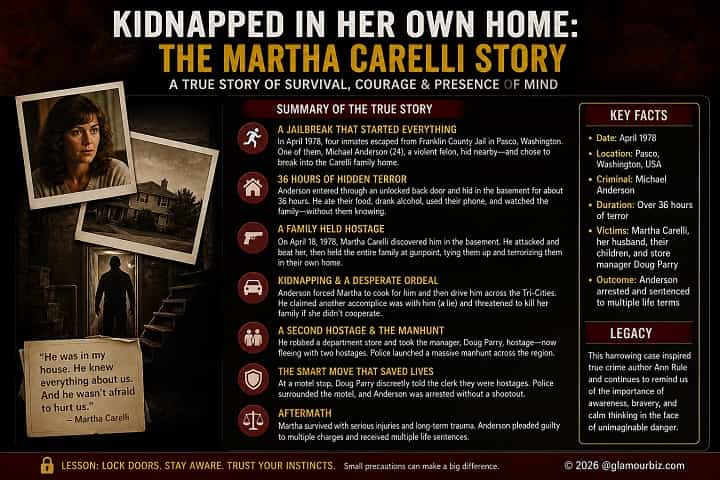
The true story of Martha Carelli has once again captured public attention, shedding light on one of the most disturbing home invasion cases in modern history. What began as an ordinary day in 1978 turned into a nightmare when an escaped fugitive secretly hid inside her home for over 36 hours before launching a violent attack and taking her family hostage.
As audiences revisit this case through recent true crime features, it continues to serve as a powerful reminder of how quickly safety can be compromised—even in familiar spaces. Experts emphasize the importance of basic home security measures, situational awareness, and staying calm under pressure. Martha Carelli’s survival is not just a story of fear but one of resilience and presence of mind. Decades later, her experience still resonates, encouraging people worldwide to remain vigilant and prepared in the face of unexpected danger.
The Night That Turned Into a Nightmare: Martha Carelli’s Shocking Home Invasion
April 1978 began like any ordinary time for Martha Carelli and her family. Life in their quiet neighborhood felt predictable, safe, and routine. There were no warning signs, no strange noises, no reason to believe danger was lurking just beyond their awareness. But what unfolded over the next few days would shatter that sense of security forever.
Unbeknownst to the family, a dangerous fugitive had escaped from a nearby jail and was hiding in plain sight—inside their own home. Entering through an unlocked back door, the intruder quietly made his way into the basement, where he would remain undetected for nearly 36 hours. During that time, he observed the family’s habits, ate their food, and waited for the right moment to reveal himself.
That moment came when Martha went downstairs to do laundry. What should have been a routine chore turned into a life-altering encounter. She was suddenly confronted by the intruder, who attacked her violently and took control of the situation within minutes. Her home—once a place of comfort—instantly became a scene of fear and uncertainty.
The shock of the invasion wasn’t just physical; it was deeply psychological. The realization that someone had been inside their home for days without their knowledge left a lasting emotional impact. It highlighted a chilling truth: sometimes, danger doesn’t knock—it quietly walks in.
36 Hours of Terror: Inside the Ordeal That Changed Martha Carelli’s Life Forever
What followed the initial confrontation was a prolonged and terrifying ordeal that tested the limits of human endurance. After attacking Martha, the intruder systematically captured the rest of the family, tying them up and holding them at gunpoint. The sense of helplessness was overwhelming.
For Martha, the experience was especially traumatic. Injured and disoriented, she was forced to comply with the demands of a man who controlled every moment. He dictated what she did, what she said, and even how she moved. The psychological pressure was relentless, as he used threats and manipulation to maintain control.
During these hours, the intruder created an environment of constant fear. He falsely claimed that he had an accomplice nearby, increasing the tension and making resistance seem impossible. The family had no way of knowing what would happen next, and that uncertainty made the situation even more unbearable.
Despite the terror, there were moments of quiet strength. Martha remained composed, focusing on survival rather than panic. Her ability to think clearly under pressure would later prove to be one of the key reasons she made it through the ordeal.
Meanwhile, outside the home, no one suspected the horror unfolding within. The contrast between the calm exterior world and the chaos inside the house adds another layer of intensity to the story. It serves as a reminder that some of the most frightening situations happen behind closed doors, hidden from view.
From Victim to Survivor: Martha Carelli’s Courage Under Captivity
As the situation escalated, Martha was forced into an even more dangerous scenario. The intruder decided to leave the house, taking her with him. What began as a home invasion turned into a kidnapping, adding a new level of unpredictability to the ordeal.
Martha was made to accompany him across different locations, including public areas where help seemed so close, yet so far. At times, she was hidden from view, further isolating her from potential rescue. Every moment required careful judgment—any wrong move could have triggered violence.
What stands out most during this phase is Martha’s courage. Rather than acting impulsively, she remained calm and observant. She understood that survival depended on patience and awareness. Her decisions were guided not by fear, but by a deep instinct to protect herself and, ultimately, her family.
The situation also brought others into the crisis, including a second hostage. This expanded the scale of the incident and intensified the urgency for resolution. Yet even in the midst of chaos, small acts of bravery began to emerge.
One such act came from another individual who recognized an opportunity to alert authorities without escalating the danger. This quiet, calculated move would become a turning point in the story, proving that courage doesn’t always look dramatic—it often appears in subtle, strategic actions.
Martha’s journey from victim to survivor is a powerful testament to human resilience. She endured physical harm, emotional trauma, and psychological manipulation, yet she never lost her will to survive. Her strength under captivity is what ultimately defined her story.
A True Crime Story of Survival, Fear, and Quick Thinking
The ordeal finally came to an end in a moment that underscored the importance of quick thinking. At a critical point, a discreet signal was sent to alert authorities, leading to a coordinated response. Law enforcement moved in carefully, ensuring that the situation was resolved without further harm.
The intruder was arrested, bringing an end to a terrifying chapter. For Martha and the others involved, however, the impact of the experience didn’t end there. The physical injuries would heal, but the emotional scars would take much longer.
In the aftermath, the story gained widespread attention, not just for its shocking details but for the lessons it carried. It became a case study in survival, highlighting the importance of awareness, preparedness, and mental strength.
Martha’s story also serves as a reminder of how quickly circumstances can change. A single unlocked door, a moment of vulnerability, or an unexpected encounter can alter the course of a life. While it’s impossible to eliminate all risks, understanding them can make a significant difference.
Beyond the fear and trauma, there is also a message of hope. The story demonstrates that even in the darkest situations, the human spirit has the capacity to endure and overcome. It’s not just a tale of crime—it’s a story of survival, courage, and the power of staying composed under pressure.
Today, the case continues to resonate with audiences, inspiring discussions about safety, resilience, and the importance of trusting one’s instincts. It stands as both a warning and a testament to the strength of those who refuse to give up, even when faced with unimaginable circumstances.
Top 5 FAQs About Martha Carelli
1. Who is Martha Carelli?
Martha Carelli is a survivor of a real-life home invasion and kidnapping case that occurred in 1978, which later inspired true crime storytelling.
2. What happened during the incident?
A fugitive hid in her home, attacked her, held her family hostage, and later kidnapped her, leading to a multi-location ordeal.
3. How long did the ordeal last?
The intruder remained hidden for about 36 hours before confronting the family, followed by several hours of captivity and kidnapping.
4. How was the situation resolved?
Authorities were alerted through a discreet act, allowing police to intervene and arrest the intruder without further violence.
5. What makes this case significant?
It highlights the importance of awareness, quick thinking, and emotional resilience during life-threatening situations.