
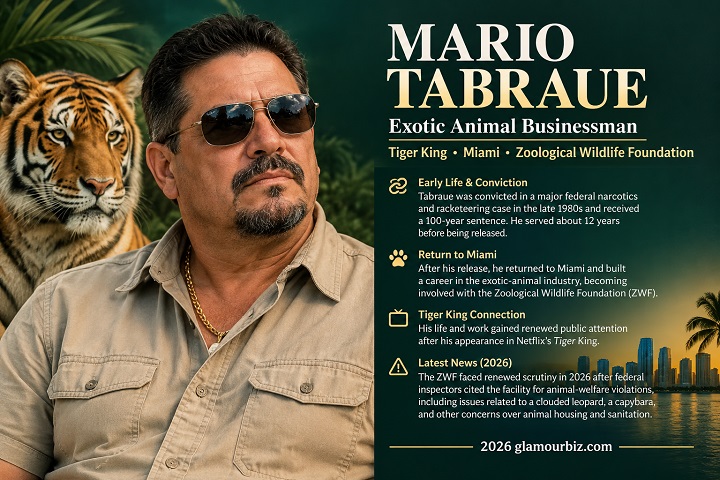
Mario Tabraue is a Cuban-American name most people know from Netflix's Tiger King, but long before that show aired, he was running one of the biggest drug operations Miami had ever seen. He and his father, Guillermo, moved marijuana, cocaine, and quaaludes for close to ten years, hiding it all behind an exotic animal import business.
Federal agents finally caught up with him in 1987 during a sting called "Operation Cobra." He was convicted on racketeering and drug charges and hit with a 100-year sentence, though he walked free in 2003 after winning an appeal.
He's also claimed for years that he helped inspire Tony Montana in Scarface, and he's talked openly about carrying suitcases of drug money into banks himself, a detail that mirrors one of the film's most famous scenes. There's a political thread too. His right-hand man, Orlando Cicilia, married into Senator Marco Rubio's family, tying Rubio's household to a $75 million cocaine ring. These days, Tabraue runs the Zoological Wildlife Foundation in Miami. The same love of exotic animals that once covered up his crimes is now just his actual job.
The Real Tony Montana: Inside Mario Tabraue's Decade as Miami's Cocaine Kingpin
Long before Netflix viewers met him swapping stories about big cats, Mario Tabraue was building one of the most notorious drug operations South Florida had ever seen. He's Cuban-American, and for roughly ten years he and his father, Guillermo, ran what amounted to a family business in narcotics while running a family drug enterprise together. To the outside world, Tabraue looked like an exotic animal importer. His company, Zoological Imports Unlimited, gave him a legitimate reason to move crates and cargo without raising too many eyebrows using his exotic animal business as a cover for the drug operation.
He wasn't shy about what he was doing either, at least not in hindsight. In interviews years later, Tabraue recalled joking on the phone that he ran "Mario's Drugstore," openly naming marijuana, cocaine, and quaaludes as the product line, and even needling the local anti-crime unit by name while making the same joke to the Metro-Dade Organized Crime Bureau itself. It's the kind of swagger that made him a legend in certain circles and a target in others.
According to the Associated Press, court evidence showed that Tabraue and his associates moved large volumes of both cocaine and marijuana over roughly a decade based on evidence presented during the trial. By his own account, the marijuana side of the business made up the bulk of it, especially in the late 1970s and early 1980s, with most of the operation involving marijuana trafficking during that period.
Then there's the Scarface connection, which is probably the reason casual true crime fans know his name at all. Tabraue has said he's considered by some to be an inspiration for Tony Montana, the character Al Pacino made iconic in the 1983 film, a claim that traces back to a Mother Jones piece from 2014 identifying him as a figure some believe inspired the Scarface character. He's even claimed credit for one of the film's most memorable images, saying he personally carried suitcases of drug money into the bank, minus the Hollywood theatrics describing how he did this alone in a Corvette rather than with a van.
Whether or not Brian De Palma's crew had Tabraue specifically in mind when they wrote the script, the comparison sticks because the broader story fits. Miami in that era really was a city transformed by cocaine money, and the documentary Cocaine Cowboys captured that shift in detail, tracking how the city went from a quiet retirement town to what one reviewer called the drug, murder, and cash capital of the country, describing how Miami transformed from a sleepy retirement community into a city defined by drugs, violence, money, and corruption.
From Cell Block to Cat Sanctuary: How a Drug Lord Became a Tiger King Regular
Fast forward a few decades and Tabraue's life looks almost unrecognizable, at least on the surface. These days he runs the Zoological Wildlife Foundation out of Miami, a facility built around the same love of exotic animals that once gave his drug operation its cover story, now running the Zoological Wildlife Foundation in Miami.
That world is exactly what pulled him into the Tiger King orbit. When Netflix's docuseries blew up in early 2020, viewers were introduced to a whole cast of larger-than-life animal people, from Joe Exotic to Doc Antle, and Tabraue slid right into that lineup as the media-shy zookeeper with a surprising past appearing as a media-shy zookeeper from Miami who had once run a massive cocaine ring. It's a strange full circle. The same passion for big cats that once helped disguise a criminal enterprise is now the thing that keeps him in the public eye, minus the federal indictments.
It's worth remembering that his current chapter didn't come cheap. Tabraue was convicted on racketeering and drug charges and handed a sentence of 100 years, only to be released in 2003 after winning an appeal, having been sentenced to 100 years in prison before his release in 2003 following a successful appeal. Going from a century-long sentence to running a nonprofit animal sanctuary is not exactly a common career arc, and it's part of why his story keeps resurfacing whenever true crime documentaries need a colorful supporting character.
The Senator's In-Law: Marco Rubio's Family Tie to a $75 Million Cocaine Ring
Here's the part of the story that pulls Tabraue's history into modern politics. His operation had a frontman named Orlando Cicilia, who ran day-to-day operations, while Tabraue stayed the boss behind the scenes, with Tabraue serving as the boss of the operation while Cicilia acted as the frontman. Cicilia is married to Barbara Rubio, the older sister of Florida Senator Marco Rubio, which means the sitting senator has a direct family connection to one of Miami's most infamous drug rings.
Court records describe the operation as a $75 million cocaine ring, with Cicilia working as one of Tabraue's key operatives, according to court records showing Cicilia worked closely with Tabraue as an operative in the drug ring. A retired Miami-Dade homicide detective who later looked into the case for a book project described Cicilia's role in blunt terms, calling him Tabraue's second-in-command and someone heavily involved in cocaine distribution, describing Cicilia as heavily involved in cocaine distribution and as Tabraue's second-in-command.
Cicilia eventually paid a steep price of his own. He was sentenced to 35 years in prison back in 1989, though he ended up walking free in 2000 after serving a portion of that time having been sentenced to 35 years in 1989 before his early release in 2000. The Rubio connection tends to resurface periodically in political reporting, less because Rubio himself was ever implicated in anything, and more because it's a reminder of how deeply the cocaine trade touched ordinary Miami families in the 1980s, including ones that would later produce a U.S. senator.
100 Years to Freedom: The Appeal That Sprung Miami's Most Notorious Trafficker
The final piece of Tabraue's story, and arguably the most dramatic, is how he managed to walk out of prison at all after being handed a sentence most people would consider a life term in all but name. Federal authorities finally caught up with the operation in the late 1980s through a sting they named Operation Cobra, a nod to the same exotic animal front Tabraue had built his cover around named after the exotic animal business cover Tabraue used. He was arrested in late 1987 and eventually convicted on multiple racketeering and drug charges, having been busted by the feds in December 1987 and later convicted on multiple racketeering and drug charges.
A 100-year sentence is the kind of number that's meant to send a message, and for a while it looked like Tabraue's story would end quietly inside a federal prison. Instead, his legal team found grounds for appeal, and in 2003 he walked out a free man, having been released in 2003 following a successful appeal.
That release is really the hinge point of his entire public story. Without it, there's no zoo, no Tiger King cameo, no renewed interest in the Scarface comparisons, and no reason for his name to keep popping up in true crime circles more than three decades after his arrest. Instead, Tabraue got a second act, one built around the very same fascination with exotic animals that once helped him move drugs across the country undetected. It's an unusual kind of redemption story, less about reform and more about simply outlasting the sentence that was supposed to keep him locked away for good.