
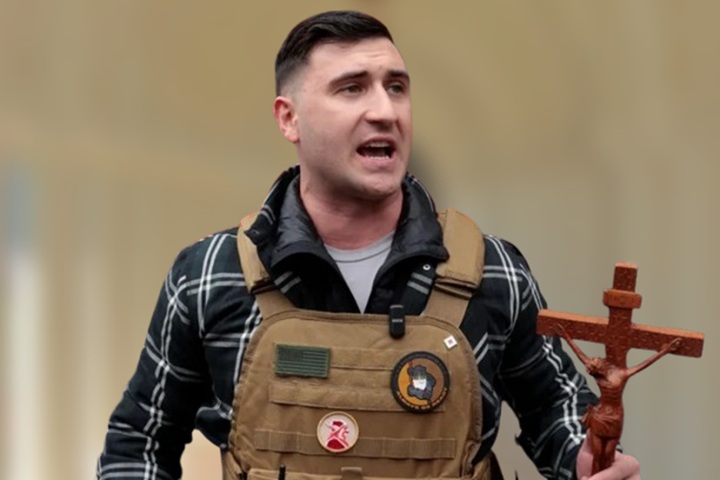
The Minneapolis protest involving conservative influencer Jake Lang quickly became a flashpoint for broader political, social, and immigration-related tensions in the United States. What began as a small rally escalated into a chaotic confrontation after a large group of counter-protesters overwhelmed Lang and his supporters, an incident captured on video and widely circulated online.
The episode has since raised questions about protest safety, disputed injury claims, media interpretation, and the growing volatility surrounding immigration enforcement debates. The following sections examine the incident from multiple angles to provide clarity, context, and factual understanding of what occurred.
Who Is Jake Lang? His Biography And Background
Jake Lang is a U.S.-based conservative activist and online personality who came into the national spotlight following his involvement in the January 6, 2021 attack on the U.S. Capitol. A Florida resident, Lang became a recognizable figure in right-wing political circles after he was charged in connection with the riot and spent several years in pretrial detention before later receiving a presidential pardon. 4
Since his release, he has remained active in political organizing, presenting himself as a critic of the federal government and a vocal supporter of strict immigration enforcement. His frequent appearances at contentious rallies and his blunt, confrontational style on social media have made him a divisive presence, attracting dedicated supporters while also provoking strong opposition in the communities where he appears.
What exactly happens in the video showing Jake Lang being pulled into a crowd of protesters in Minneapolis?
The Bloomberg video captures a chaotic moment during a downtown Minneapolis protest where Jake Lang, a conservative influencer and January 6 figure, is surrounded and physically overwhelmed by a much larger group of counter-protesters. In the footage, Lang appears to be hemmed in near a building as protesters press toward him, shouting and moving aggressively enough to restrict his ability to escape.
He is seen being pushed and pulled within the crowd, eventually losing control of his position as the counter-protesters dominate the space. While the video does not clearly show a weapon or a stabbing, it does document intense physical jostling and disorder, illustrating how quickly the confrontation escalated once Lang’s group was outnumbered.
Why was Jake Lang in Minneapolis at the time of the incident?
Jake Lang traveled to Minneapolis to lead and promote a controversial rally framed around opposition to what he called “Minnesota fraud” and support for federal immigration enforcement, particularly ICE operations. His visit came during a period of heightened tension in the city following aggressive immigration crackdowns and community outrage over recent ICE-related incidents.
Lang positioned himself as a vocal supporter of stricter immigration policies and used Minneapolis as a stage to amplify his message, which critics viewed as inflammatory and provocative given the city’s large immigrant and Muslim populations.
How did counter-protesters respond to Jake Lang’s rally?
Counter-protesters responded swiftly and in overwhelming numbers to Lang’s appearance, far outnumbering his small group of supporters. Hundreds gathered near City Hall and surrounding streets, chanting slogans and confronting Lang directly. Their actions included surrounding his group, shouting him down, throwing objects such as water balloons or snowballs, and physically pushing the demonstrators back.
The response was fueled by anger toward Lang’s rhetoric, opposition to ICE enforcement, and broader frustration with far-right activism. Ultimately, the counter-protesters succeeded in forcing Lang and his supporters to retreat from the area.
Was Jake Lang injured or stabbed during the Minneapolis protest?
Jake Lang claimed after the incident that he was stabbed during the confrontation, asserting that a protective vest prevented serious injury. He later shared images and statements online suggesting he had been attacked and nearly killed. However, official confirmation of a stabbing has not been established in publicly available police reports, and no verified video footage clearly shows a stabbing occurring.
While some recordings do show Lang with visible blood on his head, the exact cause of the injury remains unclear, and authorities have not confirmed that a knife or sharp weapon was used.
How large were the opposing crowds at the protest?
The imbalance in crowd size was one of the defining features of the Minneapolis incident. Lang’s group reportedly consisted of only a handful of supporters, while the counter-protest drew several hundred people. This numerical disparity allowed counter-protesters to quickly surround and overpower the rally both physically and audibly.
The large turnout against Lang reflected broader community opposition to his message and underscored how vulnerable a small demonstration can become when confronted by a much larger and more motivated crowd.
What role did immigration enforcement tensions play in the clash?
The confrontation was deeply tied to ongoing anger over federal immigration enforcement in Minneapolis. In the days leading up to the protest, ICE operations and a controversial shooting involving an ICE officer had sparked widespread demonstrations across the city. Lang’s vocal support for ICE placed him directly in opposition to a community already mobilized against federal enforcement actions. As a result, his rally was perceived not as an isolated event but as a provocation amid an already volatile political and social environment.
How have media outlets and eyewitnesses interpreted the incident?
Media coverage of the Minneapolis clash has varied depending on the outlet, but most reports agree that Lang’s rally was quickly overwhelmed by counter-protesters. Some coverage emphasizes Lang’s claims of violent assault and injury, while others focus on the broader context of immigration protests and the lack of independent verification for a stabbing.
Eyewitness videos circulating on social media show confusion, crowd pressure, and verbal hostility, but they leave room for differing interpretations of who initiated physical contact and how Lang was injured.
What are the legal and public safety implications of the Minneapolis protest incident?
The incident raises important questions about protest policing, public safety, and accountability. Authorities have not announced major arrests related to the confrontation, and it remains unclear whether any formal investigation into Lang’s injury claims will proceed.
The event highlights the challenges police face in managing opposing demonstrations, especially when emotions are high and crowds are uneven in size. It also underscores how politically charged protests can quickly escalate into dangerous situations, prompting renewed debate about crowd control, free speech, and security at public demonstrations.