
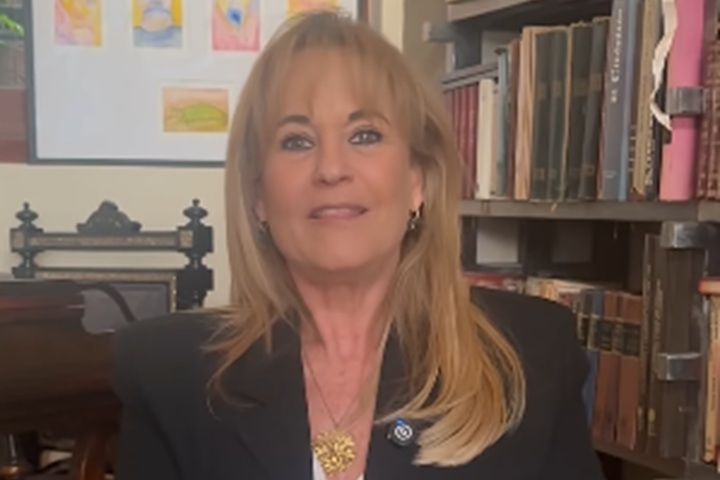
Tamara Trottner is a Mexican author best known for her memoir Nadie nos vio partir (“No One Saw Us Leave”), which recounts her childhood abduction and journey of resilience. Her story was adapted into a Netflix series, and she continues to use her writing to explore family, healing, and courage as a devoted mother and grandmother.
From Lost Childhood to Literary Power: The Early Life of Tamara Trottner
Tamara Trottner was born in Mexico City, Mexico, to a culturally vibrant and educated family with deep roots in literature and the community. At a young age, she developed a passion for reading and storytelling that would later serve as the bedrock for her career. Her childhood years were filled with a love for books, friendships from her school days, and exposure to the influences of a multilingual and diverse society where history and storytelling were of the utmost importance to her sense of identity. In such a society, words were more than just a means of communication; they were the very fabric of how her family defined itself within the world.
However, Trottner’s childhood was not peaceful or normal. When she was only five years old, a traumatic split within her family turned her world upside down. In a retaliatory move that was born from the bitter end of her parents’ relationship, her father kidnapped her and her brother Isaac, taking them away from her mother in the guise of a vacation. This was no ordinary family feud, but an international escape.
Trottner and her brother were moved from one country to another, including France, South Africa, and Israel, while their mother searched for them frantically across the continents. They were separated from her for three years, living a life of perpetual motion and secrecy. It was during this period that a young Trottner began to understand the world not only as a place of wonder but also as a space of betrayal, love, fear, and loss. She began to decipher the "unspoken" language of adults, sensing the tension and the lies that had to be spun to keep their location a secret.
These formative experiences of loss, displacement, and confusion—of having faith in family ties that were suddenly severed due to adult disagreements—formed the foundation of her later literary work. The psychological nuances of her childhood are evident in her memoir *Nadie nos vio partir*, which opens with the following line: “I have just turned five. This is the last day of my childhood.” This opening line is a turning point, marking the end of her sheltered childhood and the beginning of her role as a heroine in a life-and-death family drama.
The Birth of an Author: Education, Early Works, and Literary Foundations
However, despite the disturbing disruption of her childhood, Trottner’s passion for academic excellence and artistic expression was pursued with a ferocity that seemed to indicate a need to reclaim her own story, which had been stolen from her. She went on to study Communication Sciences at the prestigious Universidad Anáhuac in Mexico City, which provided a foundation that honed her awareness of media, narrative, and the power of stories to shape culture. She quickly came to understand that those who controlled the story held the power, and she was determined to hold that power for herself.
She went on to further her education, earning a Master’s degree in Literary Appreciation and Creation and a Doctorate in Novel Writing from the prestigious Casa Lamm in Mexico. These advanced degrees enabled her to hone her craft and to consider literature not just as a form of storytelling, but as an intellectual pursuit. She studied the “architecture” of the novel, learning how to construct memory into a form that could be shared with others.
Trottner’s first published writings include Un último pedazo de bruma (2001), a collection of stories, and Siempre las Jacarandas (2008), a novel that examines familial issues and personal history. These writings enabled her to explore the themes of domesticity and the "ghosts" of the past. At the same time, she became an active part of Mexico’s literary scene, offering her perspectives on radio programs alongside Iñaki Manero, encouraging discussion about the role of literature in the formation of personal and collective life.
Prior to Nadie nos vio partir, Trottner was already known as a thoughtful and contemplative writer—one whose writing combined the personal and the universal, and whose voice was both emotionally resonant and intellectually engaging. Her radio presence, in particular, helped to make the world of literature more accessible and more human to her listeners.
Nadie Nos Vio Partir: A Memoir of Trauma, Family, and Truth
The creative and emotional turning point in Trottner’s career came with the publication of the memoir *Nadie nos vio partir* (*No One Saw Us Leave*). The book, published in 2024, is the memoir that Trottner had been working towards writing her entire life, the culmination of decades of working through the "missing years" of her childhood.
Instead of a traditional memoir, Trottner decided to tell the story with the emotional acuity of adult hindsight, but also with the voice and confusion of the child. This gives the reader a chilling sense of the child’s innocence, while also grasping the adult’s trauma. Trottner’s writing is deeply invested in the experience of betrayal—not just as a dramatic action, but also as a fractured series of memories that have influenced her sense of self.
The reason why this story has touched so many people is that it provocatively questions violence that was not acknowledged during that period of time. Trottner herself said that “when her father abducted her, the idea of violencia vicaria—emotional harm caused to a partner through their children—had no name at all.” By realizing this, Trottner has given a voice to a silent community of victims.
This is a term that she only discovered later in life, and it provides meaning to an experience that was previously impossible to put into words. This is more than a story of loss; it is a story of love, of struggle, and of the power of community in reclaiming one’s history and identity.
A Global Stage: Netflix, Adaptation, and Cultural Impact
The impact of Trottner’s biography was not limited to the literary circles when it was adapted into the Spanish-language limited series *No One Saw Us Leave* by Netflix in 2025. The series retells the story largely through the eyes of a fictionalized version of her mother, Valeria Goldberg, who embarks on an unrelenting quest to find her kidnapped children on different continents. This change in narrative was crucial, as it allowed the audience to experience the “other side” of the story, where the mother refuses to be silenced in a world that often told her to keep quiet.
The series not only portrays the chase to find the children in France and South Africa but also the emotional struggle of loss, love, community censure, and the politics of family disputes. The series has managed to capture the look and feel of the 1970s and 80s, emphasizing how much harder it was to locate missing children before the days of digital connectivity. The adaptation of Trottner’s biography by Netflix has ensured that her story reaches a global audience and has highlighted themes of parental alienation, psychological trauma, and the power of maternal love to millions of people across the world.
The series also deals with issues of a complex nature in the Jewish community in Mexico, as well as issues of identity, marriage, reputation, and values. It examines the “internal politics” of powerful families and the way in which social prestige can be used to cover up the truth. Although the series was an adaptation and a dramatization of a true story for television, the essence of the story—the truth that Trottner had discovered in her life and expressed in her book—remained the same. A number of viewers began looking for her book after watching the series.
Beyond the Memoir: Exploring Family Memory and Ancestry
Trottner went on to explore her literary interests with another book, Pronunciaré sus nombres (“I Will Say Their Names”), released in 2025. Instead of exploring her own abduction experience, this book delves into the family history of the author, specifically her grandparents’ immigration from Eastern Europe to Mexico. She understood that her experience was only one part of a larger trend of escape and survival.
It explores how family history, which is often merely recorded in terms of dates and geographical locations, is very much human, with its own set of decisions, hopes, fears, and common human experiences. Trottner explained how finding a picture of her grandfather began an emotional journey back into the past—a recognition that history is not merely numbers, but the aggregate of individual experiences, each with its own fear, wonder, and love.
This level of engagement with memory and lineage shows that Trottner’s overall purpose as a writer is to bring the voices of those who have lived through times of turmoil, suffering, and displacement, so that their experiences are not merely remembered—but felt. By mentioning her ancestors, she is doing the act of reclaiming them, so that their names are not lost in the mist of time. This book cemented her status as not only a memoirist but a chronicler of the human experience.
Legacy and Influence: A Voice That Resonates Beyond Borders
Today, Tamara Trottner is one of the most interesting authors in Mexico, and her voice is one that connects personal experience with universal reflection. Her writing has shed light on childhood trauma and resilience with a depth of empathy that has raised awareness about psychological and emotional violence through narrative, while also reaching across generations to show how the past informs the present. Through her writing and the Netflix series based on her memoir, Trottner has been able to share Latin American stories with the world, inspiring all who read and watch her work with her bravery and honesty.
Her writing legacy is still unfolding, with *Nadie nos vio partir* already translated into several languages and *Pronunciaré sus nombres* promising to delve further into her family’s heritage. The story of a child separated from her mother and growing up to be a writer whose work inspires the world to understand and empathize with her is an inspiring one not only because of its dramatic trajectory but also because of the dignity and insight with which Trottner shares it.
Tamara Trottner is a symbol of radical reconciliation. In choosing to understand her father’s history and her grandparents’ struggles, she has transcended anger and entered a realm of deep wisdom. Her biography is one of trauma converted to testimony, loss incorporated into narrative, and love manifested through the strength to share one’s own history with the world. She encourages us that although we cannot change the past, we can definitely change how the past resides in us.